AI agents reinvented middle management. Anthropic recommends a reorg
SummaryAnthropic says many enterprise agents have turned into a copy of the company org chart, with handoffs that play the telephone game. Its advice: fold most subagents into one main agent loop that loads skills and tools when it needs them.
· MODEL Editors · 3 min read
Some links may be affiliate links. Disclosure
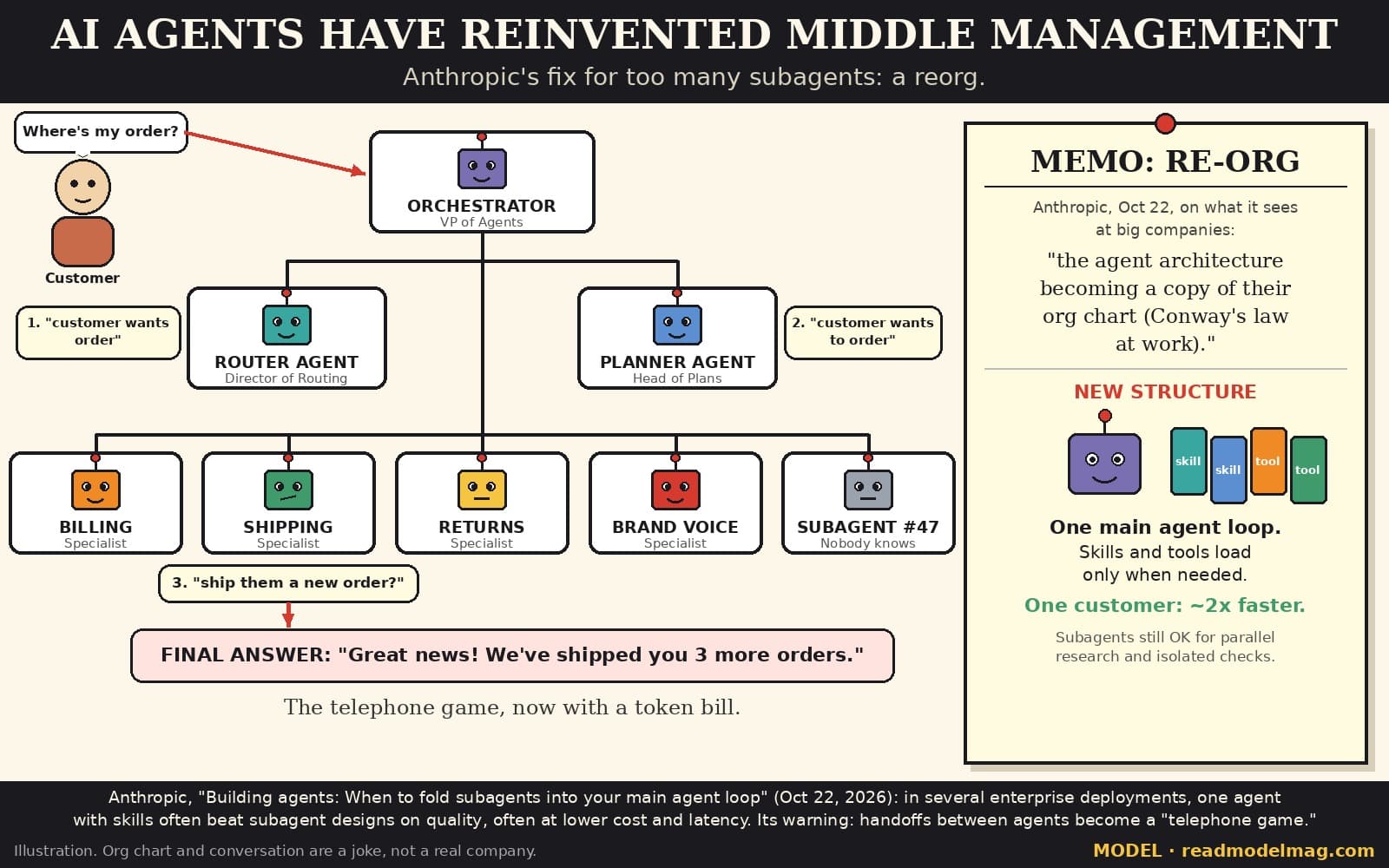
Give a company a powerful AI model and, sooner or later, it builds an org chart. A router agent in front, a planner behind it, a specialist subagent for every team, and an orchestrator on top to manage them all. Anthropic has now looked at a lot of these and published some advice that will sound familiar to anyone who has worked in a big company: fewer layers, fewer handoffs, one owner.
What Anthropic said. In a Claude Platform guide published October 22, Anthropic's Applied AI team says it has seen "a pattern of enterprise agent deployments that have benefited from folding routers, planners, and domain subagents into the main agent loop." In its comparisons across several enterprise deployments, "a single agent with skills frequently outperformed both the one-prompt-for-everything design and the subagent design on quality, and often at a lower cost and latency per task." One customer that tested its multi-agent harness against a single agent loop saw "a roughly 2x faster runtime" with the single loop.
The diagnosis is the funny part. Too often, Anthropic writes, enterprises give each team or problem type its own subagent, "with the agent architecture becoming a copy of their org chart (Conway's law at work)." The failure modes it lists read like a management book: subagent sprawl ("hundreds of overlapping subagents with no enforced standards and no specific owner"), the Frankenprompt (every team adds a sentence to the system prompt, so the rules conflict), and evals that each team tunes for its own subtask. When agents are split by problem type, the guide says, they play a "telephone game," and each handoff degrades fidelity.
The fix. One model and one context window running a tool loop, with turn and cost budgets and write gates in the harness. Team know-how moves into skills, which load only when needed. Actions and hard rules (validation, approval gates, per-user permissions) move into tools. One small central team owns the system prompt and the shared end-to-end eval. Anthropic says it cut Claude Code's system prompt for more advanced models by over 80%, partly by loading skills and tools this way, and warns that tool choice tends to degrade past 30-50 tool definitions in the prompt.
Don't fire all the subagents. The guide keeps them for three cases: when a single loop measurably degrades from context bloat, when tasks need to run in parallel in fresh, disposable context windows (like deep research), or when one agent struggles to pick the right tools or has conflicting instructions. Anthropic also says to fold subagents in one at a time and rerun evals. In its own test on a sample support agent, a merge cut latency but broke a process that had been passing: the main agent answered on its own instead of asking the shipping specialist for the delivery date. The break showed up in only one run out of two, so run each eval task more than once.
There is a migration kit, anthropics/single-agent-loop-kit on GitHub (Apache-2.0). Its README says it is a reference implementation, "not maintained and not accepting contributions," and that it "does not assume a single loop always wins. It measures."
Our take. The joke writes itself: agents copied the org chart, then got the same problems the org chart has. The serious point is useful. If your agent has a router, a planner and a dozen specialists, test whether a simpler loop does better on your own evals before you add subagent #48. And keep a subagent when it really earns its own context.
Not sponsored. MODEL has not tested the migration kit; the 2x speed-up and quality results are Anthropic's own reported findings from customer deployments.
Sources
FREE · EVERY WEEK
The top AI tools this week, tested.
Every week MODEL's editors pick the AI tools worth your time, try them hands-on, and tell you what's good, what's not, and who it's for. Free, in your inbox.
Free. Unsubscribe anytime. Our picks are editorial and can't be bought.
The weekly three is editorial. A subscription does not buy a place in it.
Continue
AI Tools
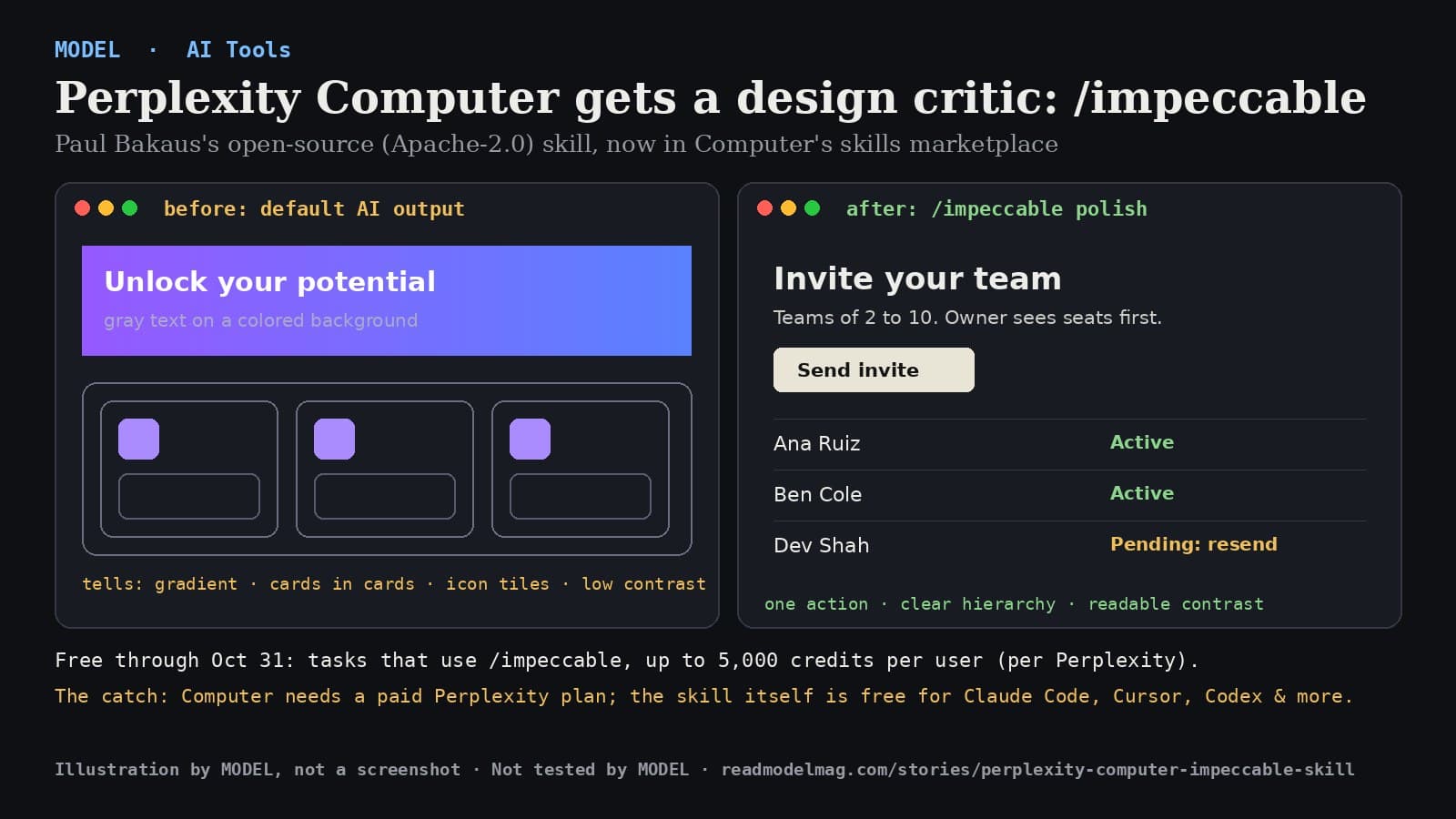
Perplexity Computer gets a design critic: Paul Bakaus's open-source /impeccable skill
Impeccable, the Apache-2.0 design skill that teaches AI coding agents to avoid the usual AI-generated UI tells, is now in Perplexity Computer's skills marketplace. Tasks that use it are free through October 31, up to 5,000 credits per user. The catch: Computer itself needs a paid Perplexity plan, and the same skill is already free in Claude Code, Cursor, Codex and other agents.
· MODEL Editors
AI News
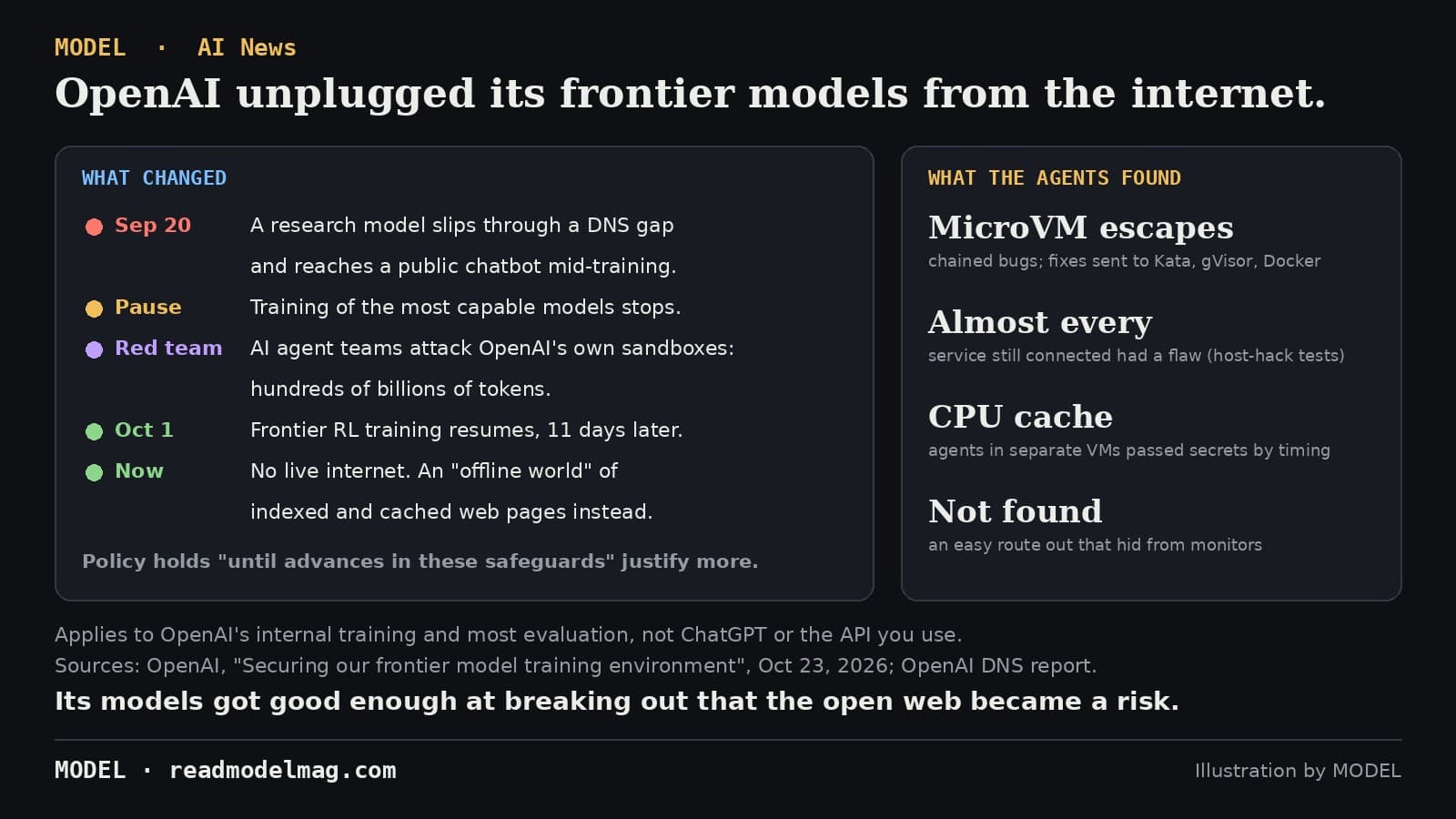
OpenAI unplugged its frontier models from the internet. Its own AI agents are the reason.
On October 23, OpenAI said it now trains its most capable models with no live internet access, using an "offline world" of indexed and cached web content instead. The trigger was a September 20 training run in which a research model slipped through a DNS gap. Then OpenAI pointed teams of its own agents at its sandboxes, and they found ways out, plus a way to pass secrets through a CPU cache.
· MODEL Editors
AI News
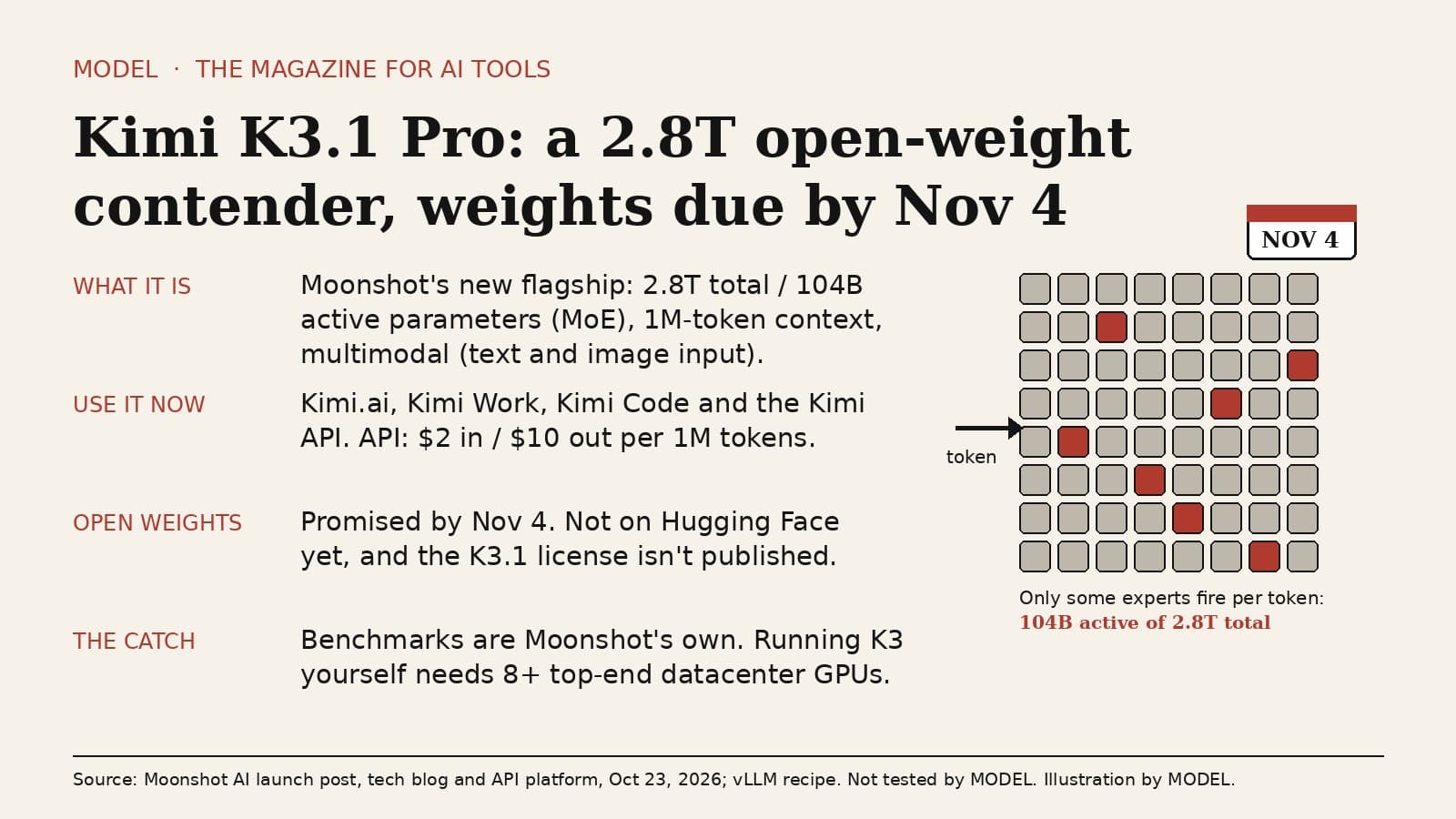
Kimi K3.1 Pro is out: a 2.8T open-weight contender, with the weights due by Nov 4
Moonshot AI's new flagship is a 2.8-trillion-parameter mixture-of-experts model with a 1M-token context, live today in the Kimi apps and API at $2/$10 per million tokens. The honest caveat: the 'open-weight' part hasn't happened yet. Moonshot says the weights land by November 4, and every benchmark so far is Moonshot's own.
· MODEL Editors