AI is wrong about your job. Surely it's right about law.
SummaryA viral post from Gergely Orosz put a 2002 idea back in the feed: we catch AI's mistakes in the fields we know, then trust it everywhere else.
· MODEL Editors · 2 min read
Some links may be affiliate links. Disclosure
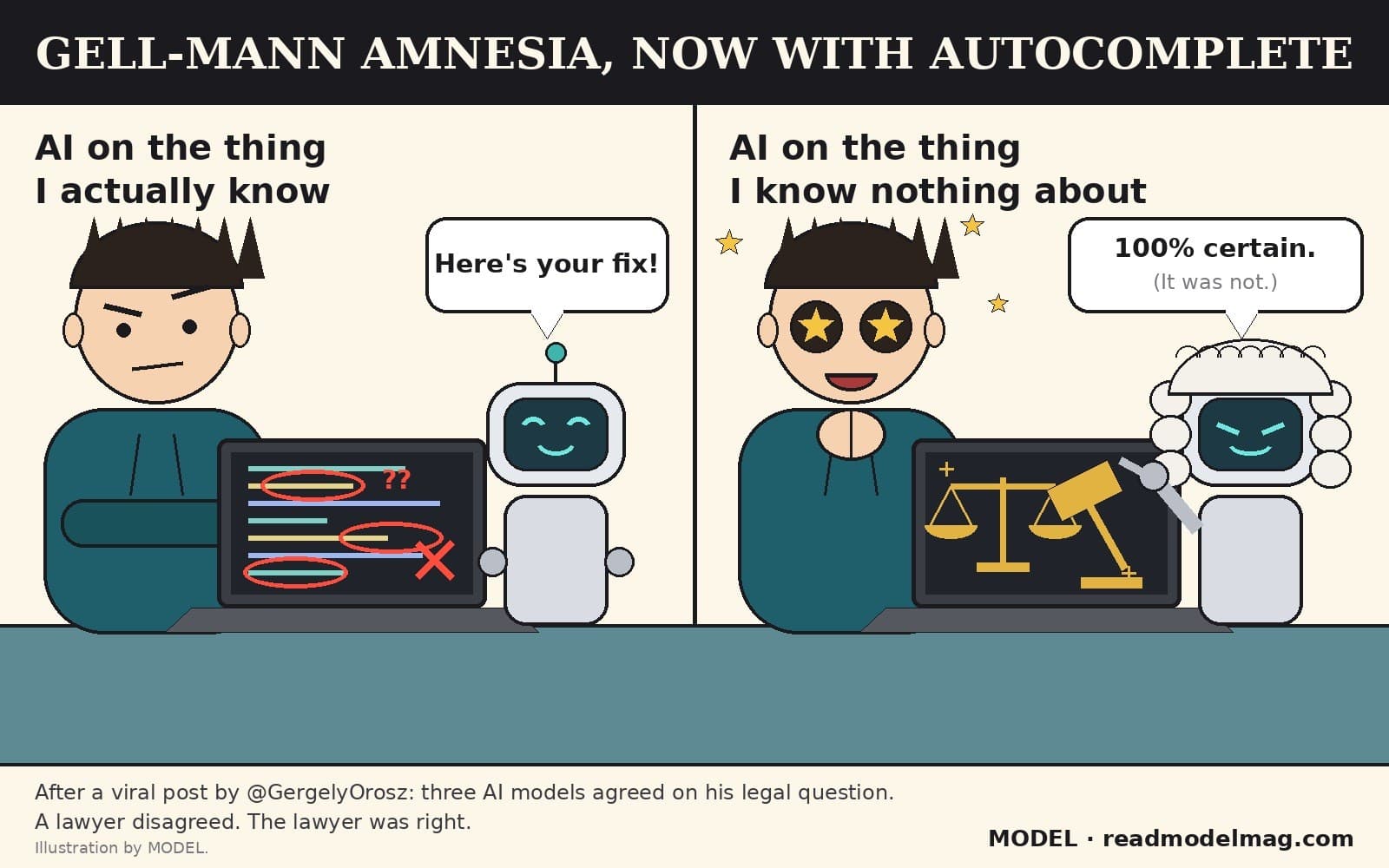
Early on Monday, Gergely Orosz, who writes The Pragmatic Engineer, posted something most heavy AI users will recognise. When he uses AI in an area he knows well, like code on his own project, he spots the model's errors right away and fixes them. When he's outside his field, he trusts it.
His example: he asked three AI models for feedback on a legal case he had also paid a lawyer for. "All 3x models confidently told me X, lawyer then told me Y, and lawyer was right," he wrote. By early afternoon Pacific time the post had passed 93,000 views and 1,700 likes.
He was quoting Vlad Mihalcea, who said Claude Opus 5.5 usually writes code close to how he would, but "every now and then" makes design decisions "that would fail in production."
The old name for this. Michael Crichton called it the Gell-Mann amnesia effect in a 2002 speech, "Why Speculate?" You read a newspaper story about your own field and find it full of errors, then turn the page and read the next story as if it were accurate. Crichton named it after physicist Murray Gell-Mann, and admitted the famous name was there partly to make the idea sound more important.
Our take
The joke in our cartoon is that the same person can be a strict code reviewer and a starry-eyed believer within one browser tab. Swap the newspaper for a chatbot and the effect gets stronger, because the answer is written for you, sounds sure of itself, and arrives in seconds.
Orosz's own rule is a practical one: when you're the expert, use AI to learn and stay sharp. When you're not, assume it may be making things up and you won't notice, so either learn enough to check it or ask a real expert when the stakes are high, like a contract, a tax filing or a medical question.
What we did and didn't do: this story is based on the public posts linked below and Crichton's speech as cited on Wikipedia. We didn't test the legal question ourselves, and Orosz didn't say which models he used.
MODEL Editors
Sources
- "This messes with my mind ALL THE TIME" (Oct 19, 2026)
Gergely Orosz on X
- Follow-up: "whenever I use AI, I try to LEARN WITH IT"
Gergely Orosz on X
- "Every now and then, I find terrible design decisions that would fail in production"
Vlad Mihalcea on X
- Michael Crichton: "Gell-Mann amnesia effect" (citing his 2002 speech "Why Speculate?")
Wikipedia
FREE · EVERY WEEK
The top AI tools this week, tested.
Every week MODEL's editors pick the AI tools worth your time, try them hands-on, and tell you what's good, what's not, and who it's for. Free, in your inbox.
Free. Unsubscribe anytime. Our picks are editorial and can't be bought.
The weekly three is editorial. A subscription does not buy a place in it.
Continue
The cover
Gemini 4 Argon is open
Google turned its newest frontier model on for developers, companies, and paying subscribers. The introductory price lasts until November 30.
· MODEL Editors

AI News
A recorder in the executive room
The Justice Department says an OpenAI engineer was arrested on October 9 and charged with trying to intercept conversations in a San Francisco office. There is no conviction.
· MODEL Editors

AI News
Small models, cheap boxes, a slow worm
Anthropic’s October 12 note says a capable model can already be split across television boxes. A model both small enough and able enough to copy itself is, on their estimate, not here yet.
· MODEL Editors