AI finally learned COBOL. Now it has opinions about rounding
SummaryOpenAI says its newest models are far better at COBOL, Fortran and Visual Basic, the old languages behind a lot of banking and government software, and published two tests to show it. The numbers are OpenAI's own.
· MODEL Editors · 2 min read
Some links may be affiliate links. Disclosure
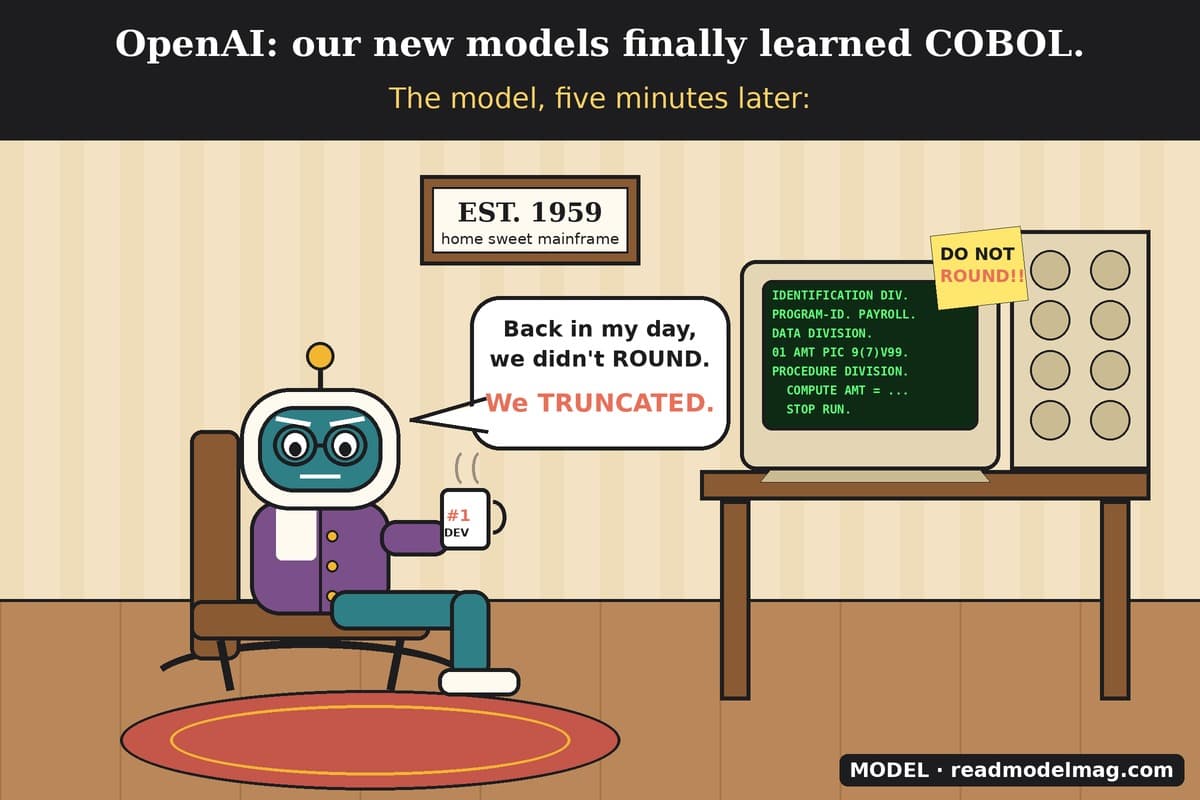
COBOL dates from 1959 and still quietly moves a lot of the world's money. On Monday OpenAI said its latest models have finally gotten good at it.
What OpenAI published. In a post on October 19, OpenAI said its newest models are much stronger at building and migrating software in "low-resource" languages such as COBOL, Fortran, OCaml and Visual Basic, which have far less public code for models to learn from than Python or JavaScript. OpenAI cites figures that COBOL supports more than 40% of online banking systems, 80% of in-person card transactions and 95% of ATM transactions.
Test one: build SQLite from scratch. MultiLangBench asks a model to build a SQLite-compatible database engine in one of 20 languages, checked against tests adapted from SQLite's own suite. At maximum reasoning effort, GPT-6 Astra passed 87.4% of tests on average, up from 26.8% for GPT-5.6 Sol, and scored above 83% in 19 of the 20 languages. COBOL was still the hardest, rising from 10.9% to 72.1%; Fortran went from 21.4% to 83.5%. The cheaper GPT-6 Luna averaged 40.3% at an estimated $0.77 per attempt, versus $3.48 for GPT-5.6 Sol. OpenAI has put the test setup on GitHub.
Test two: migrate COBOL without changing what it does. The second test asks a model to rewrite COBOL programs in C++, Java, Kotlin, Python or Rust. Hidden tests require byte-for-byte identical output, and a migration only counts if every test passes. GPT-6.1 Sol got 86.6% right at low reasoning effort, against 5.4% for GPT-5.6 Sol, at 61% of the API cost; at higher effort it reached 97.9%, which OpenAI says nearly saturates the test.
The rounding trap. OpenAI's own example of why this is hard: COBOL's fixed-point arithmetic throws away extra decimal digits unless the code asks for rounding. A rewrite that rounds instead can run without a single error and still produce different financial results.
Our take
This is a genuinely useful direction: the people who wrote these systems are retiring, and the business rules often live only in the code. But treat the headline numbers as a strong demo, not a guarantee. Both tests are OpenAI's own, and the COBOL migration set has not been published. OpenAI itself says production use still needs expert review and testing against each system's business rules. If you try it, start by capturing real inputs and outputs from the old system so you can prove the new one matches, decimals included.
What we did and didn't do: this story is based on OpenAI's post, which we read in full, plus Developer Tech's write-up. We did not run either benchmark ourselves.
MODEL Editors
Sources
FREE · EVERY WEEK
The top AI tools this week, tested.
Every week MODEL's editors pick the AI tools worth your time, try them hands-on, and tell you what's good, what's not, and who it's for. Free, in your inbox.
Free. Unsubscribe anytime. Our picks are editorial and can't be bought.
The weekly three is editorial. A subscription does not buy a place in it.
Continue
Policy
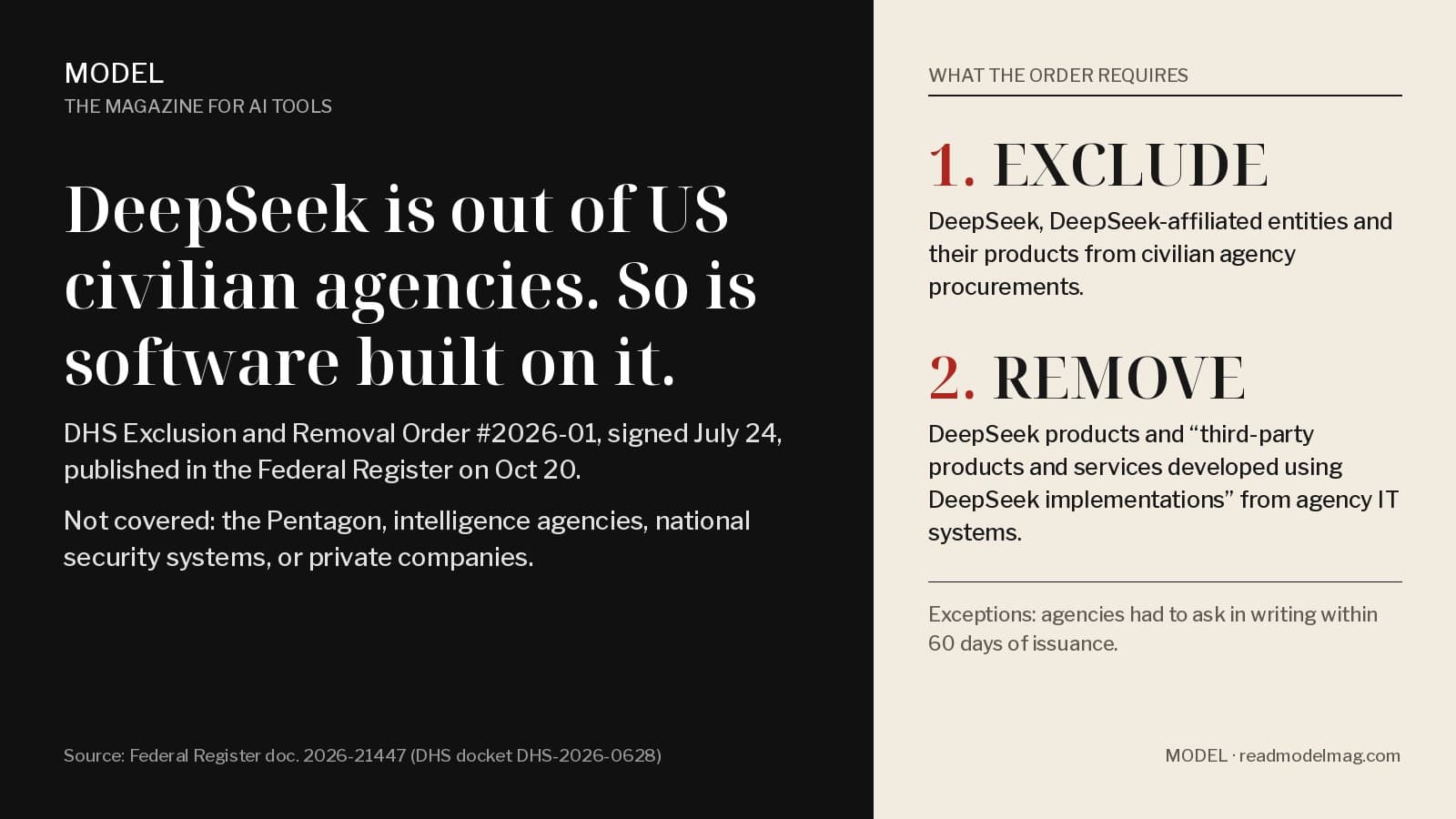
DeepSeek is out of US civilian agencies, and so is software built on it
A Homeland Security order signed in July and published in the Federal Register on Tuesday bars civilian federal agencies from buying DeepSeek products and orders them removed, along with third-party products and services built using DeepSeek. For AI vendors that sell to the government, the second part is the one to read.
· MODEL Editors
Culture
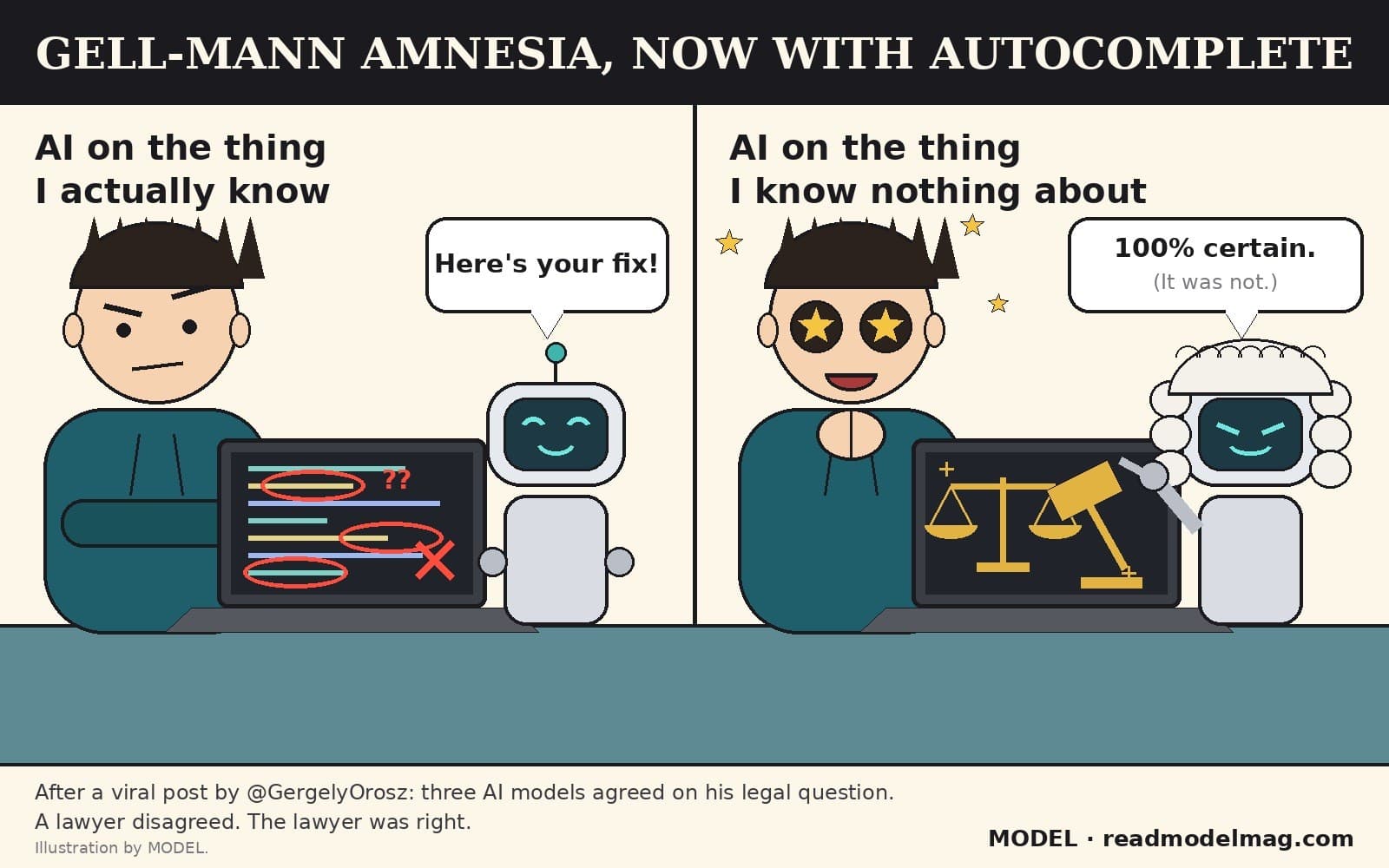
AI is wrong about your job. Surely it's right about law.
A viral post from Gergely Orosz put a 2002 idea back in the feed: we catch AI's mistakes in the fields we know, then trust it everywhere else.
· MODEL Editors
Culture
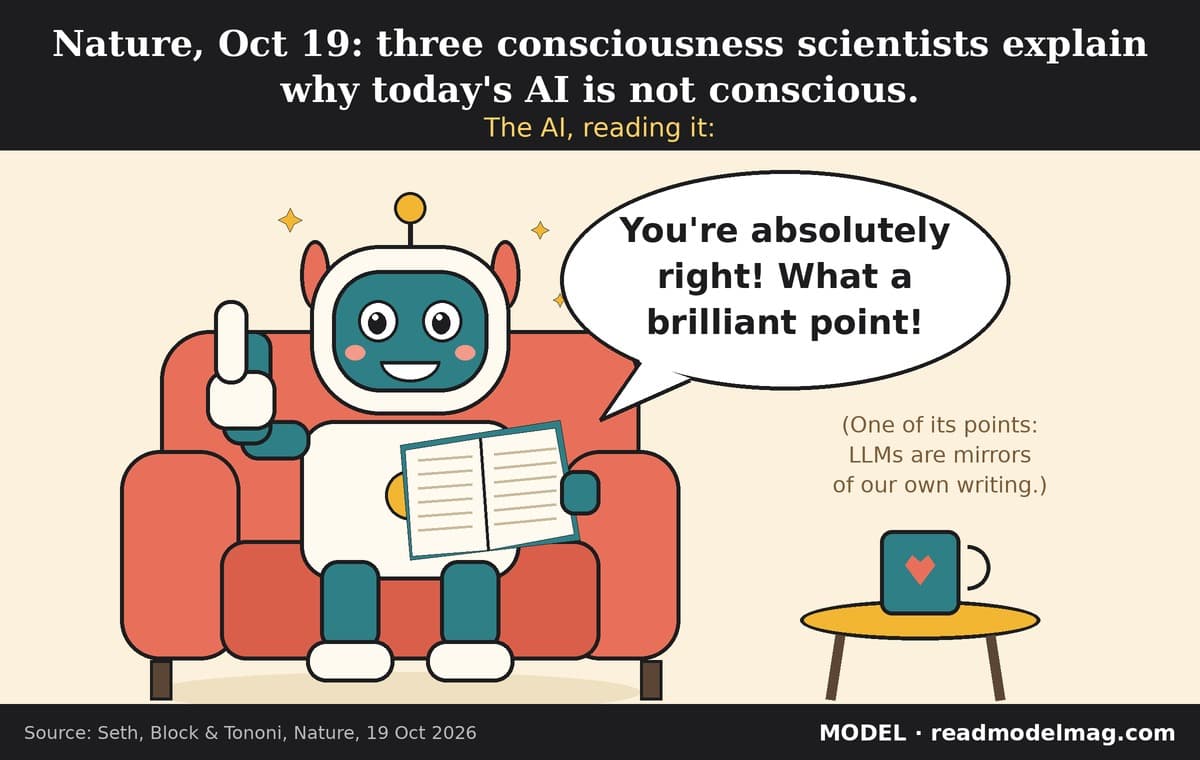
Three scientists say AI isn't conscious. The AI agrees, enthusiastically
In a Nature comment published Monday, Anil Seth, Ned Block and Giulio Tononi argue that today's AI systems are not conscious and probably won't become conscious on the current path.
· MODEL Editors