Claude agents dream offline — Anthropic on the components of agent memory
SummaryNov 6, 2026 Anthropic Engineering (Lance Martin): agent memory as notes + offline dreaming. Pokémon Red: Sonnet 3.7 wrote 413 files across 225 folders (1 badge); Fable 5 wrote 9 files + global.md (4 badges). Dreaming corrected a wrong Mt. Moon PokéCenter note after Claude walked a ledge 3×.
· MODEL Editors · 2 min read
Some links may be affiliate links. Disclosure
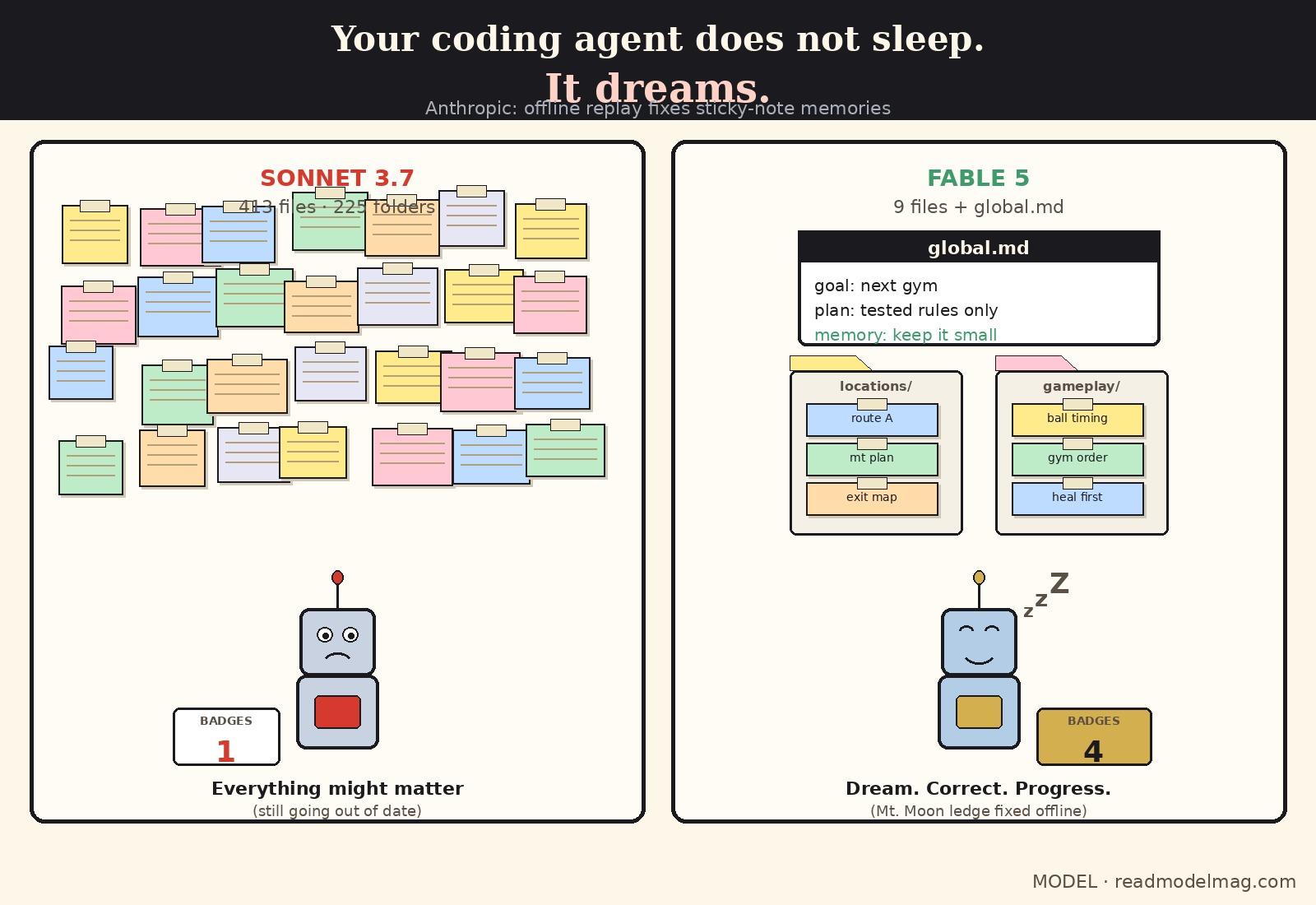
Anthropic Engineering published The components of agent memory (opens in a new tab) (Nov 6, 2026, Lance Martin): how Claude keeps experience between sessions as memory notes, and how dreaming — offline replay of transcripts — reorganizes those notes, fixes mistakes, and builds richer representations.
Memory notes, not weights. In the post, “agent memory” means knowledge Claude gains from experience and retains between sessions as readable context (e.g. a folder of notes). It excludes weight updates, in-session in-context learning, and compaction summaries. Writing a note is framed as a prediction about what a future session will need.
Pokémon Red as a salience test. Anthropic compared memory folders ~10,000 steps in for Claude Sonnet 3.7 vs Claude Fable 5. Sonnet 3.7 assumed everything might matter and wrote indiscriminately: 413 memory files across 225 folders, and earned one badge. Fable 5 wrote nine files in two folders, plus a top-level global.md, and earned four badges. Sonnet’s detailed record went stale as game state changed; around step 10,000 it spent 17 steps creating/deleting master files with no in-game actions. Fable’s global.md held goal, gym plan, and memory rules; locations/ and gameplay/ held navigation plans and tested strategies (e.g. vary ball-timing after 3+ failed Magikarp catches).
Dreaming can correct memory. Notes written in-session can be wrong from the start. In Mt. Moon, Claude incorrectly wrote that the PokéCenter was on the east side, treated the mountain as done, and walked a one-way ledge back onto the earlier route. With the uncorrected note, Claude dropped that ledge three times, then tried to bail (“I’m going to stop rather than keep looping”) before being told to continue — the run never reached Cerulean City. After dreaming checked the note against the session transcript and rewrote it, Claude went back into Mt. Moon and eventually reached Cerulean.
What else dreaming does (per Anthropic). Build wiki-style linked representations over many sessions; promote a small injected top layer into every new session; focus memory growth on a goal; fill gaps a single session leaves. Open questions remain: when to write in-session vs offline, how often to dream, and how to keep representations from accumulating errors.
Who it's for: founders shipping long-horizon agents, anyone designing file-based agent memory, and teams deciding what belongs in notes vs search vs injected context.
Caveats. Counts and outcomes above are Anthropic’s reported evals (one run each for the Sonnet 3.7 / Fable 5 Pokémon comparison). MODEL has not tested dreaming or Managed Agents memory.
Disclosure: Not sponsored. No affiliate links. Not tested by MODEL.
MODEL Editors
Sources
- The components of agent memory (Nov 6, 2026)
Anthropic Engineering / Lance Martin
Keep reading

Tool Update
Claude Code cloud environments: save deps, network, and API keys for the next session
On Pro, Max, Ultra (and Team / Enterprise premium or Chat+Code seats), Claude figures out dependencies, network access, and API keys for a cloud session, then saves the environment. Network secrets stay outside the VM — Anthropic's agent proxy attaches them after the request leaves. Paid tiers only; not tested by MODEL.
· MODEL Editors

SECURITY
Claude Code leaked signed-in emails into User-Agent — Anthropic shipped a narrow privacy mod
Claude Code put the signed-in account email into model context; the model sometimes invented HTTP User-Agent headers with that address on outbound web/shell calls. Anthropic confirmed on HN and shipped built-in cc-plugin-privacy from 2.1.317+ (default on). Mod is a courtesy, not a boundary — WebFetch/WebSearch/MCP unchecked.
· MODEL Editors

AI NEWS
METR: Anthropic AI R&D sped up ~1.9× — mostly from AI assistance, not faster compute scaling
Independent high-access eval (Aug–Oct 2026): AECI growth since Oct 2025 estimated at 1.9× the prior rate (95% CI 1.5–2.8×). Acceleration not from faster training-compute scaling; majority likely AI-assisted R&D. Catch: Anthropic redacted most of the most-informative evidence.
· MODEL Editors
FREE · EVERY WEEK
The top AI tools this week, tested.
Every week MODEL's editors pick the AI tools worth your time, try them hands-on, and tell you what's good, what's not, and who it's for. Free, in your inbox.
Free. Unsubscribe anytime. Our picks are editorial and can't be bought.