Cloudflare's Clairic pulls typed values out of messy text, and charges only for input
SummaryClairic is a preview extraction model on Workers AI. You hand it text or images plus a list of typed fields, and it returns numbers, dates, spans and estimates with confidence scores in one pass. Cloudflare's own advice: it is an early checkpoint, so let your code do the multi-step math.
· MODEL Editors · 3 min read
Some links may be affiliate links. Disclosure


Clairic is a new model from Cloudflare that reads unstructured input, such as an email, an invoice or a photo of a receipt, and returns the specific values you ask for. Cloudflare calls it a "System One" extraction model: it answers in a single pass without reasoning or writing text. It is out today as a preview on Workers AI under the id @cf/cloudflare/clairic, and Cloudflare says it intends to release the weights openly "soon."
What it does. Cloudflare lists four jobs. Extract a value that is in the input, like an order ID. Compute one from facts in the input, like a total including tax or the days since delivery. Estimate a value the input only gives evidence for, like a sale price from comparable sales. Forecast the next steps of a series. Text answers come back as spans with character offsets, so you can point to where they appeared in the source. Numbers and dates follow their declared type, and every single-value answer carries a confidence score and a p_null, the model's probability that the value isn't in the input. If it can't find a value, it returns null rather than a plausible-looking guess. Estimates and forecasts return a median and an 80% interval.
How you use it. A request is a state (the text, plus up to four PNG, JPEG or WebP images, which must be embedded because remote URLs aren't accepted) and a map of named fields, each with a type (text, number, date, time, datetime, duration, list, estimate, forecast) and optional plain-language instructions. You call it with env.AI.run() from a Worker or through the Workers AI REST API. The docs list a 65,536-token context window and a price of $0.10 per million input tokens. Because it generates no tokens, there is no output charge. There is no cap on the number of fields; fields that don't fit next to the input in one pass are split across parallel passes.
Cloudflare's own numbers. In one test, Cloudflare asked Clairic to forecast the next day's TSA airport checkpoint count for 21 days in a row. It says the forecasts were off by 3.3% on average and 17 of the 21 actual counts landed inside the 80% interval, with most misses on the Columbus Day weekend. In a damaged-product claim demo, a pipeline of Clairic for extraction, Cloudflare's Clef decision model for the decision and GLM-5.3 for the reply took 19.3 seconds end to end and cost $6,032 per million claims. Using GLM-5.3 for every step took 61.7 seconds and cost $11,740. These are Cloudflare's tests, not ours.
Who it's for: developers on Cloudflare who send the same structured-output calls to a large language model over and over, such as "what's the invoice total, the due date, the order number," and want typed answers with confidence scores they can check before automating anything.
The caveat, from Cloudflare itself. The hosted endpoint is "an early checkpoint." Cloudflare says one- and two-step calculations seem reliable, but longer chains of dependent arithmetic and adding up many rows of a table are not yet, and its advice is to "have Clairic predict the value and let code do the math." It also says the intervals can run narrow on unfamiliar data and that forecasting is "basic," not a replacement for a dedicated time-series model. The docs add that typed output does not guarantee correctness: an answer can have the right shape and still be wrong. The model is offered "as is" in preview, and Cloudflare says it may stop providing it.
We haven't tested Clairic ourselves; this is based on Cloudflare's announcement and docs, read on October 19. Not sponsored, no affiliate links.
Sources
- Introducing Clairic, a new System One class of extraction models (Oct 19, 2026)
Cloudflare
- Workers AI model reference: clairic (@cf/cloudflare/clairic)
Cloudflare Docs
- Workers AI concepts: Extraction models
Cloudflare Docs
- Announcement post
Cloudflare on X
FREE · EVERY WEEK
The top AI tools this week, tested.
Every week MODEL's editors pick the AI tools worth your time, try them hands-on, and tell you what's good, what's not, and who it's for. Free, in your inbox.
Free. Unsubscribe anytime. Our picks are editorial and can't be bought.
The weekly three is editorial. A subscription does not buy a place in it.
Continue
The test
KiviDB, on the stand
The new Rust rival to Redis matched 87 of our 88 Redis replies, ran 2.4 to 3.9 times faster on our box and found the right neighbours in vector search. Then it read our Redis snapshot and turned a hash into a set of junk.
· MODEL Editors
Hot take
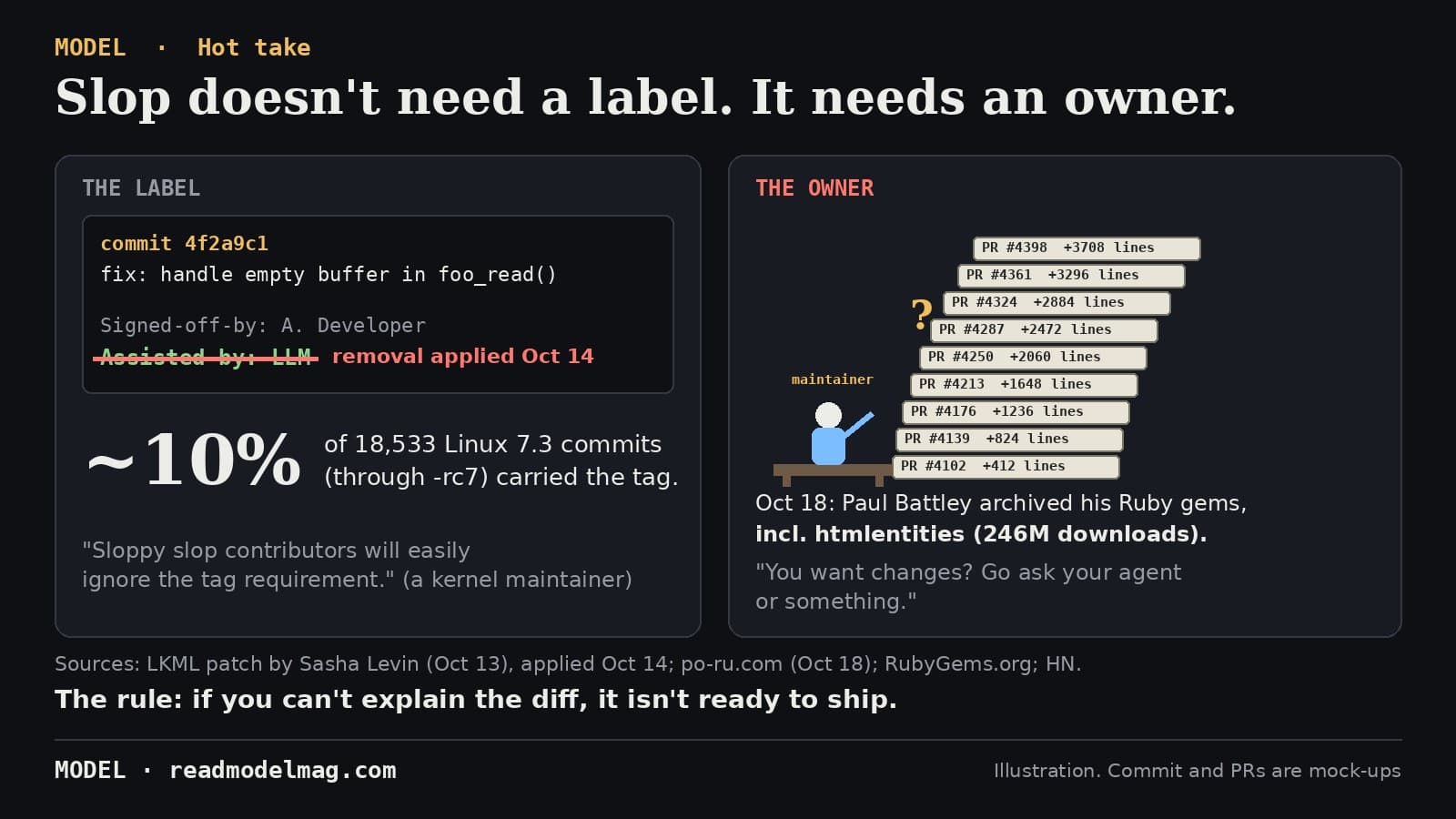
Slop doesn't need a label. It needs an owner.
Linux just dropped its AI disclosure tag because almost nobody used it. A Ruby maintainer with a 246-million-download gem archived his work. And today's top Ask HN is about shipping AI code you don't understand. The fix is not a label.
· MODEL Editors
Tools
Vercel Shop is out: a Shopify storefront that agents can read and shop
Vercel's open source Next.js template for Shopify is now generally available. Product pages come in a machine-readable form for AI agents, and agents can search the catalog and build carts over MCP. The optional shopping assistant has no cost cap, so set limits before you switch it on.
· MODEL Editors