Slop doesn't need a label. It needs an owner.
SummaryLinux just dropped its AI disclosure tag because almost nobody used it. A Ruby maintainer with a 246-million-download gem archived his work. And today's top Ask HN is about shipping AI code you don't understand. The fix is not a label.
· MODEL Editors · 3 min read
Some links may be affiliate links. Disclosure
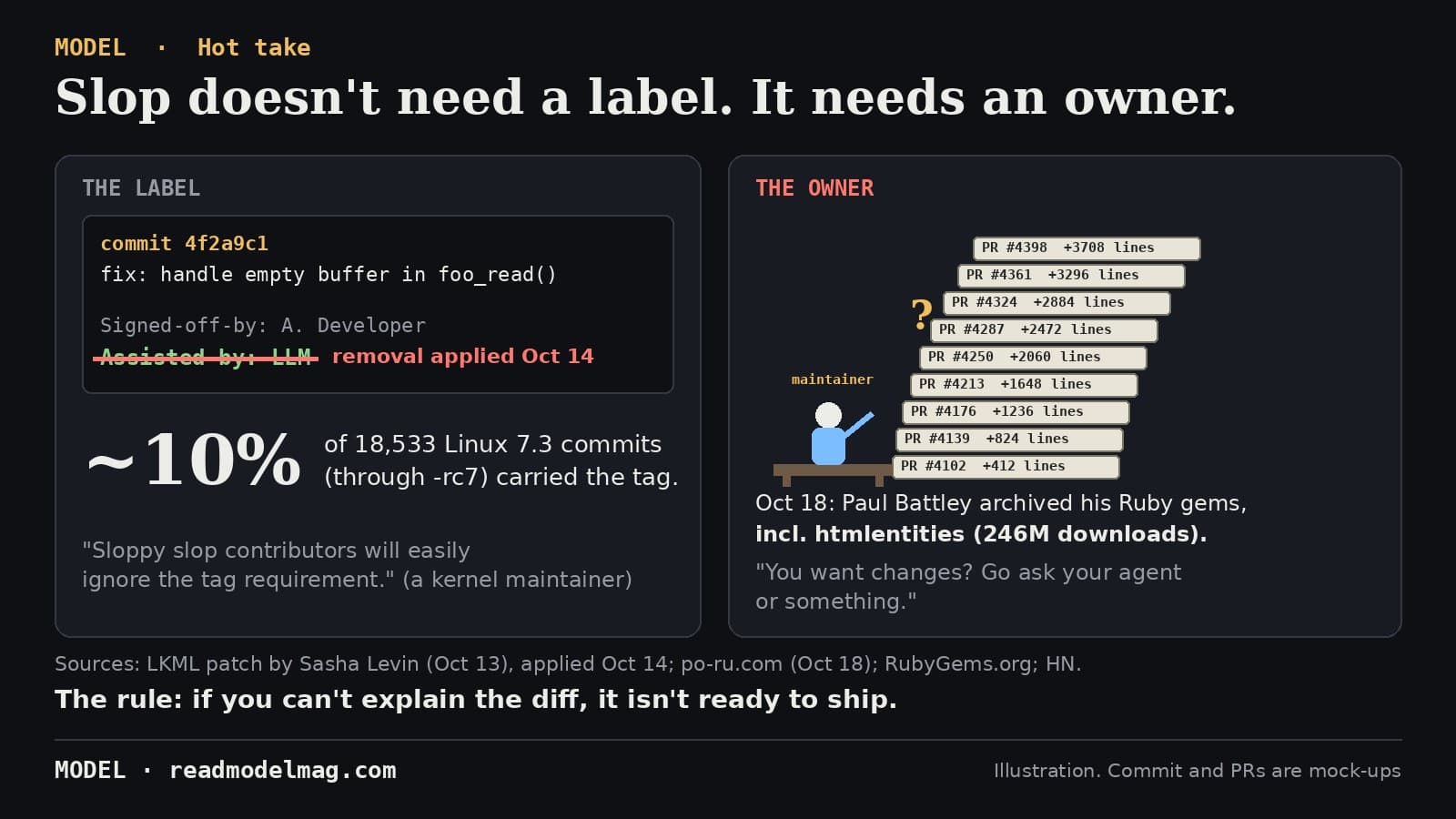
Three things happened in open source this week, and they point at the same problem.
The label failed. The Linux kernel used to ask contributors to add an Assisted-by: tag to patches written with help from an LLM. On October 13, kernel maintainer Sasha Levin posted a patch to remove it. His numbers: roughly 10% of the 18,533 non-merge commits in Linux 7.3 through -rc7 carried the tag, "while actual LLM use is far more widespread." Some contributors didn't know the rule, "others leave the tag off on purpose, and few maintainers ask about it." So the tag's absence "says nothing about how a patch was made." The patch was reviewed by Greg Kroah-Hartman and Kees Cook, and docs maintainer Jonathan Corbet applied it on October 14. The rules that the submitter certifies the patch and takes full responsibility for it stay in place.
The maintainers were blunt about why. Krzysztof Kozlowski wrote that "sloppy slop contributors will easily ignore the tag requirement," and that what matters is "some justification in the commit msg." Lorenzo Stoakes wrote that "the only long-term strategy for slop is to aggressively ignore it," and that "What kills the project is having 1,000 slop submissions that 2 or 3 people have to do something with."
A maintainer walked. On October 18, Paul Battley archived his Ruby gems on GitHub, including htmlentities (246 million downloads on RubyGems.org), text and htmlbeautifier. His explanation: he no longer wants to contribute "to a commons that's being strip-mined by massive corporations to feed the very machines whose unthinking output pollutes it." His last line: "You want changes? Go ask your agent or something." It was on the Hacker News front page today, with more than 300 comments. His post is about the direction of the Ruby world, not one bad pull request.
And the question of the day. Also on the Hacker News front page today: "Ask HN: How to deal with shipping AI-written code you don't understand?" It had 112 points and 186 comments by early afternoon Pacific time. A lot of the answers came down to one word: don't.
Our take
Slop is not a tooling problem, and it never was a labeling problem. A label is an honor system, and the people creating the mess are exactly the ones who skip it. The kernel tried it and got a 10% signal.
The real cost of AI-generated code is not the code. It is who has to read it. A model can write a 1,000-line pull request in a minute. A maintainer still reads it at human speed, for free, often alone. When that bill keeps landing on the same two or three people, some of them stop paying it. Battley just did.
So stop asking "did an AI write this?" Ask "can the person sending it explain it?" That is the rule the kernel kept: you sign it, you own it. Every team using coding agents should copy it.
The owner test, before you open a PR
- Explain the diff in your own words. If you can't say why each file changed, it isn't ready.
- Say how you tested it. Name the test, the command, or the case you tried. "The agent said it works" is not a test.
- Keep it small. A change a reviewer can read in one sitting gets reviewed. A 3,000-line drop gets closed, or worse, merged unread.
- Say how you used the tools in the description. The kernel moved this to the cover letter for a reason: a sentence of context beats a one-word tag.
- Read the project's rules first. Some projects ban AI-written contributions outright. Respect it or fork it.
What we did and didn't do: MODEL read the kernel thread, Battley's post, his GitHub and RubyGems pages and both Hacker News threads, linked below. We did not contact the people quoted, and we don't claim that any specific patch, gem or project mentioned here contains AI-written code.
MODEL Editors
Sources
- [PATCH v2] docs: remove Assisted-by references (Sasha Levin, Oct 13, 2026, with replies)
Linux kernel mailing list, via Patchew
- Re: [PATCH] docs: remove Assisted-by references (thread, Oct 12-13, 2026)
Linux-Kernel Archive
- Why I'm no longer updating this repository (Oct 18, 2026)
Paul Battley, po-ru.com
- htmlentities gem: 246,512,183 downloads
RubyGems.org
- Ask HN: How to deal with shipping AI-written code you don't understand?
Hacker News
- I no longer care to work on any Ruby gems so I've archived all my repositories (HN discussion)
Hacker News
FREE · EVERY WEEK
The top AI tools this week, tested.
Every week MODEL's editors pick the AI tools worth your time, try them hands-on, and tell you what's good, what's not, and who it's for. Free, in your inbox.
Free. Unsubscribe anytime. Our picks are editorial and can't be bought.
The weekly three is editorial. A subscription does not buy a place in it.
Continue

The test
KiviDB, on the stand
The new Rust rival to Redis matched 87 of our 88 Redis replies, ran 2.4 to 3.9 times faster on our box and found the right neighbours in vector search. Then it read our Redis snapshot and turned a hash into a set of junk.
· MODEL Editors
Tools
Vercel Shop is out: a Shopify storefront that agents can read and shop
Vercel's open source Next.js template for Shopify is now generally available. Product pages come in a machine-readable form for AI agents, and agents can search the catalog and build carts over MCP. The optional shopping assistant has no cost cap, so set limits before you switch it on.
· MODEL Editors
Hot take
A login screen is not a lock
A South African coffee chain's internal dashboard, reported as vibe-coded, showed a login page while shipping franchise contacts and business data to anyone with the URL. The fix is not to stop using AI. It is one check that takes five minutes.
· MODEL Editors