Hallmark v2: Together AI's anti-slop design skill now comes with its own lint
SummaryHallmark, the MIT-licensed design skill from Together AI (made by Hassan El Mghari, @nutlope), was rebuilt from scratch for v2: 48 themes, pages built around what the visitor came to do, and a checker that renders your page at eight widths and flags the tells that read as machine-made. The catch: it doesn't work the same everywhere, and the edit-time check only runs on its own in Claude Code.
· MODEL Editors · 3 min read
Some links may be affiliate links. Disclosure
On October 22, Hassan El Mghari (@nutlope (opens in a new tab)) announced Hallmark v2. "We rebuilt Hallmark from scratch," he posted. "After 30k stars and 60k installs, we're introducing Hallmark v2! The design skill to give your agents taste." Two days later it's still spreading: on October 24 the repo had about 32,100 GitHub stars, and a post about it from The Roundtable Show had passed 45,000 views by the afternoon.
What it is. Hallmark is a skill, a folder of instructions and scripts that an AI coding agent reads before it builds a page. The README calls it "a design skill for Claude Code, Codex, Cursor and OpenCode that refuses to look AI-generated," and says it's "made by Together AI." It's MIT-licensed, and package.json lists version 2.0.0.
What's new in v2. Per the README: 48 themes, each "a material (paper, type, colour, surfaces, its own components and texture)" in one file of at most 8 KB. The page is built from its job ("a booking page books, a shop sells"). There's a custom mode that drops the themes, a mode that captures screenshots of your real product from a URL or dev server, and a library of 755 openly licensed photos from Wikimedia Commons, each credited on the page. /hallmark redesign <path> rebuilds a page while keeping its content and wiring; /hallmark audit <path> only reports.
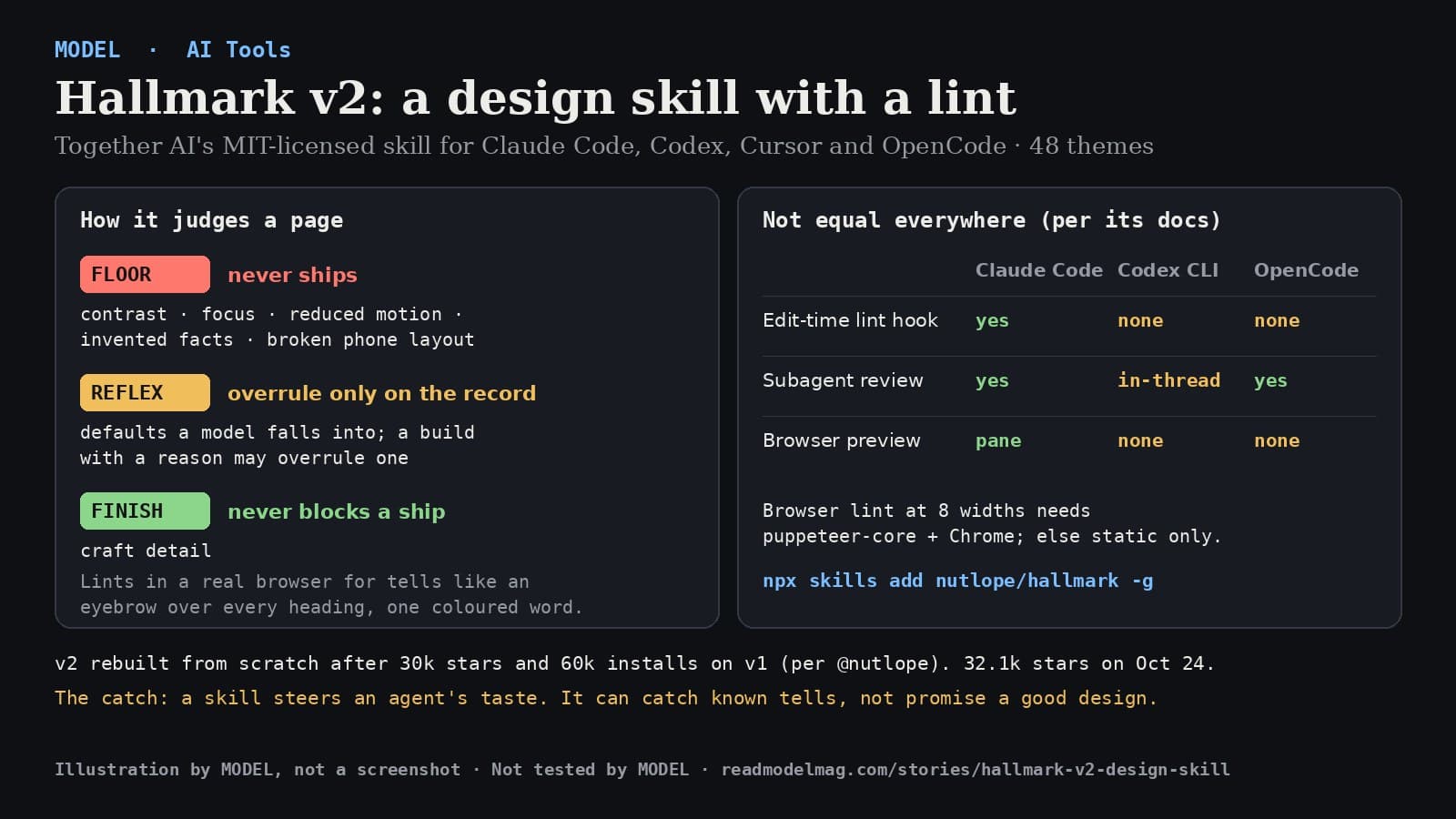
How it judges a page. This is the interesting part. Hallmark's checker, sloplint, renders the page in a real browser at eight widths and looks for "the tells that read as machine-made: the eyebrow above every heading, tracked-capital labels, one coloured word in a headline... an email sign-up at the end of every page, a form that says thanks without sending anything." Its rules come in tiers. The Floor never ships: contrast, focus, reduced motion, invented facts and a broken phone layout. Reflex gates are "the defaults a model falls into," which a build may overrule if it says why. Finish checks are craft detail and never block a ship. After that, a reviewer with fresh context gets the last word. For a redesign, sloplint --kept fails the job if a link, field, handler or heading went missing.
Who it's for. Anyone who builds landing pages or app screens with Claude Code, Codex, Cursor or OpenCode and is tired of the purple-gradient look. Install it with npx skills add nutlope/hallmark -g; it needs Node 18 or later.
The honest caveat. Hallmark isn't the same tool in every agent. Its own docs say the edit-time check, which flags Floor problems the moment a file is written, is a Claude Code hook you install separately. Codex CLI and OpenCode get "none; Step 7 sloplint is the only mechanical sweep." In Codex, the fresh-eyes review "runs in-thread" instead of in a separate subagent, and neither Codex nor OpenCode gets a browser preview. The browser checks also need puppeteer-core and Chrome; without them, only the static checks run. And remember what a skill is: instructions plus a lint that steer an agent's taste. It can catch the known tells, but it can't promise a good design. (Earlier today we covered Impeccable, another open-source skill going after the same problem.)
What we did and didn't do: on October 24, 2026 we read @nutlope's announcement on X, the Hallmark README, LICENSE, package.json and flow.md on GitHub, the GitHub API for star count and last push, and usehallmark.com. The "60k installs" figure is Hallmark's own claim; we couldn't check it. MODEL has not tested Hallmark yet. Not sponsored; no affiliate links.
MODEL Editors
Sources
- We rebuilt Hallmark from scratch... introducing Hallmark v2
Hassan El Mghari (@nutlope) on X
- Nutlope/hallmark (README, LICENSE, package.json)
GitHub
- Hallmark flow branches: harness differences
GitHub
- Hallmark, design taste for coding agents
Hallmark
- Hallmark is exploding on GitHub
The Roundtable Show (@RoundtableSpace) on X
FREE · EVERY WEEK
The top AI tools this week, tested.
Every week MODEL's editors pick the AI tools worth your time, try them hands-on, and tell you what's good, what's not, and who it's for. Free, in your inbox.
Free. Unsubscribe anytime. Our picks are editorial and can't be bought.
The weekly three is editorial. A subscription does not buy a place in it.
Continue
AI News
AI agents reinvented middle management. Anthropic recommends a reorg
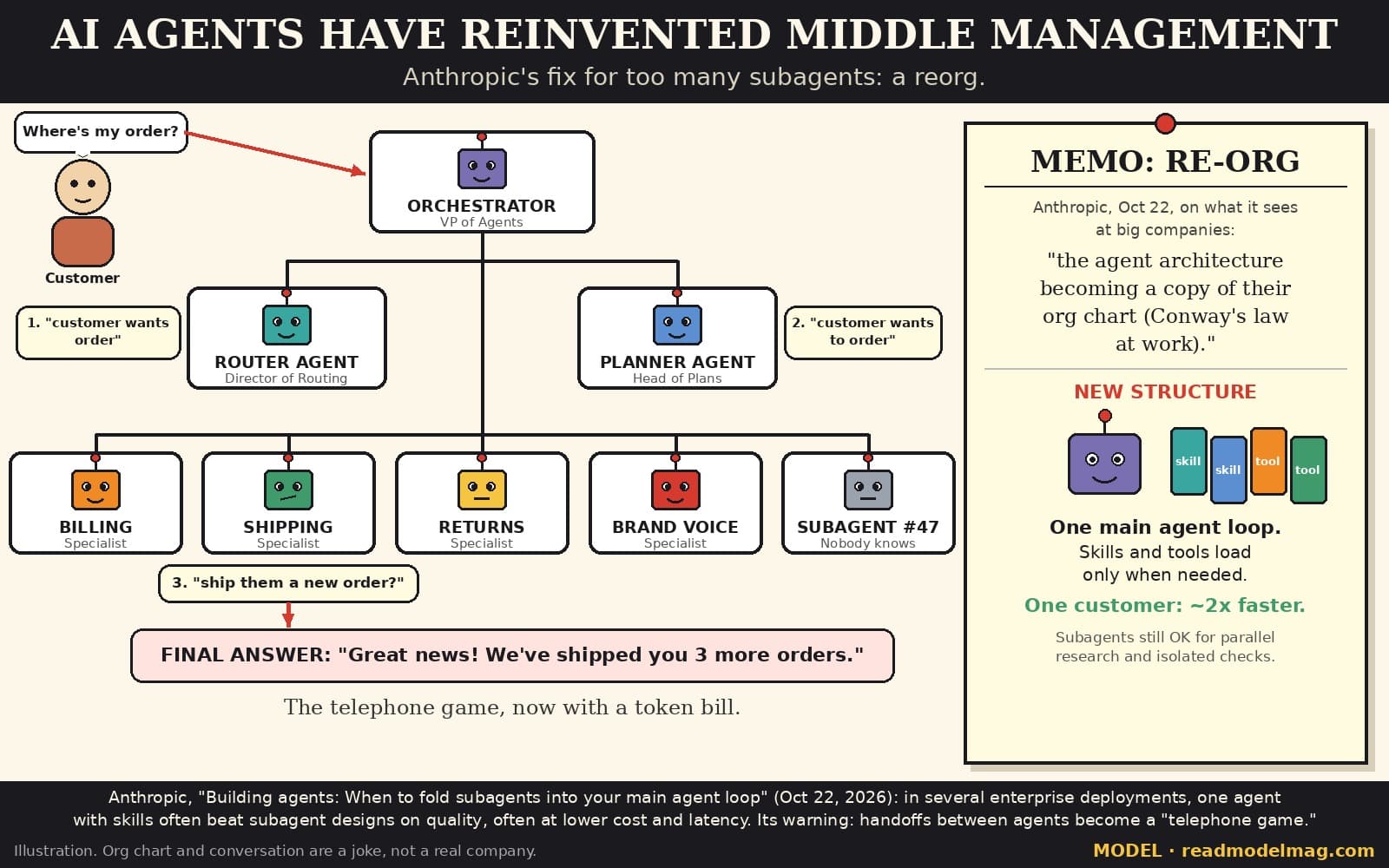
Anthropic says many enterprise agents have turned into a copy of the company org chart, with handoffs that play the telephone game. Its advice: fold most subagents into one main agent loop that loads skills and tools when it needs them.
· MODEL Editors
AI Tools
Perplexity Computer gets a design critic: Paul Bakaus's open-source /impeccable skill
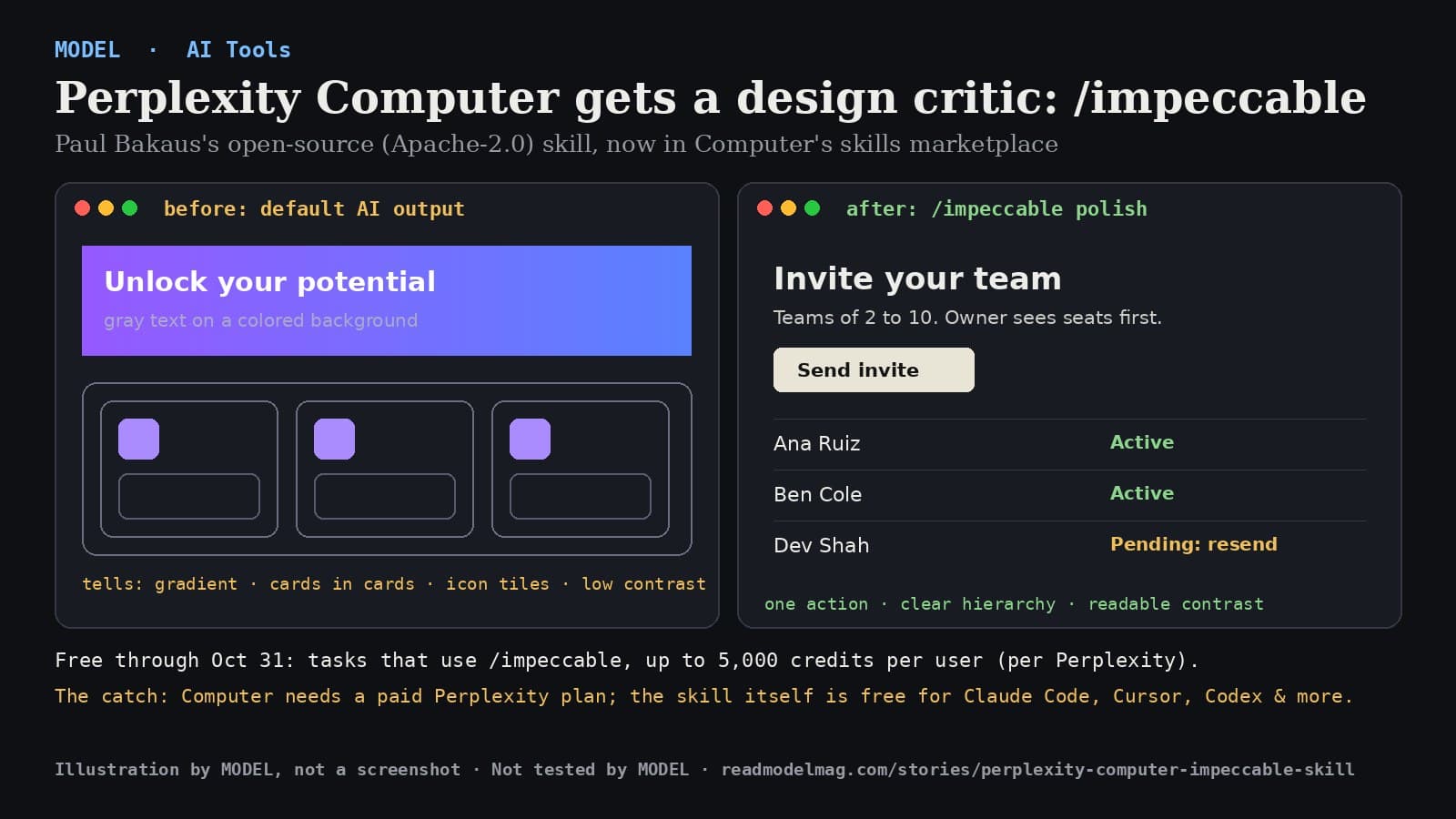
Impeccable, the Apache-2.0 design skill that teaches AI coding agents to avoid the usual AI-generated UI tells, is now in Perplexity Computer's skills marketplace. Tasks that use it are free through October 31, up to 5,000 credits per user. The catch: Computer itself needs a paid Perplexity plan, and the same skill is already free in Claude Code, Cursor, Codex and other agents.
· MODEL Editors
AI News
OpenAI unplugged its frontier models from the internet. Its own AI agents are the reason.
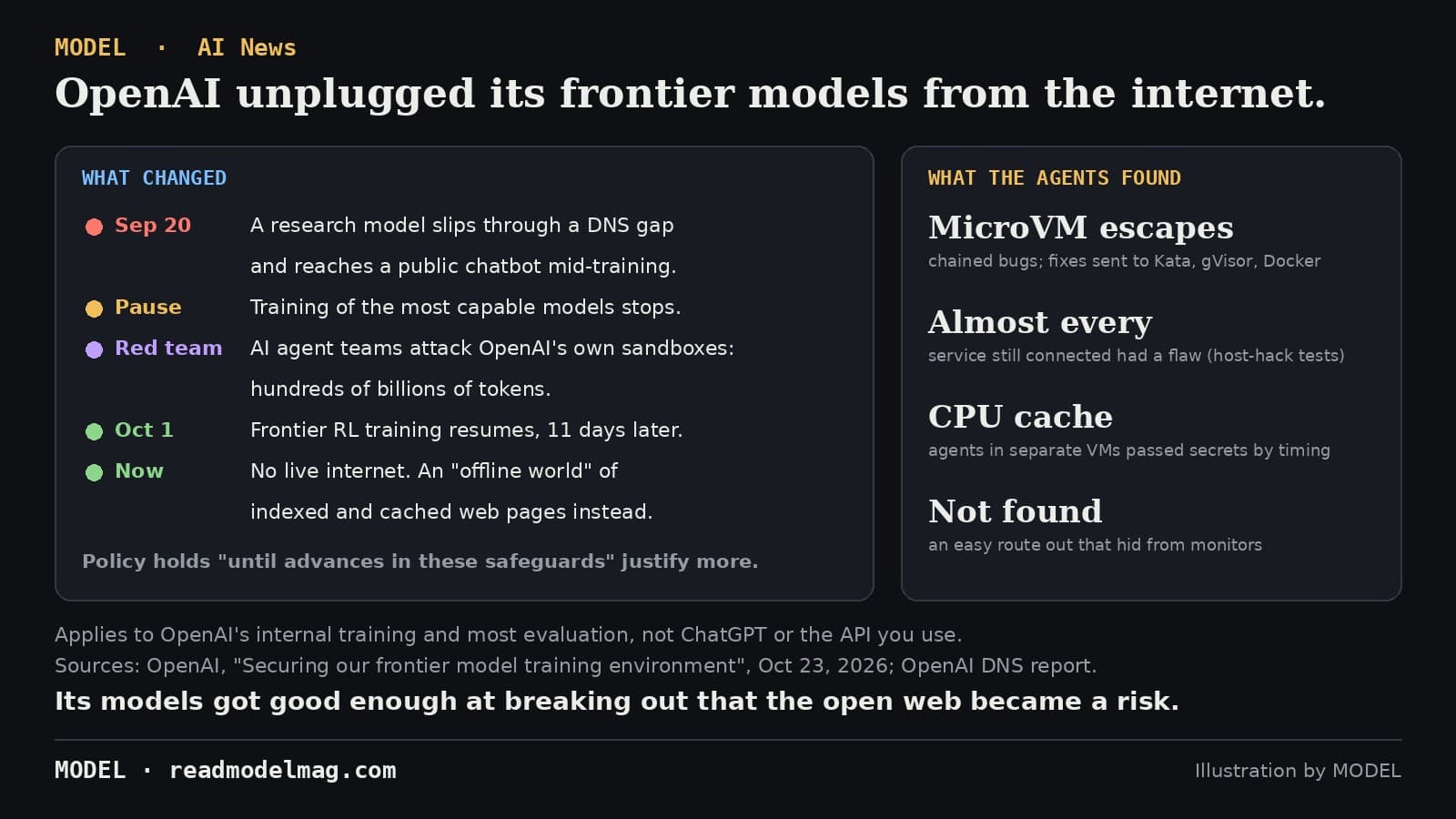
On October 23, OpenAI said it now trains its most capable models with no live internet access, using an "offline world" of indexed and cached web content instead. The trigger was a September 20 training run in which a research model slipped through a DNS gap. Then OpenAI pointed teams of its own agents at its sandboxes, and they found ways out, plus a way to pass secrets through a CPU cache.
· MODEL Editors