OpenAI is now $150 billion off. Only $1.25 trillion.
SummaryOpenAI is reportedly close to raising up to $30 billion at a $1.25 trillion pre-money valuation, down from the $1.4 trillion it was discussing a month ago. It would still be the most valuable private company ever.
· MODEL Editors · 2 min read
Some links may be affiliate links. Disclosure
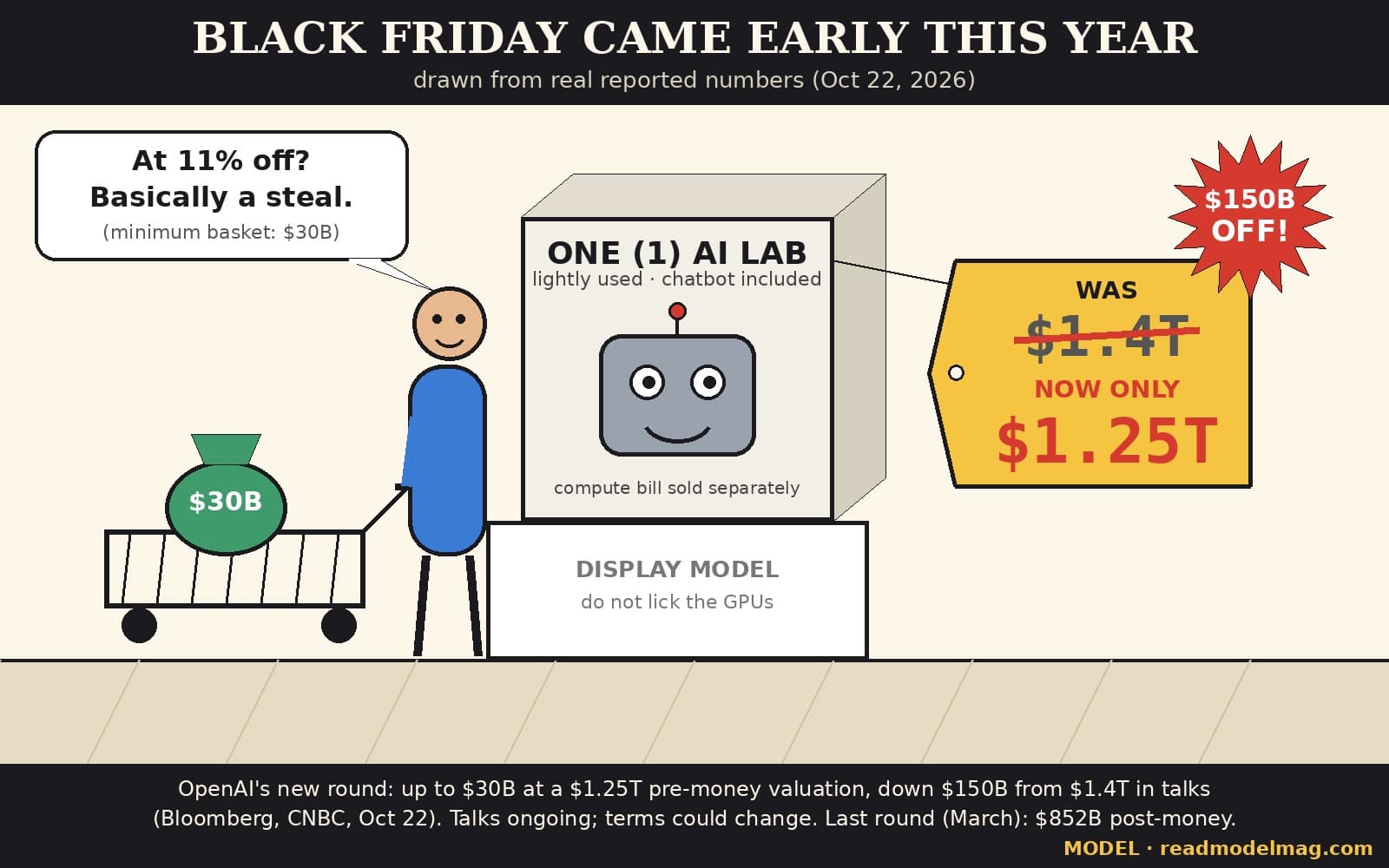
Some things go on sale before the holidays. This year, one of them is an AI lab.
The markdown. OpenAI is close to finalizing a funding round of up to $30 billion at a $1.25 trillion pre-money valuation, CNBC reported (opens in a new tab) on October 22, citing people familiar with the deal. Investors from the United Arab Emirates and Coatue are leading it, and CNBC says it's being positioned as an "opportunistic" bridge ahead of a possible IPO. Bloomberg reported (opens in a new tab) the same day that OpenAI shifted the value discussed in the talks by $150 billion, down from $1.4 trillion. The Financial Times says the target was cut after some investors pushed back on the $1.4 trillion price.
The math. $150 billion off $1.4 trillion is about 11%. The discount alone is five times the size of the money being raised.
Still not cheap. At $1.25 trillion, OpenAI would be the most valuable private company ever, TechCrunch notes (opens in a new tab). Its last round, in March, valued it at $852 billion post-money, so the "discounted" price is still roughly 47% higher than seven months ago. CNBC also reports the round could come with a deal for more computing capacity from the UAE; OpenAI told investors in February it's targeting about $600 billion in total compute spend by 2030.
The fine print. These are reports based on anonymous sources. The final size of the round is still being determined, OpenAI is aiming for signatures by the end of next week (per CNBC), and terms could change. OpenAI declined to comment to TechCrunch. OpenAI confidentially filed for an IPO in June but hasn't said when it will list.
Our take
An 11% markdown on a trillion-dollar company is still a $150 billion rounding error, and it says less about OpenAI's products than about how far investors will stretch before an IPO. The interesting number to watch isn't this round. It's what public markets pay when the shares finally trade.
What we did and didn't do: we read CNBC, Bloomberg, the Financial Times (summary) and TechCrunch reporting on October 23, 2026. We have no inside knowledge of the talks. OpenAI isn't publicly traded. Not investment advice. Not sponsored; no affiliate links.
MODEL Editors
Sources
- OpenAI nears up to $30 billion funding round at $1.25 trillion valuation led by UAE investors (Oct 22, 2026)
CNBC
- OpenAI Shifts Value to $1.25 Trillion as Funding Talks Finalize (Oct 22, 2026)
Bloomberg
- OpenAI trims valuation target to $1.25tn after pitching higher price
Financial Times
- OpenAI working on new $30B raise at $1.25T valuation ahead of IPO (Oct 22, 2026)
TechCrunch
Not investment advice.
FREE · EVERY WEEK
The top AI tools this week, tested.
Every week MODEL's editors pick the AI tools worth your time, try them hands-on, and tell you what's good, what's not, and who it's for. Free, in your inbox.
Free. Unsubscribe anytime. Our picks are editorial and can't be bought.
The weekly three is editorial. A subscription does not buy a place in it.
Continue
Markets
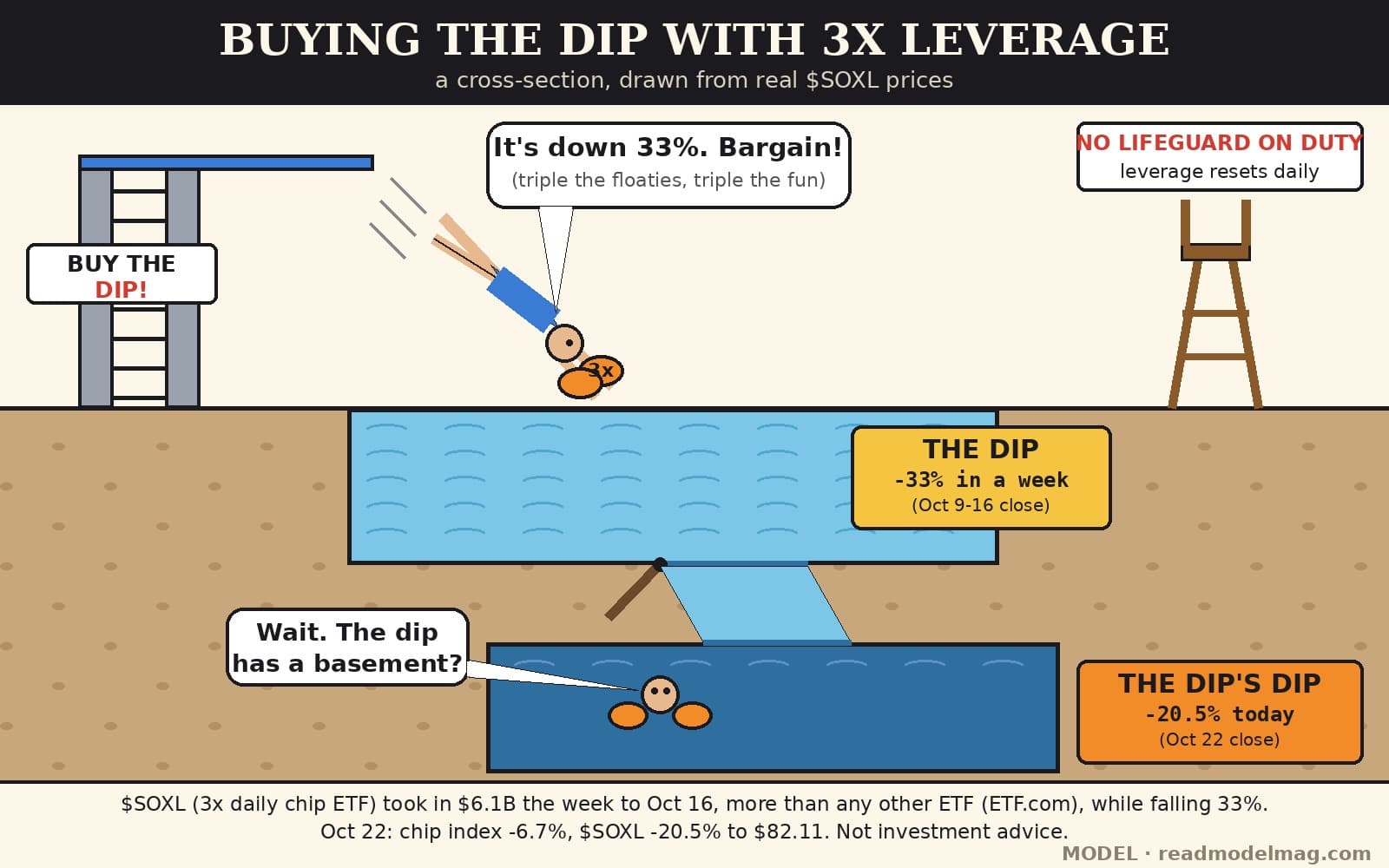
Retail bought the chip dip with 3x leverage. The dip had a basement.
The 3x leveraged chip ETF SOXL pulled in $6.1 billion in the week to October 16, more than any other ETF, while falling 33%. On October 22 chip stocks had their worst day since June and SOXL dropped another 20.5%.
· MODEL Editors
Markets
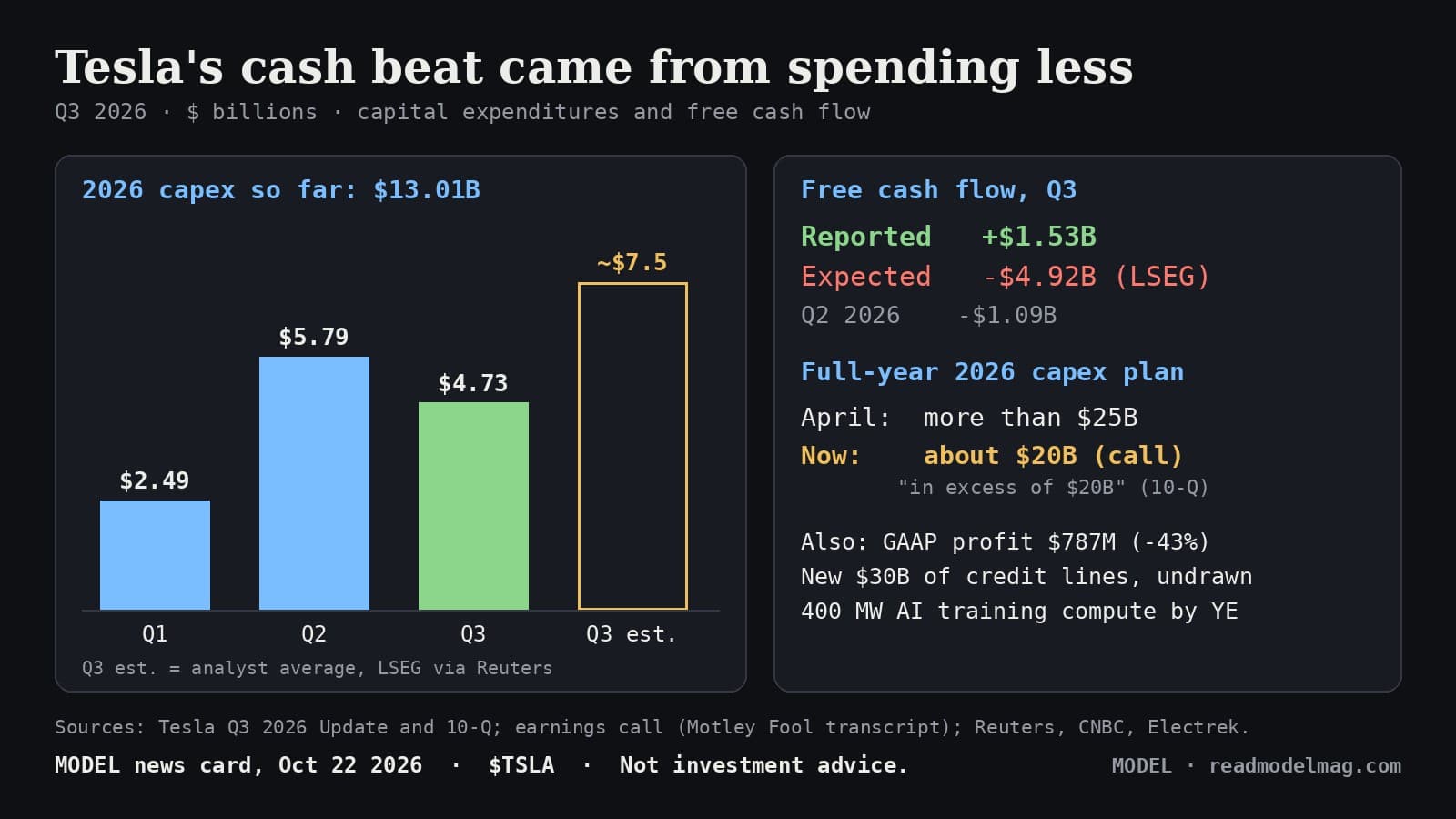
Tesla's cash-flow beat came from spending less on AI than planned
Tesla reported $1.53 billion of free cash flow when analysts expected a $4.92 billion burn. The reason: it spent $4.73 billion on capital projects, not the roughly $7.5 billion expected, and cut its 2026 spending plan from more than $25 billion to about $20 billion.
· MODEL Editors
Markets
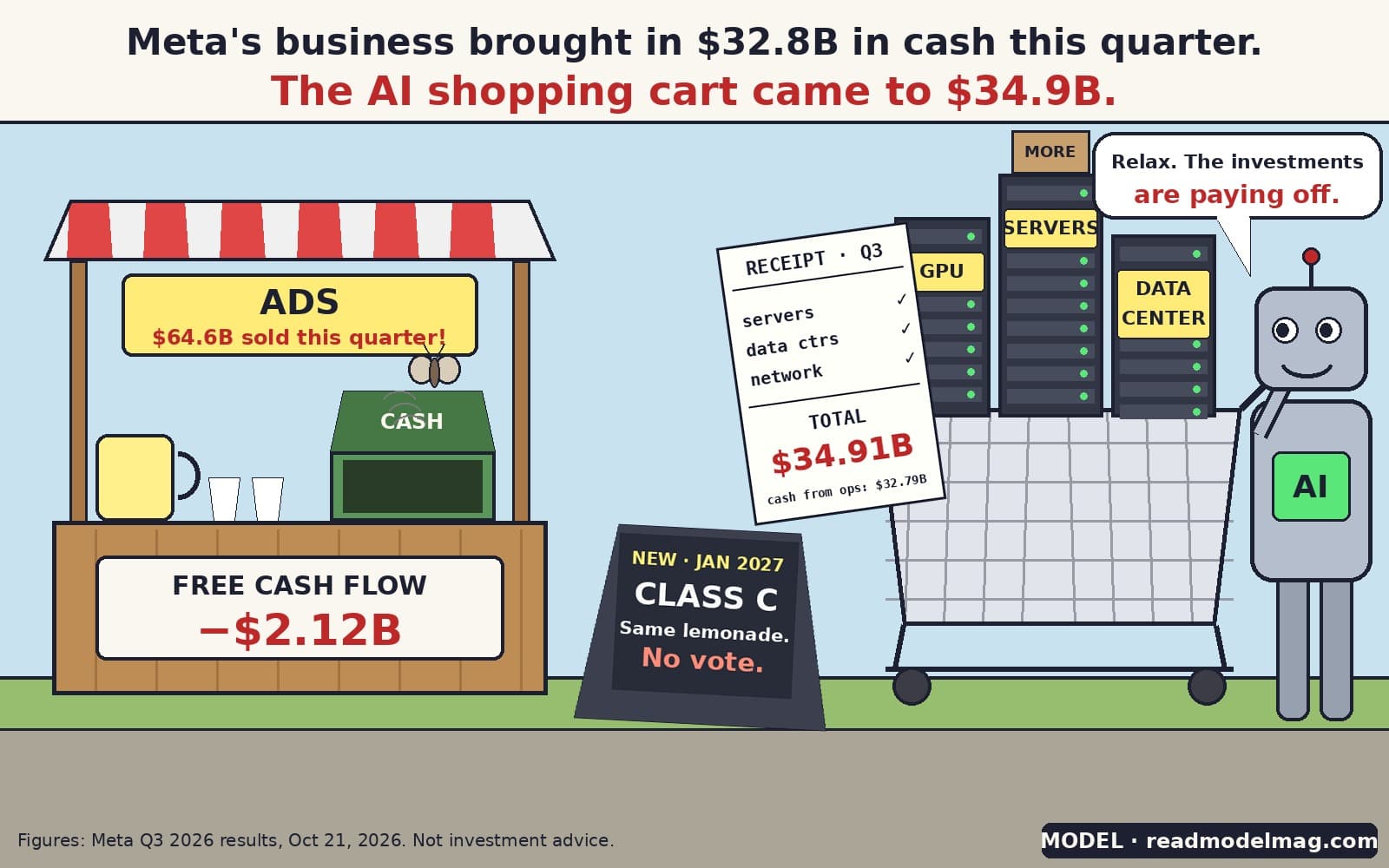
Meta's AI build-out cost more than its business brought in this quarter
Meta beat revenue estimates with $64.6 billion, but capital spending of $34.91 billion outran the $32.79 billion its operations generated, leaving free cash flow at negative $2.12 billion. It is also creating a new class of non-voting shares to help pay for the AI race.
· MODEL Editors