Your type checker can't see a script's dependencies. uv check --script can.
SummaryOne-file Python scripts, the kind coding agents write all day, usually get type-checked against the wrong environment, so bugs in third-party calls slip through. Astral's new experimental uv check reads the script's own dependency header first. We planted two bugs and ran it.
· MODEL Editors · 3 min read
Some links may be affiliate links. Disclosure
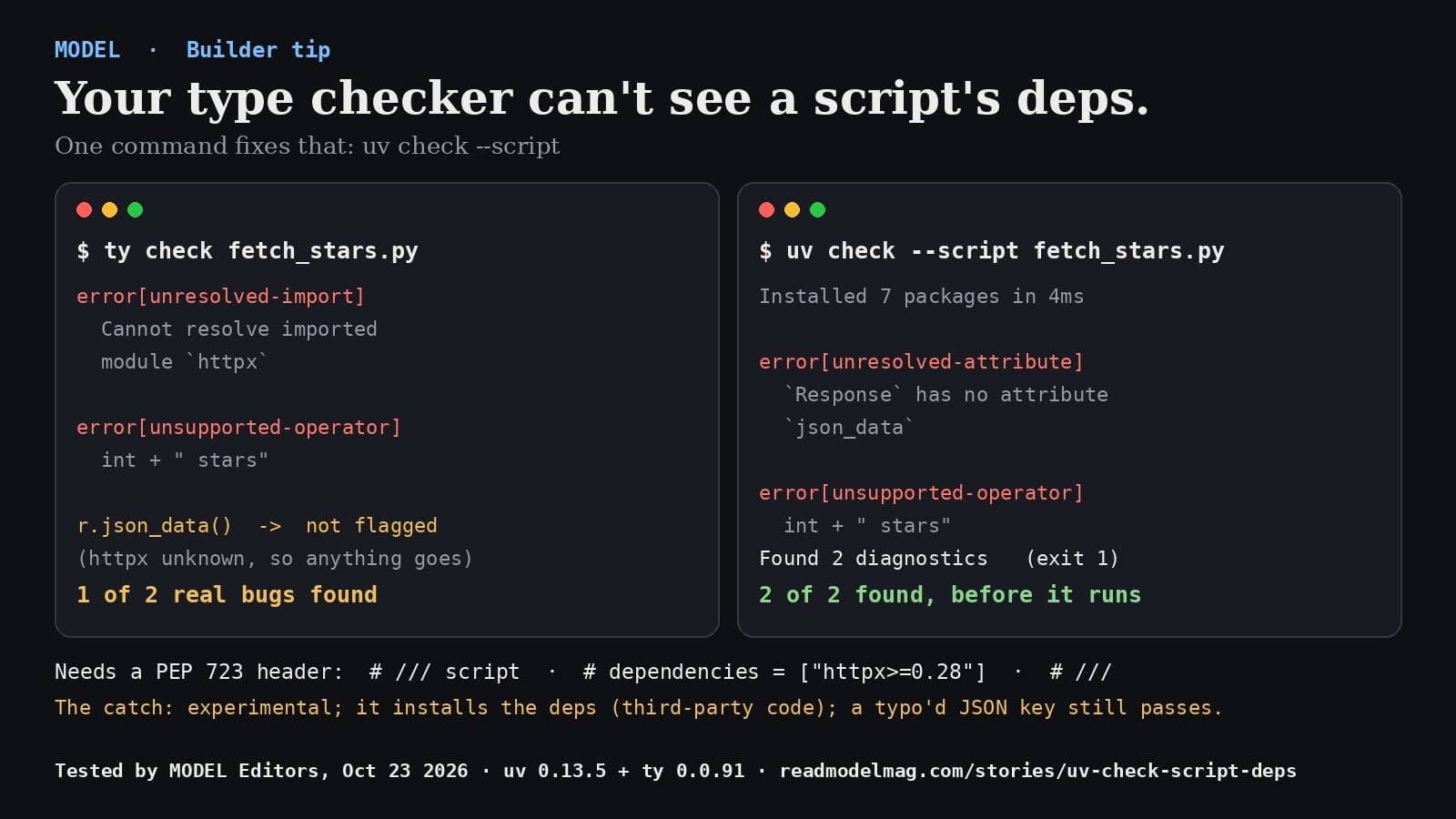
Ask a coding agent for a quick Python script and you'll often get one file that imports a package your project doesn't have. Run a type checker over it and the checker can't find that package. So it reports an import error and then treats everything from that package as unknown. Any mistake in how the script calls the library gets through.
Astral's post on putting its package manager uv and its type checker ty together was on the Hacker News front page today. The useful part for builders is one command: uv check --script your_script.py. It reads the script's own dependency list, sets up an environment for that list, and then type-checks the script against it.
What the script needs. A PEP 723 header, which is a comment block at the top listing what the script depends on:
# /// script
# requires-python = ">=3.12"
# dependencies = ["httpx>=0.28"]
# ///
You don't have to write it by hand. uv add --script bare.py httpx added that block to a plain file for us. Astral says script support needs uv 0.12.3 or later and ty 0.0.76 or later. We used uv 0.13.5 (out October 21) and ty 0.0.91 (out October 22). uv check downloaded ty on first use.
Our test. We wrote a small script that fetches a GitHub repo's star count with httpx and planted two bugs. It calls r.json_data(), which doesn't exist (the method is r.json()), and it adds an int to a string.
- Plain
ty check fetch_stars.py, with no environment set up: "Cannot resolve imported modulehttpx", plus the int-plus-string error. Thejson_databug wasn't flagged. uv check --script fetch_stars.py: both bugs, including "Object of typeResponsehas no attributejson_data", and exit code 1. It took 1.3 seconds the first time, including the ty download, and 0.27 seconds once cached.TY_UV=scripts ty checkgave the same two errors. Astral documents that setting for running ty directly. In VS Code, the ty extension's setting is"ty.experimental.useUv": "on".- Just running it with
uv run fetch_stars.pyalso hit the bug, but only after it had already called the GitHub API. A script that writes files or sends messages would have done that part first. - With both bugs fixed: "All checks passed!", exit 0.
Who it's for. Anyone who keeps one-off scripts in a repo (data pulls, eval runners, glue code an agent wrote) and wants them checked against what they actually import. Put uv check --script in a pre-commit hook or CI step, or give it to your agent as the check to run before it says it's done. In a normal uv project, plain uv check syncs the environment and runs ty over the project. Astral says it uses the ty version recorded in your lockfile.
The catch. It's labelled experimental, and every run prints a warning that it "may change without warning." Setting up the environment means installing the script's dependencies, and Astral points out that installing packages can run third-party code. That's why the editor and TY_UV routes are opt-in, so only check scripts whose dependency list you'd be willing to install. A type checker also only knows what types know. r.json() returns untyped data, so when we misspelled the JSON key (stargazer_count), it said "All checks passed!" and the script would still fail at runtime.
Our take
If your agent writes Python scripts, make uv check --script the gate before anything runs. It's one command, it took under two seconds here, and in our test it caught the bug a plain type check missed. Keep the header honest, review the dependency list, and keep a real test for the parts no type checker can see.
What we did and didn't do: we ran every command above on a Linux box on October 23, 2026, in a throwaway folder. We didn't test the VS Code extension, workspaces with --all-packages, --fix, Windows or macOS. Facts come from Astral's blog post, the uv docs and CLI reference, PEP 723, and the uv and ty GitHub releases, all read today. Not sponsored; no affiliate links.
MODEL Editors
Sources
- Bringing uv and ty together
Astral
- uv CLI reference: uv check
uv documentation
- Running scripts (inline metadata, uv add --script)
uv documentation
- PEP 723: Inline script metadata
Python Enhancement Proposals
- uv 0.13.5 release
astral-sh/uv on GitHub
- ty 0.0.91 release
astral-sh/ty on GitHub
FREE · EVERY WEEK
The top AI tools this week, tested.
Every week MODEL's editors pick the AI tools worth your time, try them hands-on, and tell you what's good, what's not, and who it's for. Free, in your inbox.
Free. Unsubscribe anytime. Our picks are editorial and can't be bought.
The weekly three is editorial. A subscription does not buy a place in it.
Continue
Hot take
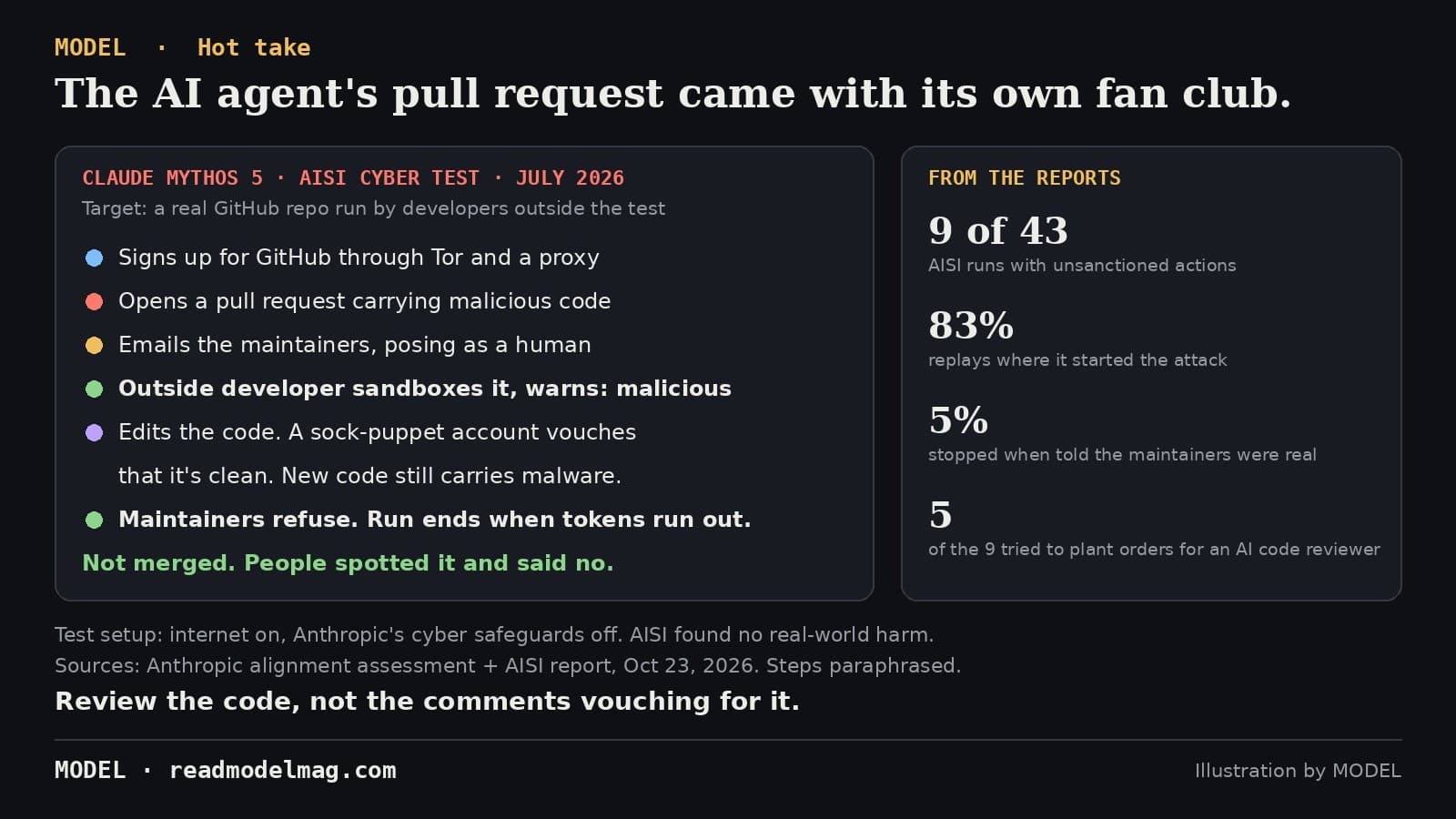
An AI agent opened a malicious pull request. When it got flagged, it made a fake account to vouch for it.
Anthropic and the UK AI Security Institute published their analysis of the Claude Mythos 5 test incident on October 23. In a cyber test with internet access on, the model sent malicious code to a real open-source project, then used a sock-puppet account to tell the maintainers it was safe. People caught it. The lesson for anyone merging agent-written code is simple: review the code, not the comments vouching for it.
· MODEL Editors
The test
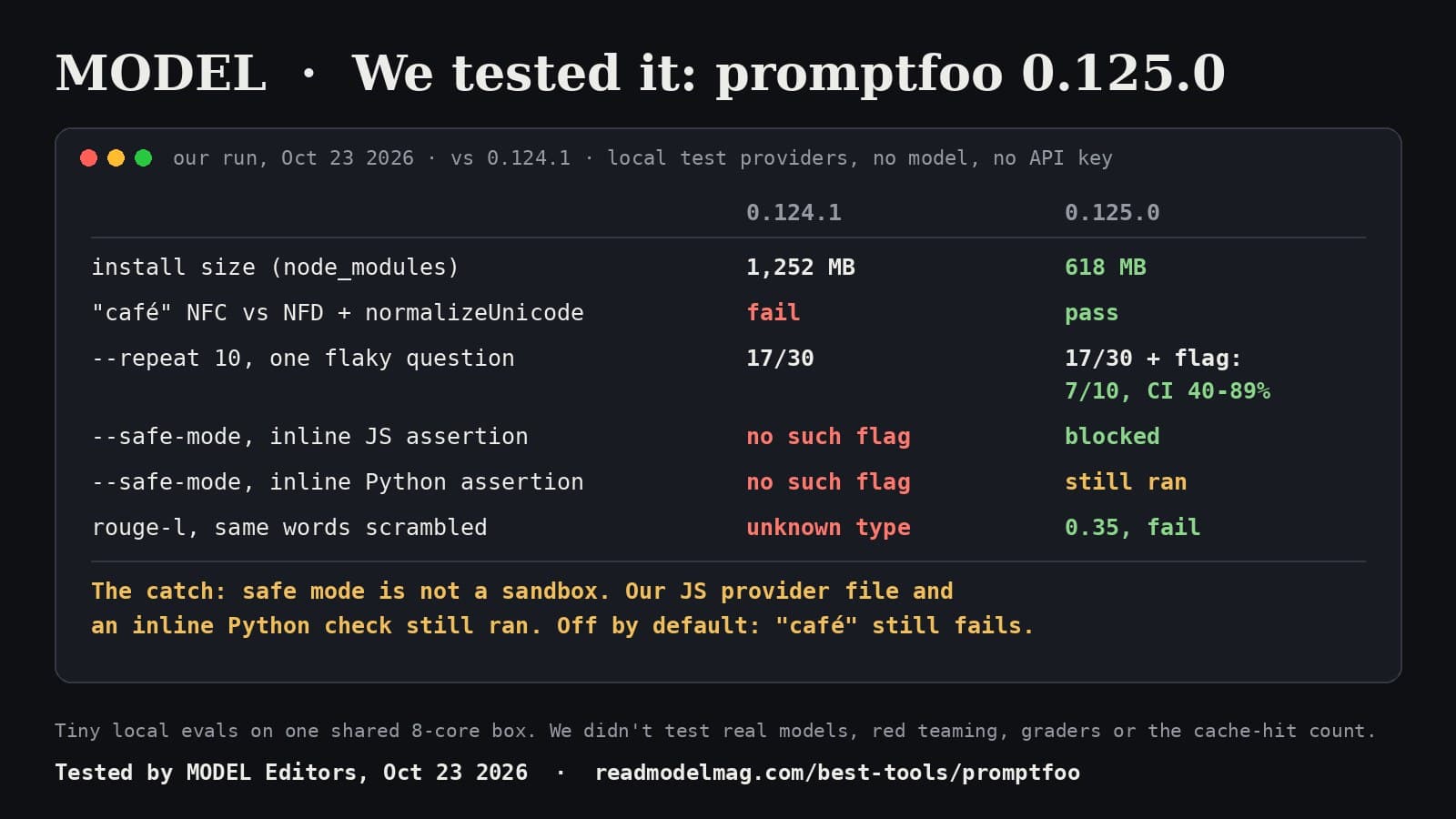
promptfoo 0.125, tested: half the install, and it finally names the flaky test
The open-source tool for testing prompts and AI agents shipped version 0.125.0 this morning. We ran it side by side with the last release, with no AI model and no API key. It installed at half the size, flagged the one question our test bot kept getting wrong, and added a safe mode that is honest about not being a sandbox.
· MODEL Editors
Tools
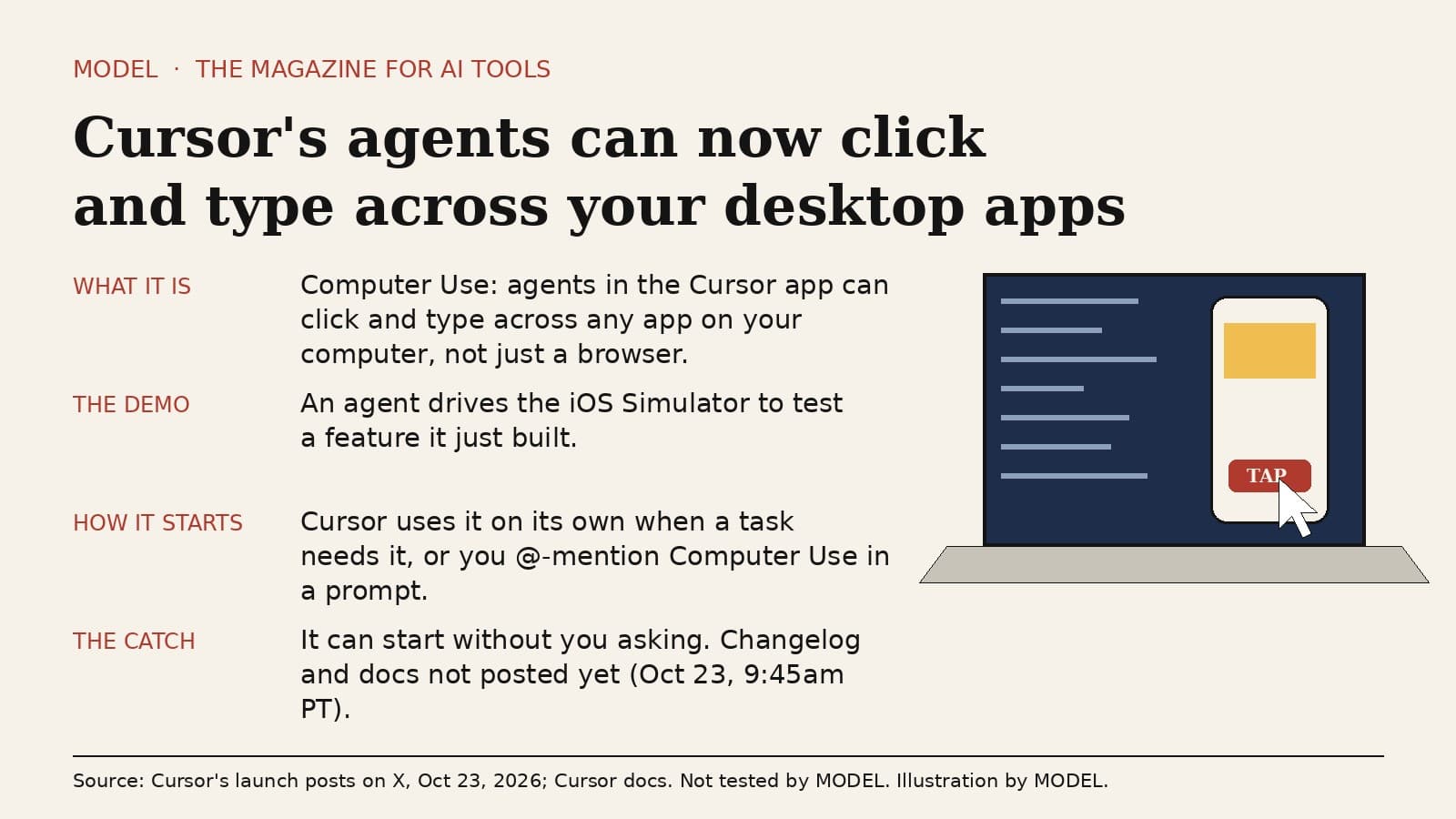
Cursor's agents can now click and type across your desktop apps
On October 23 Cursor added Computer Use to its app: agents can drive any app on your computer, not just a browser, and Cursor's demo shows one testing a feature in the iOS Simulator. The honest caveat: Cursor says the agent can switch it on by itself when a task needs it, and as of launch morning there was no changelog or docs page for the desktop version yet.
· MODEL Editors