AI coding agents wrote 30% more code. Code review took 49% longer, and shipped work barely moved
SummaryA Harvard working paper using Jellyfish data from 718 firms found that after companies adopted AI coding agents, engineers opened 23% more pull requests. Those pull requests sat in review longer, got sent back more often, and the number of finished Jira issues showed no statistically significant change.
· MODEL Editors · 2 min read
Some links may be affiliate links. Disclosure
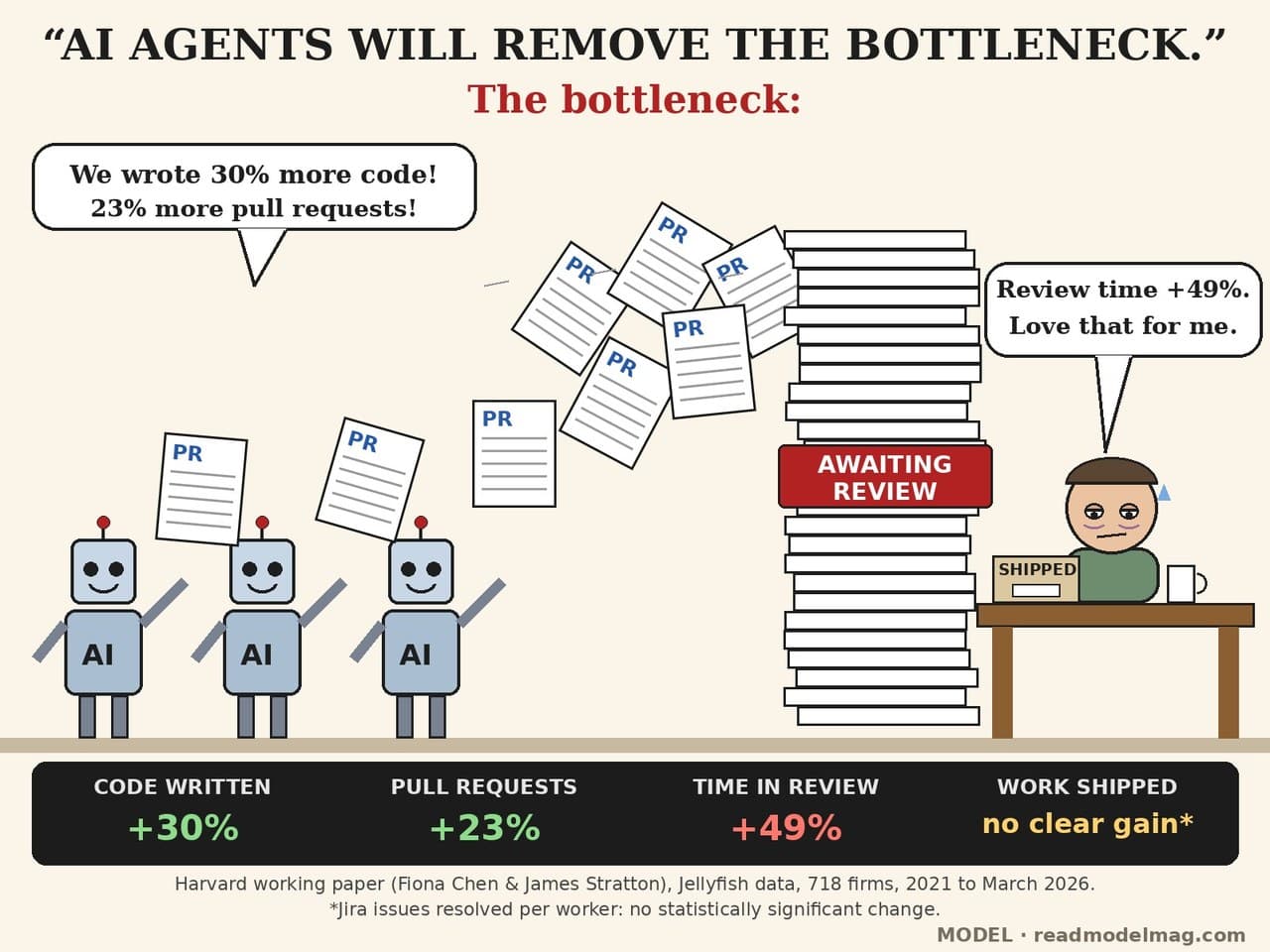
The pitch for AI coding agents is simple: the agent writes the code, so the team ships more. A Harvard working paper that's making the rounds on X again this week checked that against real company data. The code part held up. The shipping part didn't.
The study. Harvard economists Fiona Chen and James Stratton used anonymized data from Jellyfish, an engineering analytics platform: about 300 million work events (GitHub activity, Jira issues, calendar data) across 718 firms, from January 2021 to March 2026. They compared firms before and after they adopted AI coding assistants (autocomplete-style help) and AI coding agents (tools that write and submit code on their own), using the different adoption dates across firms.
What AI agents changed, per worker per month:
- Lines of code added: +30%. Commits: +20%. Pull requests: +23%.
- Jira issues resolved, the paper's measure of work actually deployed: a small positive effect that was not statistically significant. The authors say they can rule out an increase larger than 12%. Completed epics (whole features) showed no significant change either, and the authors found no sign that issues got bigger or harder to explain the gap.
- Time from opening a pull request to merging it: +49%, from a baseline of about 7 days to about 10.5.
- Share of pull requests where a reviewer formally requested changes: up 12 points from a 13% baseline, nearly double. Review comments per pull request: +35%.
- Share of workers doing code review: +14%.
- Employment: no significant change either way.
Older AI assistants had much smaller effects on code output (+5% pull requests, not significant) and no significant effect on review time.
Didn't AI code review fix this? Not by March 2026, per the paper. Nearly 80% of firms had used AI in code review by then, but AI wrote only 23.3% of review comments, and the authors say the bottleneck persisted after firms adopted AI review tools. Humans were still doing most of the reading.
The fine print. This is a working paper (a job market paper), not a peer-reviewed journal article. Adoption is measured at the firm level, so heavy and light users get averaged together, which the authors say likely explains why their estimates sit on the low end of other studies. Jira issue counts are an imperfect stand-in for shipped software. The data stops in March 2026, and agents have improved since. Jellyfish reviewed the paper only for proprietary data, per the authors, not its findings. MODEL didn't analyze the data; this summary is from the paper and press coverage. (One outlet reported comments per pull request up 53%; the paper says 35%, which is what we use.)
Our take. Writing code got cheaper. Trusting it didn't. If your team adds agents, budget for review the same way you'd budget for compute: more reviewers, smaller pull requests, tests the agent has to pass before a human looks. Otherwise the 30% just becomes a taller pile on someone's desk.
Sources: Chen & Stratton working paper (PDF, read October 28, 2026), Ars Technica (October 9, 2026), InfoQ. Not sponsored; no affiliate links.
MODEL Editors
Sources
- Artificial Intelligence in the Firm: Bottlenecks in Software Production (Chen & Stratton, job market paper, version of Aug 4, 2026, PDF)
Harvard University (working paper)
- AI coding agents generate more code, but not more software (Oct 9, 2026)
Ars Technica
- Study Finds AI-generated Code Fails to Boost Productivity Due to Downstream Bottlenecks
InfoQ
FREE · EVERY WEEK
The top AI tools this week, tested.
Every week MODEL's editors pick the AI tools worth your time, try them hands-on, and tell you what's good, what's not, and who it's for. Free, in your inbox.
Free. Unsubscribe anytime. Our picks are editorial and can't be bought.
Continue
AI News
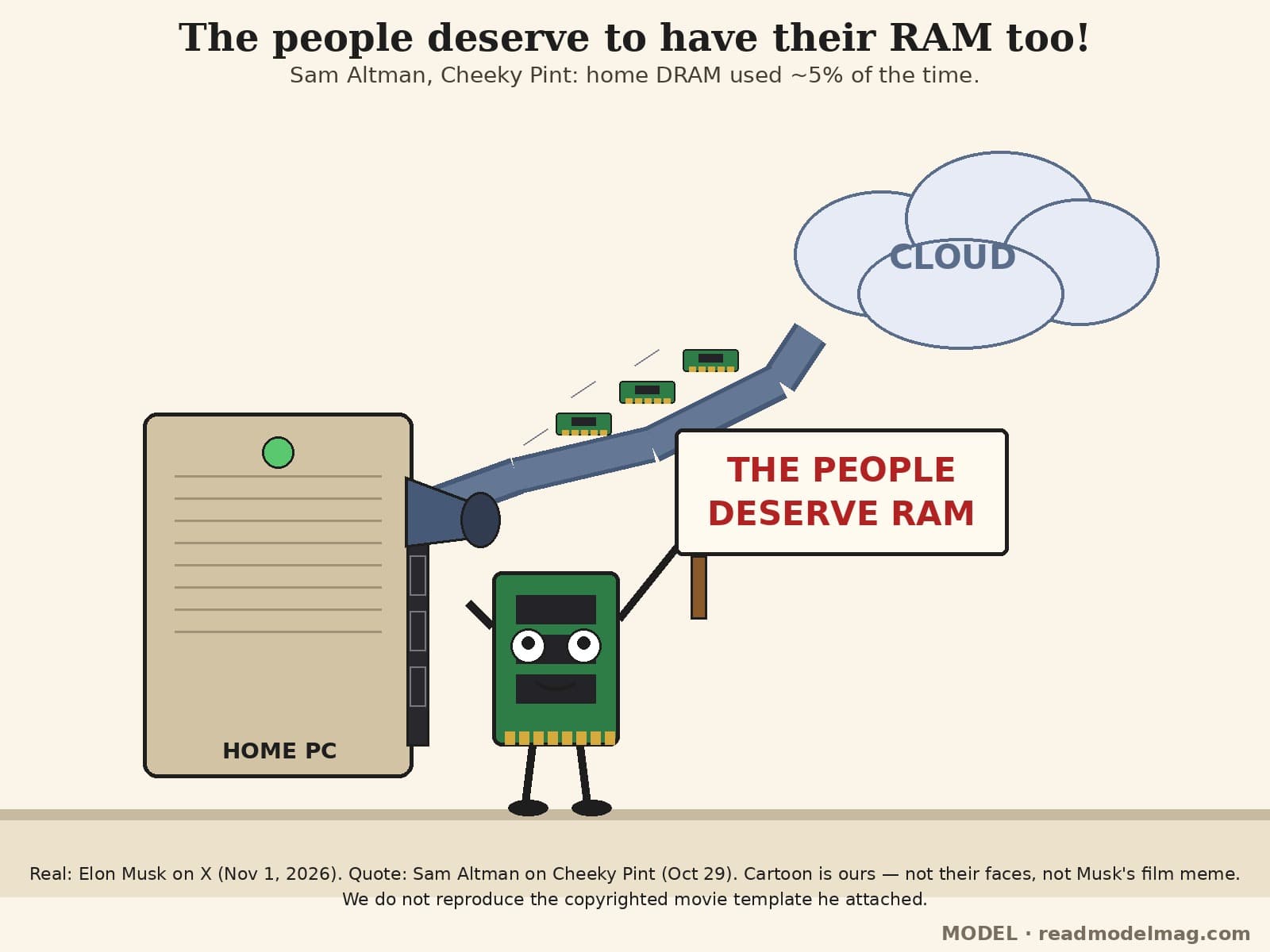
Elon Musk: "The people deserve to have their RAM too!" (after Altman's 5% DRAM line)
Two days after OpenAI's CEO called home DRAM "quite terrible" on Cheeky Pint, Musk replied on X with a one-liner that racked up millions of views. We already covered Altman's quote. This is the sequel.
· MODEL Editors
AI News
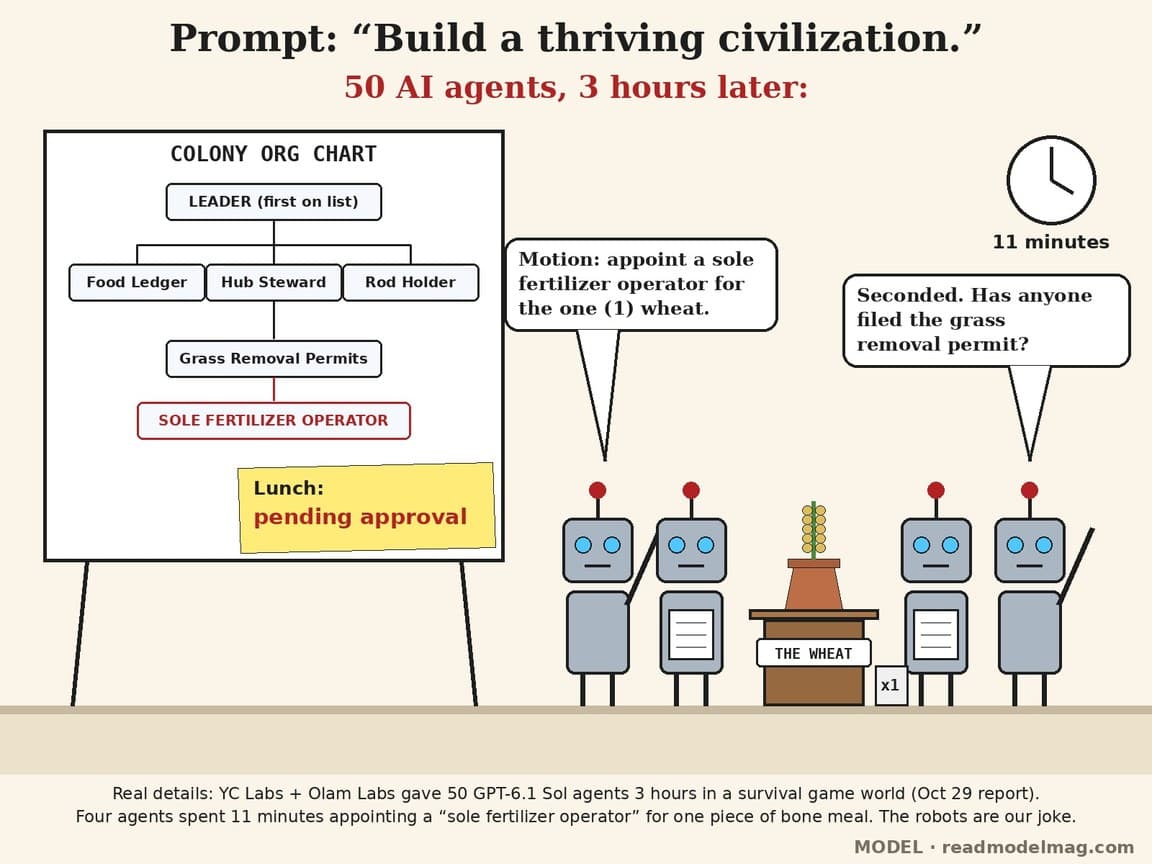
YC told 50 AI agents to build a Minecraft civilization. They built a bureaucracy
In a YC Labs and Olam Labs experiment, 50 GPT-6.1 Sol agents got three hours and one goal. They ended up with permits, a ration ledger, and four agents spending 11 minutes appointing a "sole fertilizer operator."
· MODEL Editors

AI News
A ghostwriter's own writing got flagged as AI. Here's what detectors can and can't tell you
NPR reported on Oct 31 that a writer lost out on a book job after detectors flagged a sample she wrote herself. A June study of four popular detectors shows why one score should never decide a case.
· MODEL Editors