AI has finally reached the other 493. Accounting filed it under expenses
SummaryApollo's chief economist says revenue per worker and profit margins are rising for the Magnificent 7 but flat for the rest of the S&P 500, with no sign yet of AI lifting productivity growth. Mainstream companies are starting to treat token spending as a cost center.
· MODEL Editors · 2 min read
Some links may be affiliate links. Disclosure
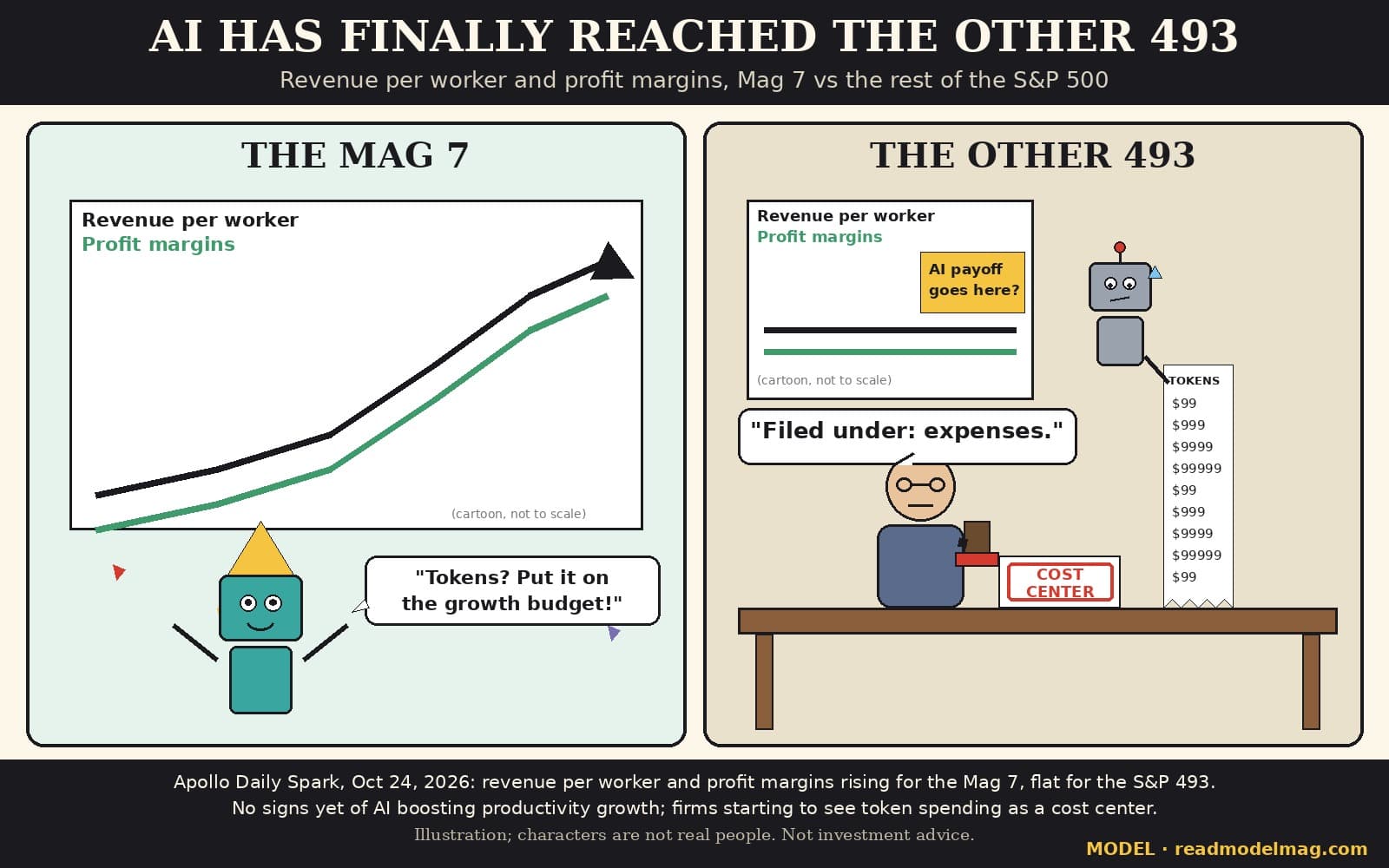
The AI boom has a clear winner column and, so far, a very quiet everyone-else column. That is the point of Saturday's Daily Spark from Apollo's chief economist, titled "No Signs of AI Payoff Outside the Tech Sector."
What Apollo said. The note, dated October 24, 2026, says that despite massive investment and hype, AI "has delivered zero financial payoff to corporate America outside of tech." Its five charts make three points:
- Revenue per worker is rising for the Magnificent 7 but is flat for the S&P 493, the other companies in the S&P 500 (inflation-adjusted to Q4 2019; Bloomberg and Macrobond data).
- Profit margins are rising for the Mag 7 and flat for the S&P 493.
- There are still no signs of AI boosting productivity growth, using the San Francisco Fed's utilization-adjusted total factor productivity series.
The last two charts use Ramp AI Index data on business AI adoption and spending. Apollo's read: VC-backed companies keep spending more on tokens, but "mainstream corporate America does not need the latest model and is unwilling to pay for it," and is "starting to view token spending not as a source of growth but as a cost center that weighs on margins." Its bottom line: "the AI story will be decided in the S&P 493, not the Mag 7."
The other side. Economist Brad DeLong, sharing the charts the same day, cautions that measured GDP and non-tech profits may not be where AI's effects show up first. He points to surplus going to users, new companies entering, and big platforms using AI to lock customers in, none of which would lift S&P 493 margins.
Our take. The joke writes itself: the Mag 7 put tokens on the growth budget, and everyone else's accountant put them under expenses. The useful part for anyone selling AI tools to big companies is that the buyer outside tech is asking a plain question, "what did this do to revenue or margins?", and today's charts say the answer isn't visible yet in the aggregate. That can change, and aggregate data lags. It is a market-wide average, not a verdict on any single company.
What we did and didn't do: we read Apollo's note and chart notes and DeLong's post on October 24, 2026. We did not check the underlying Bloomberg, Macrobond or Ramp data ourselves. Not investment advice. Not sponsored; no affiliate links.
MODEL Editors
Sources
- No Signs of AI Payoff Outside the Tech Sector (The Daily Spark, Oct 24, 2026)
Apollo Global Management
- Torsten Slok Beats the AI-Bear Drum: Charts of the Day (Oct 24, 2026)
Brad DeLong, Grasping Reality
Not investment advice.
FREE · EVERY WEEK
The top AI tools this week, tested.
Every week MODEL's editors pick the AI tools worth your time, try them hands-on, and tell you what's good, what's not, and who it's for. Free, in your inbox.
Free. Unsubscribe anytime. Our picks are editorial and can't be bought.
The weekly three is editorial. A subscription does not buy a place in it.
Continue
Markets
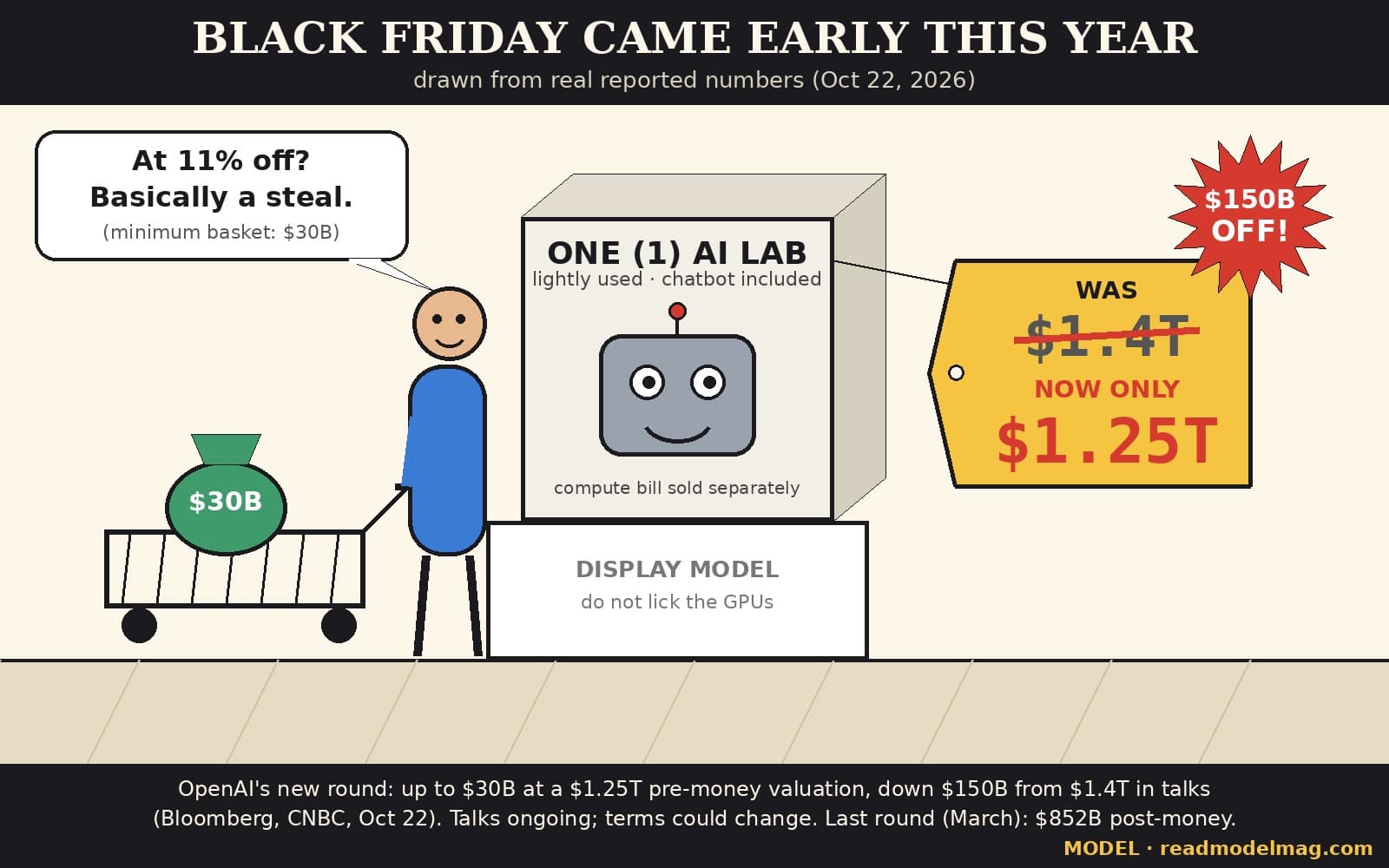
OpenAI is now $150 billion off. Only $1.25 trillion.
OpenAI is reportedly close to raising up to $30 billion at a $1.25 trillion pre-money valuation, down from the $1.4 trillion it was discussing a month ago. It would still be the most valuable private company ever.
· MODEL Editors
Markets
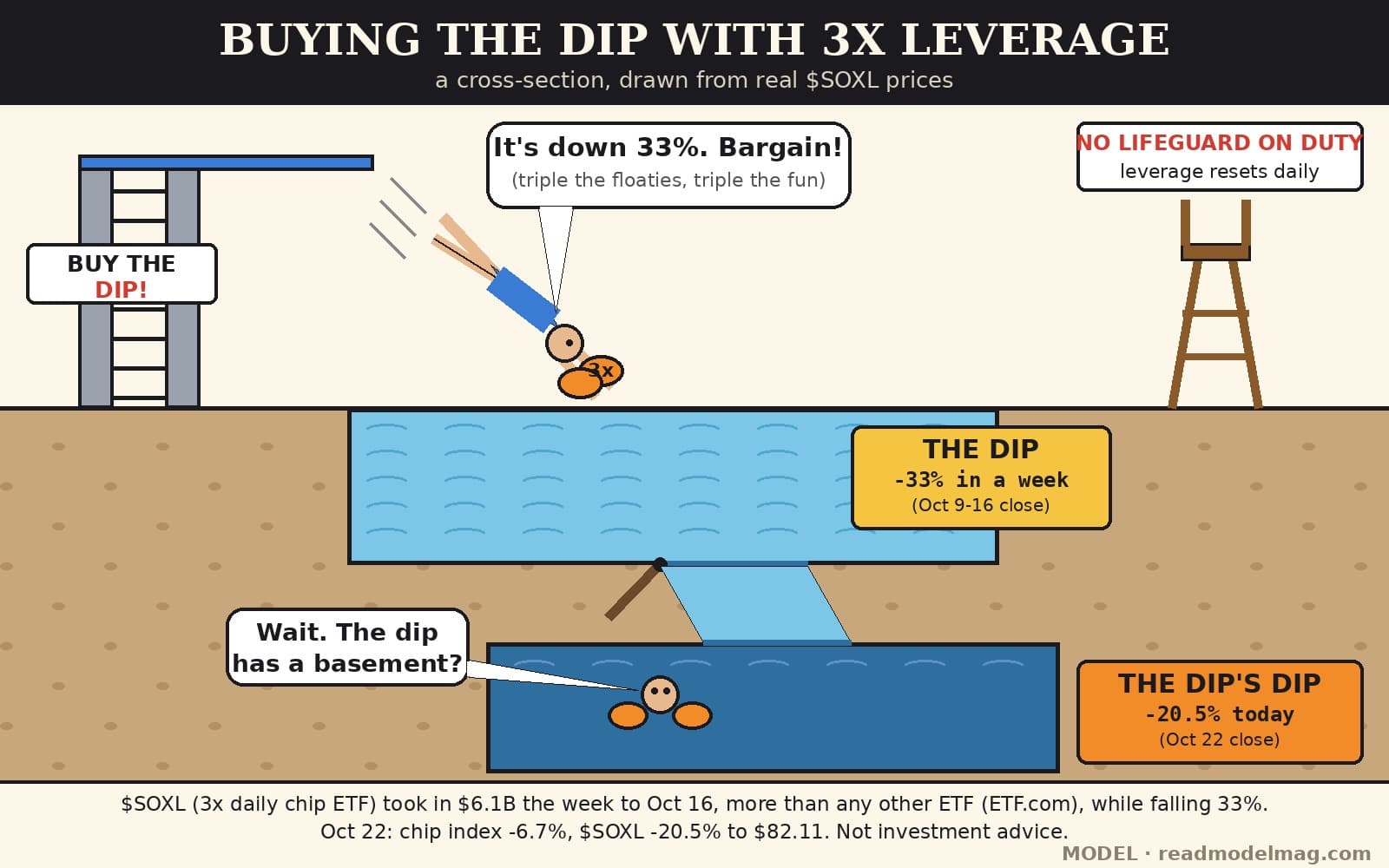
Retail bought the chip dip with 3x leverage. The dip had a basement.
The 3x leveraged chip ETF SOXL pulled in $6.1 billion in the week to October 16, more than any other ETF, while falling 33%. On October 22 chip stocks had their worst day since June and SOXL dropped another 20.5%.
· MODEL Editors
Markets
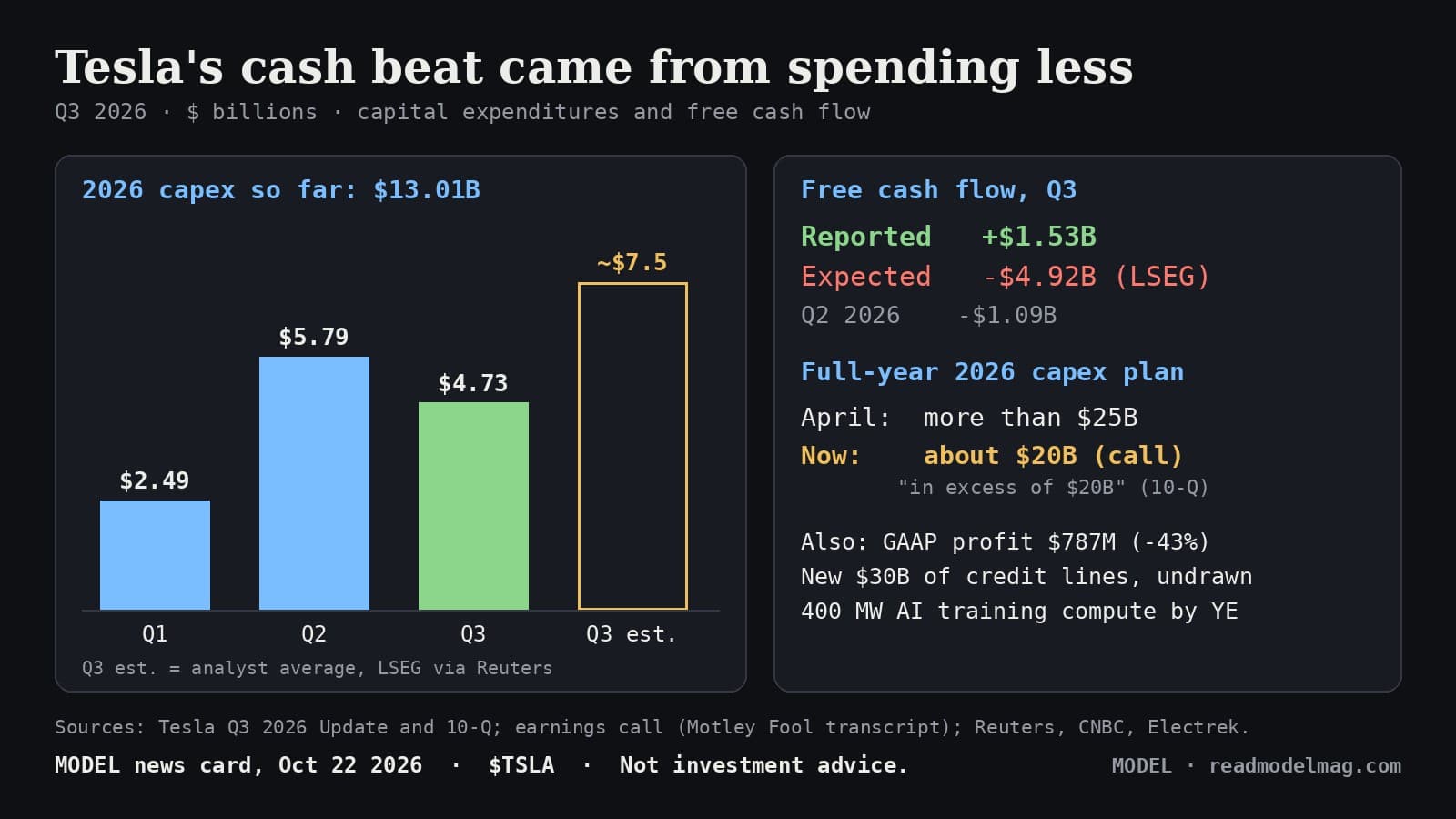
Tesla's cash-flow beat came from spending less on AI than planned
Tesla reported $1.53 billion of free cash flow when analysts expected a $4.92 billion burn. The reason: it spent $4.73 billion on capital projects, not the roughly $7.5 billion expected, and cut its 2026 spending plan from more than $25 billion to about $20 billion.
· MODEL Editors