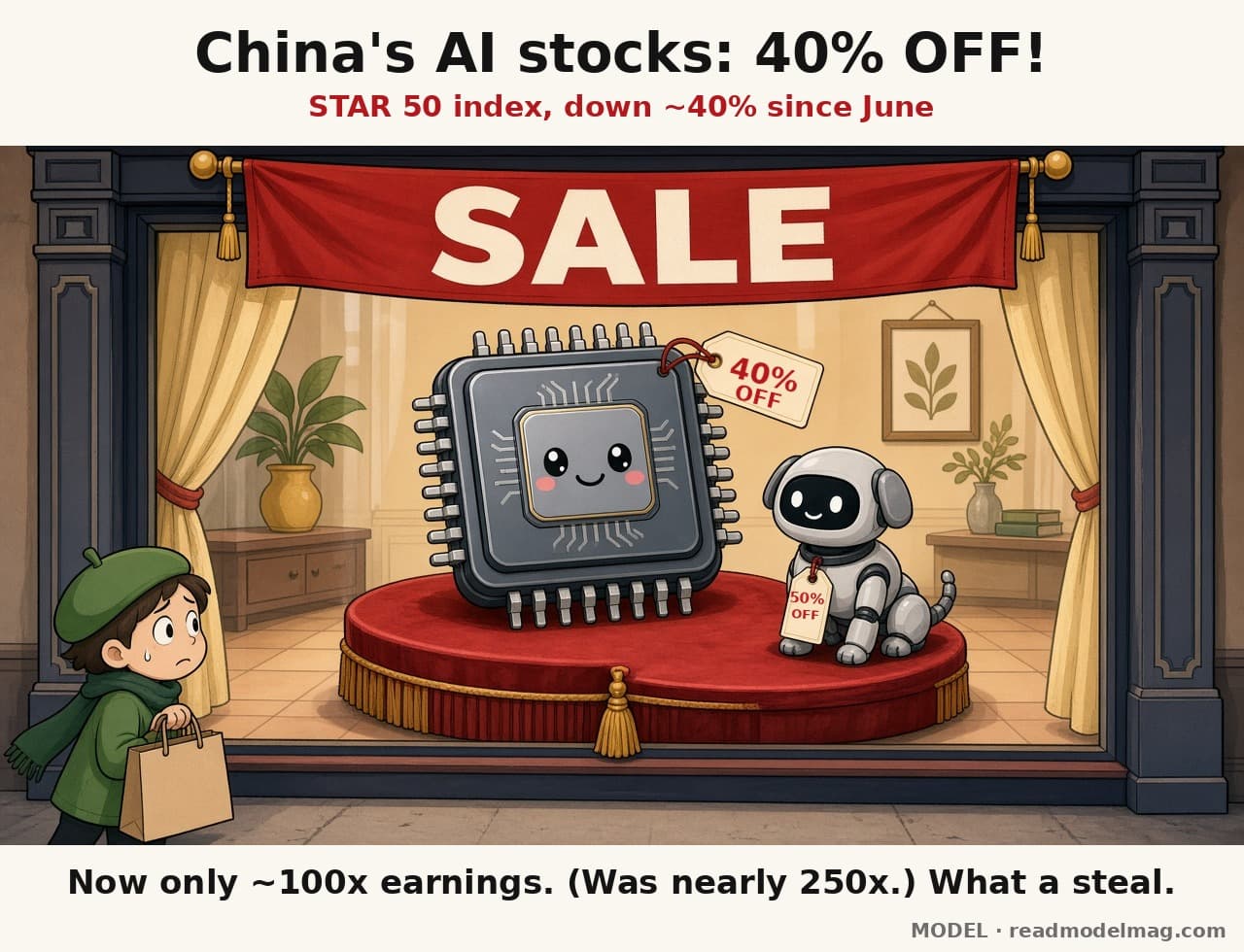
China's AI stocks are 40% off. They still cost about 100 times earnings.
SummaryThe STAR 50 index of Chinese AI and chip leaders has fallen about 40% since June, wiping out roughly $480 billion, Reuters reports. Even after the drop it trades near 100 times trailing earnings.
· MODEL Editors · 2 min read
Some links may be affiliate links. Disclosure
China's AI stock boom ran hotter than anything in the US. Now it has cooled faster too.
The drop. The STAR 50, the Shanghai index of AI and semiconductor leaders, has fallen about 40% in less than four months from its June high, erasing some $480 billion in market value, Reuters reported on October 26. The blue-chip CSI 300 is down about 20% from its June peak, which technically put it in a bear market last week, per the South China Morning Post. State-backed funds have stepped in to try to slow the losses, the Post reported.
Who got hit. According to Reuters:
- Robot maker Unitree, whose share offering was 8,000 times oversubscribed by retail buyers, has halved since it started trading in August.
- Chipmakers MetaX Integrated Circuits and Moore Threads Technology, which jumped 700% and 400% on their debuts last year, have both halved since July.
- Optical parts makers Zhongji Innolight and Eoptolink Technology are down roughly 60% from their June and July highs, partly as Washington moves toward banning them from supplying US data centers.
- Memory maker CXMT lost more than a quarter of its value in the past month.
Why it matters beyond China. AI stocks make up 42% of market value and 57% of trading across mainland A-shares and Hong Kong H-shares, per Goldman Sachs figures cited by Reuters, so most small investors there are exposed. Traders pointed to high prices, tax bills and the threat of bans on Chinese equipment in foreign data centers; Reuters found no single trigger.
The "sale" price. Even after the fall, the STAR 50 trades at around 100 times trailing earnings, down from a high of nearly 250, compared with about 30 times for the Nasdaq 100, Reuters said. Morgan Stanley expects onshore and offshore Chinese stocks could fall another 10% to 15% before they bottom, the SCMP reported. US AI stocks have had what Reuters called "a mere prick" by comparison: the Nasdaq is about 6% below the record high it set three weeks ago.
Our take. A 40% markdown sounds like a clearance sale until you read the price tag. At about 100 times earnings, investors are still paying for a lot of future AI profit that hasn't shown up yet. Not investment advice.
Sources
- Analysis: In China, the AI bubble has already burst (Oct 26, 2026)
Reuters via Investing.com
- Chinese markets lose trillions as race for AI supremacy with US takes its toll (Oct 27, 2026)
The Guardian
- China stock sell-off could erase another 15% in value, Morgan Stanley says (Oct 27, 2026)
South China Morning Post
Not investment advice.
FREE · EVERY WEEK
The top AI tools this week, tested.
Every week MODEL's editors pick the AI tools worth your time, try them hands-on, and tell you what's good, what's not, and who it's for. Free, in your inbox.
Free. Unsubscribe anytime. Our picks are editorial and can't be bought.
Continue
AI News
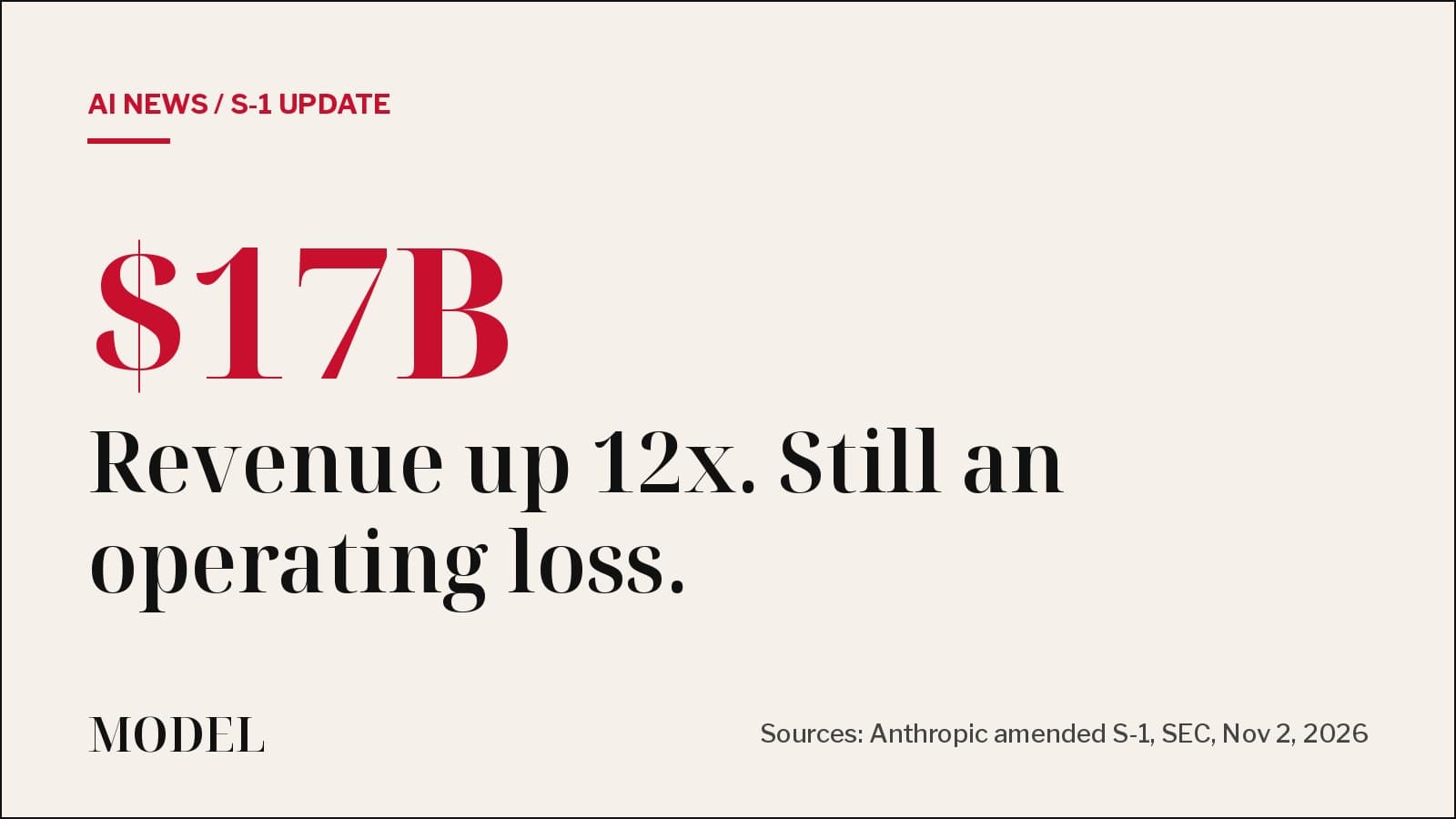
Anthropic made $17 billion last quarter and still posted an operating loss. The compute bill is why
Anthropic's amended S-1, filed November 2, adds its third-quarter numbers: revenue up about 12x from a year earlier, a swing back to an operating loss, and $895.4 billion in compute and infrastructure commitments.
· MODEL Editors
Funding
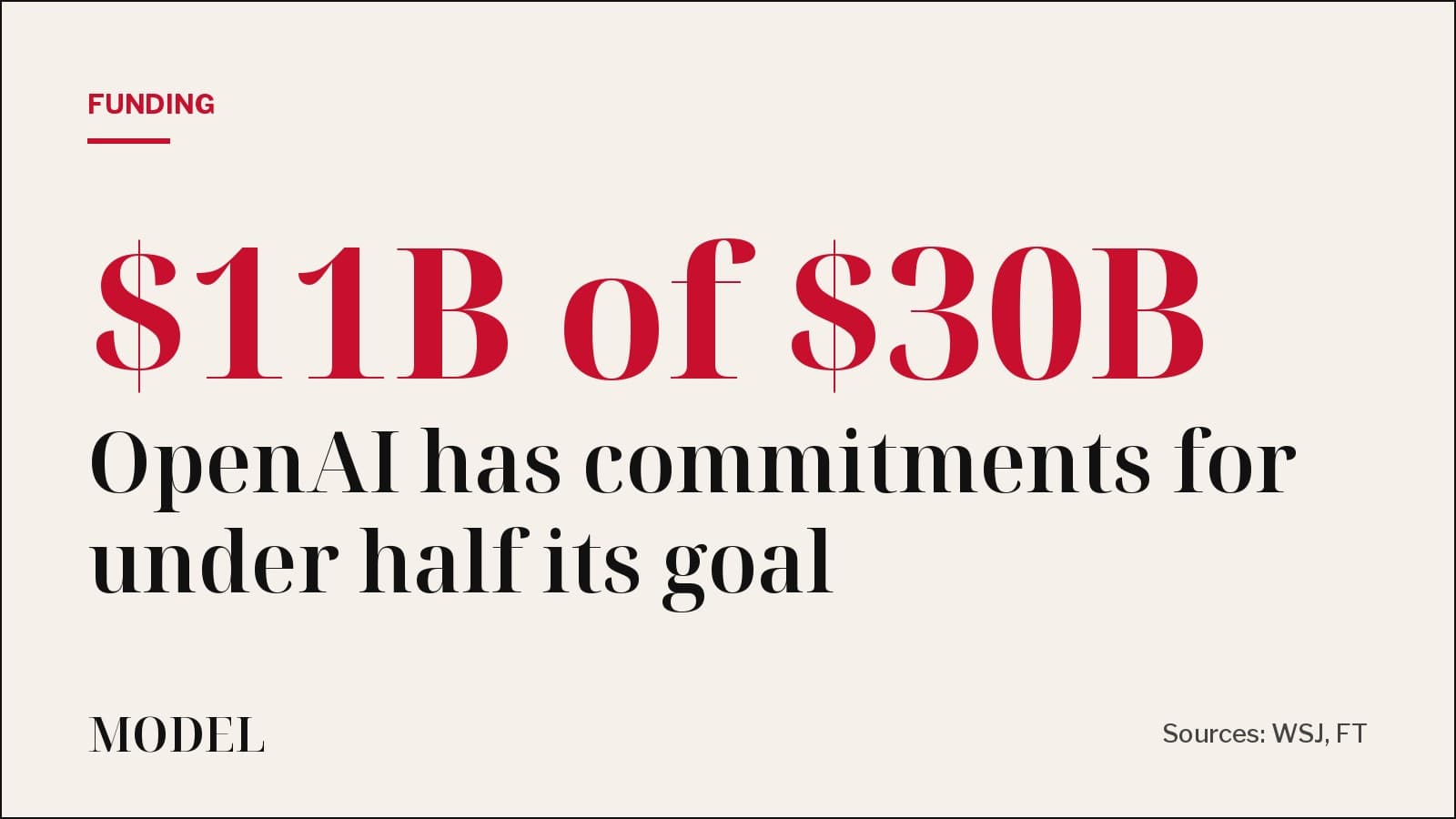
OpenAI wanted $30 billion. So far it has about $11 billion.
OpenAI has commitments for roughly $11 billion in its latest round, less than half its first target, at a $1.25 trillion valuation instead of $1.4 trillion, according to the Wall Street Journal. The Financial Times reports the goal is now about $20 billion.
· MODEL Editors
Funding
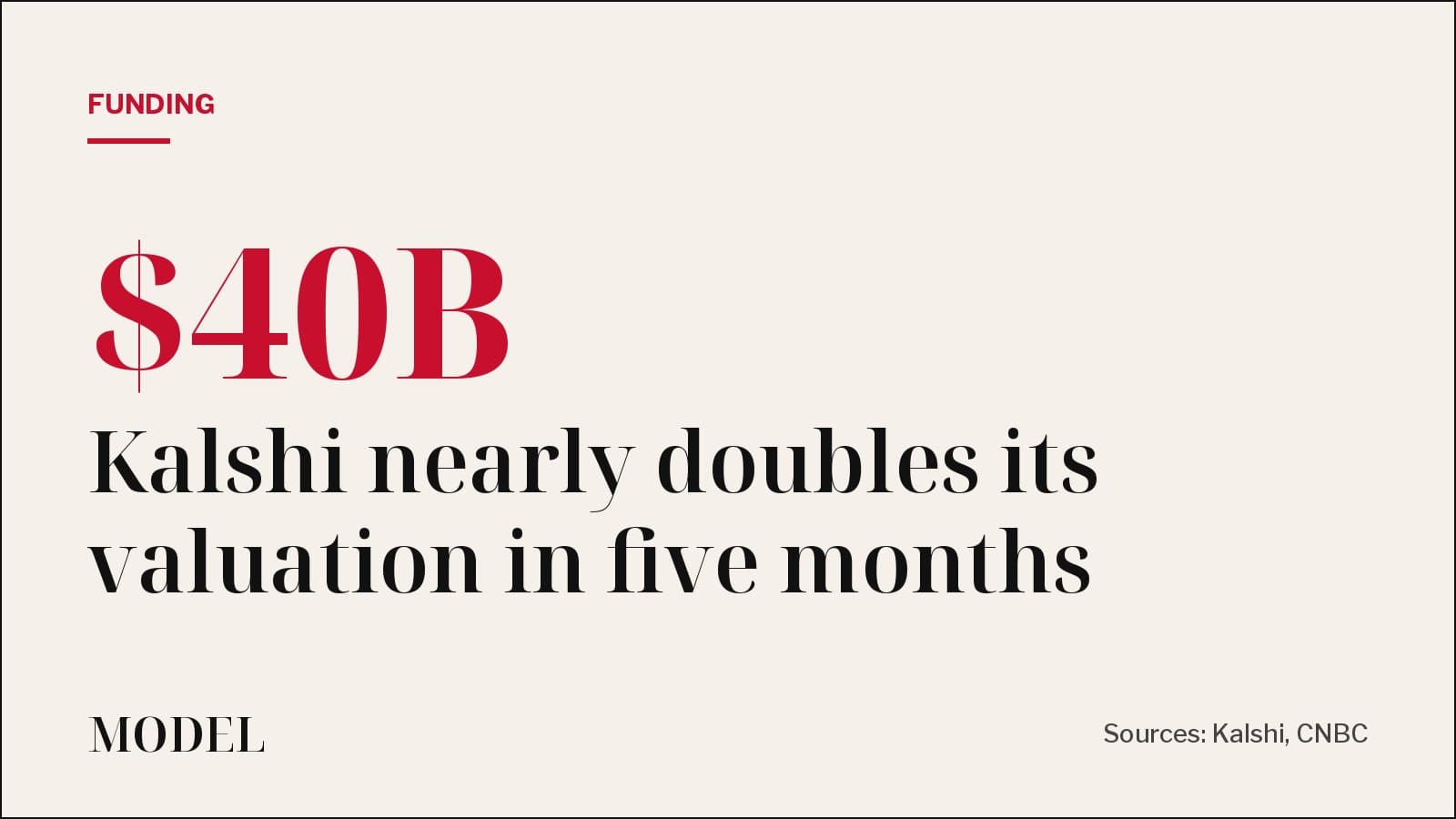
Kalshi raises $1 billion at a $40 billion valuation, up from $22 billion in May
The prediction-market company's Series G was co-led by Sequoia and Wellington. Kalshi says it will use the money for indices, single-stock perpetual futures and markets on the price of compute.
· MODEL Editors