Claude Code's "How is Claude doing?" prompt only sends a rating. The question after it can send your code
SummaryAnthropic's page on whether your data is used for training hit the Hacker News front page today. The Claude Code docs spell out what each feedback click actually sends, and for how long it's kept. Here's the short version, and the one setting that turns the survey off.
· MODEL Editors · 3 min read
Some links may be affiliate links. Disclosure
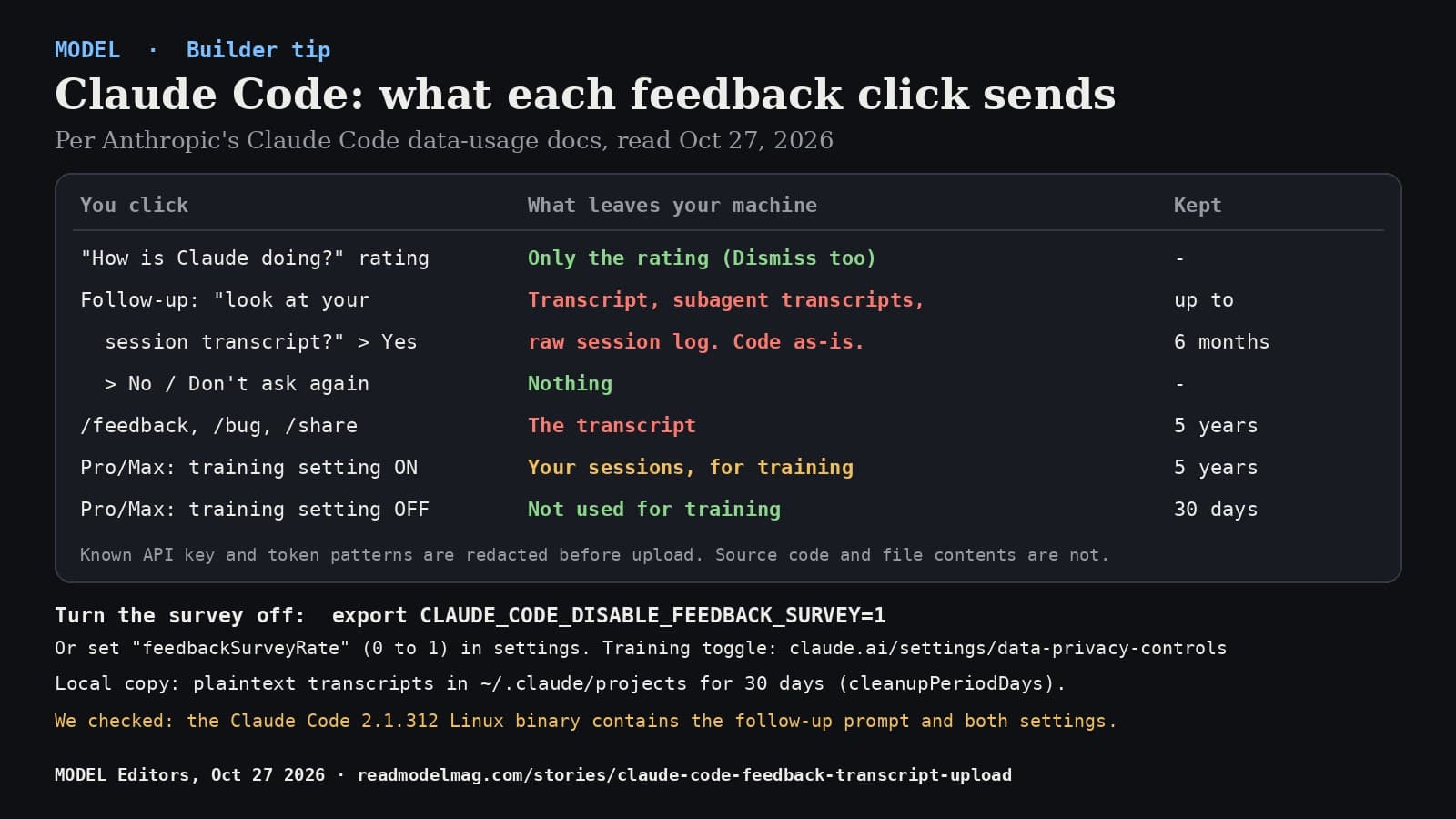
Anthropic's help page "Is my data used for model training? (opens in a new tab)" reached the Hacker News front page today. Most of the thread is about the thumbs up and thumbs down buttons. One commenter asked the question that matters for anyone running Claude Code: does answering the "How is Claude doing this session?" prompt count too?
Anthropic's Claude Code data-usage docs (opens in a new tab) answer it, and the answer has two parts.
The rating itself sends only the rating. Per the docs, responding to "How is Claude doing this session?", including picking Dismiss, "records only your rating." No transcript goes with it.
The follow-up is different. After the rating you may see a second question: "Can Anthropic look at your session transcript to help us improve Claude Code?" If you pick Yes, Claude Code uploads your conversation transcript, any subagent transcripts and the raw session log file from disk. The docs say known API key and token patterns are redacted first, but "Source code, file contents, and other conversation content are uploaded as-is." Shared transcripts are kept for up to six months. Anthropic says these survey answers don't change your training preferences and can't be used to train its models. No sends nothing, and Don't ask again stops the follow-up in future sessions. On Amazon Bedrock, Google Cloud's Agent Platform, Microsoft Foundry and signed-in Claude apps gateway sessions, Yes writes the bundle to ~/.claude/feedback-bundles/ instead of uploading it.
The slash commands keep things longer. Transcripts you send with /feedback, /bug or /share go through the same path and are kept for five years.
Your plan matters more than any click. On Free, Pro and Max, Anthropic trains new models on your data when the setting that lets your data improve future Claude models is on, "including when you use Claude Code from these accounts," and keeps it for five years. With the setting off, retention is 30 days. You can check it at claude.ai/settings/data-privacy-controls. On Team, Enterprise, the API and third-party platforms, Anthropic says it doesn't train on your Claude Code prompts or code unless your organization opts in, for example through its Development Partner Program. Even on commercial plans, the privacy page says a thumbs up or down in Claude stores the whole conversation for up to five years and may be used for training.
Turn the survey off. Set this in your shell profile:
export CLAUDE_CODE_DISABLE_FEEDBACK_SURVEY=1
The survey also stays off when DISABLE_TELEMETRY, DO_NOT_TRACK or CLAUDE_CODE_DISABLE_NONESSENTIAL_TRAFFIC is set. If you just want it less often, set feedbackSurveyRate in your settings file to a number between 0 and 1.
And don't forget the copy on your own disk. Claude Code keeps session transcripts in plaintext under ~/.claude/projects/ for 30 days by default so you can resume them. Change that with cleanupPeriodDays. If a secret ever lands in a session, it's sitting in that folder too.
What we checked. We downloaded Claude Code 2.1.312, the current release on npm today, for Linux x64 and confirmed it reports that version. Its binary contains the follow-up question word for word, the CLAUDE_CODE_DISABLE_FEEDBACK_SURVEY variable, the feedbackSurveyRate setting (described in the binary as a probability from 0 to 1) and the feedback-bundles path. We didn't sign in, run a session or watch network traffic, so what's uploaded and how long it's kept come from Anthropic's docs, not our own test.
Our take
Rate sessions if you like; that's harmless. Read the second question before you click Yes, because Yes ships your code as-is. If you work on code you can't share, set CLAUDE_CODE_DISABLE_FEEDBACK_SURVEY=1, skip /bug on sensitive sessions, and check your training setting if you're on Pro or Max.
Sources: Anthropic's Claude Code data-usage docs and Privacy Center, read October 27, 2026; the Claude Code 2.1.312 package from npm. Not sponsored; no affiliate links.
MODEL Editors
Sources
- Data usage
Claude Code documentation (Anthropic)
- Is my data used for model training?
Anthropic Privacy Center
- @anthropic-ai/claude-code 2.1.312
npm
- Hacker News discussion (item 50259406)
Hacker News
FREE · EVERY WEEK
The top AI tools this week, tested.
Every week MODEL's editors pick the AI tools worth your time, try them hands-on, and tell you what's good, what's not, and who it's for. Free, in your inbox.
Free. Unsubscribe anytime. Our picks are editorial and can't be bought.
Continue
Tool Update
OpenAI's Tibo: dots are getting GPT-6 Astra, GPT-6.1 Terra, and more
OpenAI's Tibo Sottiaux said the team is expanding the frontier models that power ChatGPT dots beyond today's Astra-only setup, adding GPT-6.1 Terra for speed and personality so more people can get a dot. Your dot will pick the model. It hasn't shipped yet.
· MODEL Editors
Hot Take
Hot take: sloppy AI code is a checking problem, not a model problem
Anthropic says Claude wrote the Rust port of its Messages API, starting with no Rust developers on the team, and that the safety net was shadow traffic, not line-by-line review. The same week, Veracode found about 4 in 10 AI coding tasks still produce code with a known vulnerability. Here is what was actually said, what the viral version gets wrong, and our take.
· MODEL Editors

Tool Update
Notion's week: its agent now makes Excel, Word, PowerPoint and PDF files, and edits say which agent did them
Notion's Halloween recap bundles four updates from Oct 27 to 30: an agent that builds real office files, speaker labels for Google Meet notes, bigger automatic offline downloads, and a 'Last edited by' label that names the agent or MCP client behind a change. Here is what each one does, and what Notion hasn't said.
· MODEL Editors