Claude for Legal gets a gallery of ready-made legal artifacts
SummaryAnthropic added a gallery of interactive legal tools to Claude for Legal: six of its own, such as cite check, tabular review and a regulatory horizon scan, four built by Goodwin, Harvey, Foley & Lardner and PwC, and nine access-to-justice tools. Each opens with an example, and Claude does the first pass for a lawyer to check.
· MODEL Editors · 3 min read
Some links may be affiliate links. Disclosure
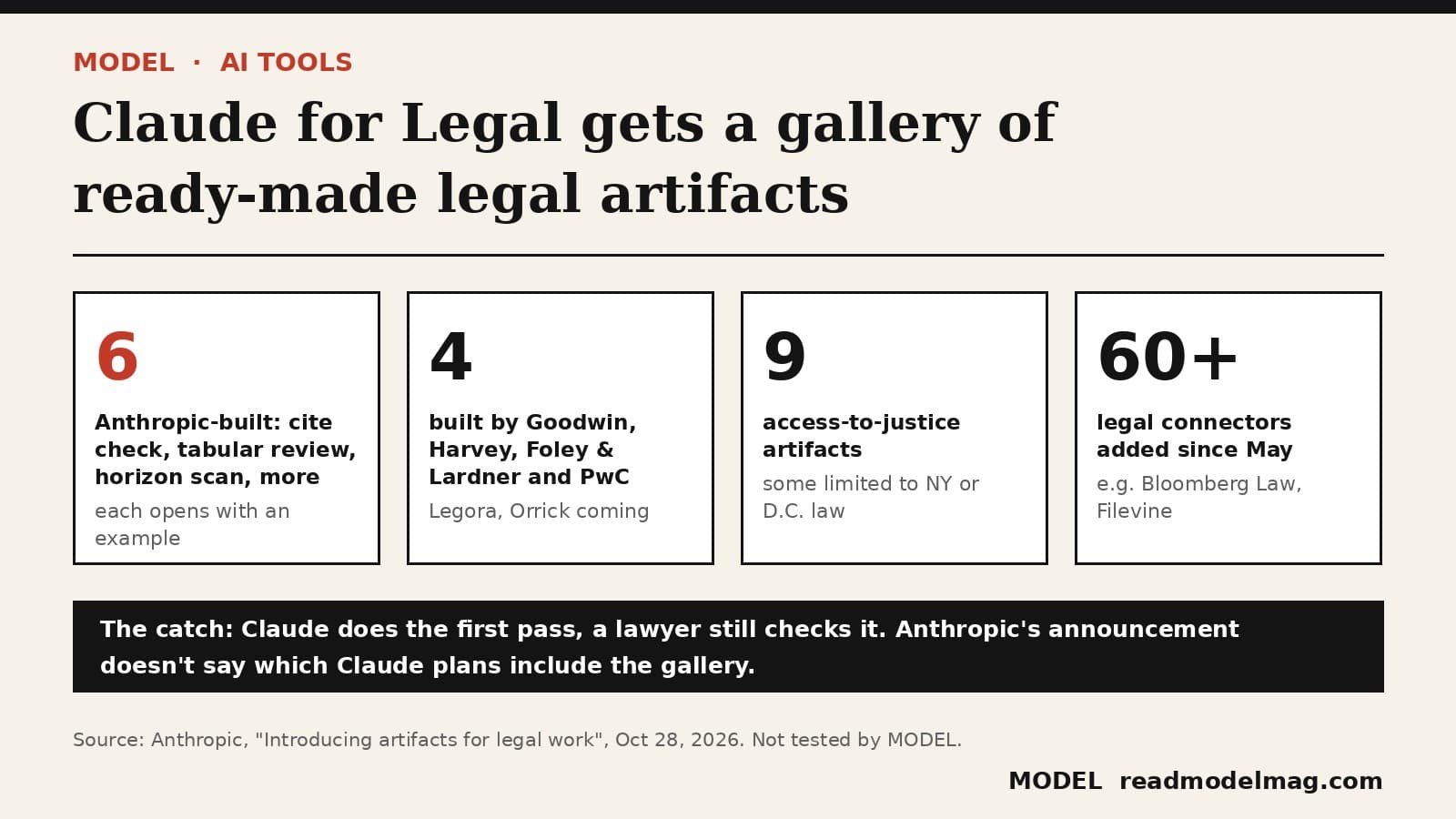
Anthropic announced on October 28 that Claude for Legal, the legal product it launched in May, now has a gallery of ready-to-use "artifacts." Artifacts are interactive tools, such as trackers and dashboards, that run and get shared inside Claude. Anthropic says the most common requests from legal teams since May were simpler setup and easier ways to work with colleagues.
How it works. Each artifact opens with a built-in example, so you can see the workflow before adding your own documents and connectors. You can ask Claude to tailor an artifact to your team, and Anthropic says every answer or output links to its source. In Anthropic's words, the lawyer brings the documents and sources, "Claude completes the first pass, and a lawyer applies their judgment to the results."
The six Anthropic-built artifacts.
- Cite check compares a legal document with its sources and flags quotes that don't match, wrong page numbers and sources that don't support the claim.
- Jurisdiction survey matrix compares one legal topic, such as data breach notice rules, across states or countries in one table, linked to the underlying law.
- Matter board turns engagement letters, emails or spreadsheets into one board of open matters with owner, next step and next deadline.
- Playbook deviation board compares contracts with your standard terms, flags each clause that differs and sends it to the person who approves exceptions.
- Regulatory horizon scan puts upcoming regulations on a timeline based on what your company does and where it operates, ranked by impact, with links to sources.
- Tabular review builds a table from a set of contracts for the terms you ask about, such as severance or non-competes, linked to the exact language.
Built by others. Four artifacts come from partners: an AI Governance Benchmark from Goodwin, Harvey Intake from Harvey (routes legal questions from business users, answering routine ones from Legal's own guidance in Harvey), an Obligations Checker from Foley & Lardner, and a Subpoena Response Tool from PwC. Anthropic says more are coming from Legora and Orrick.
Access to justice. The gallery also has nine access-to-justice artifacts, five built by nonprofit and public interest groups that Anthropic supported with Claude credits. Some are tied to one place: Zealous's Criminal Charge Reality Check is New York only, and Rising for Justice's Rent Ledger Reviewer and Record-Sealing Screener are based on D.C. law. Anthropic is also starting a Legal Ambassadors Program, with a waitlist.
Connectors and sharing. Anthropic says it has added more than 60 legal connectors since May, including Bloomberg Law, Filevine, Ivo, Legora and Patlytics, so teams can pull in playbooks and research sources instead of uploading files. Artifacts can be shared with colleagues, clients and partners, with sharing settings Anthropic says support privacy and ethical walls between teams.
Who it's for. In-house legal teams and law firms that already use Claude and want a structured starting point for repeat work (contract review, regulatory tracking, intake) instead of a blank chat.
The catch.
- It is a first pass, not an answer. Anthropic's own framing puts the lawyer in charge of the result, and source links only help if someone clicks them.
- The announcement doesn't say which Claude plans include the gallery; it is filed under Claude Enterprise, and for rollouts Anthropic points to its sales team and implementation partners.
- Anthropic's legal page says it doesn't train on your content by default on Team and Enterprise plans. If you are on another plan, check your data settings before you add client documents.
- Partner artifacts such as Harvey Intake work with that partner's product (Harvey Intake answers from Legal's guidance in Harvey).
Our take. This is the right shape for legal AI: narrow tools with an example, a table and a source link on every cell, rather than "ask the chatbot." Cite check is the one we'd try first, because a wrong quote or page number is easy to verify and expensive to miss.
What we did and didn't do: we read Anthropic's October 28, 2026 announcement, its Claude for Legal page and the @claudeai post. We have not used the gallery or any of the artifacts. Not sponsored; no affiliate links.
Sources
- Introducing artifacts for legal work
Anthropic (Claude blog)
- Claude for legal teams
Anthropic
- New in Claude for Legal: a gallery of ready-made artifacts
@claudeai on X
FREE · EVERY WEEK
The top AI tools this week, tested.
Every week MODEL's editors pick the AI tools worth your time, try them hands-on, and tell you what's good, what's not, and who it's for. Free, in your inbox.
Free. Unsubscribe anytime. Our picks are editorial and can't be bought.
Continue
Tool Update
OpenAI's Tibo: dots are getting GPT-6 Astra, GPT-6.1 Terra, and more
OpenAI's Tibo Sottiaux said the team is expanding the frontier models that power ChatGPT dots beyond today's Astra-only setup, adding GPT-6.1 Terra for speed and personality so more people can get a dot. Your dot will pick the model. It hasn't shipped yet.
· MODEL Editors
Hot Take
Hot take: sloppy AI code is a checking problem, not a model problem
Anthropic says Claude wrote the Rust port of its Messages API, starting with no Rust developers on the team, and that the safety net was shadow traffic, not line-by-line review. The same week, Veracode found about 4 in 10 AI coding tasks still produce code with a known vulnerability. Here is what was actually said, what the viral version gets wrong, and our take.
· MODEL Editors
Tool Update
Notion's week: its agent now makes Excel, Word, PowerPoint and PDF files, and edits say which agent did them
Notion's Halloween recap bundles four updates from Oct 27 to 30: an agent that builds real office files, speaker labels for Google Meet notes, bigger automatic offline downloads, and a 'Last edited by' label that names the agent or MCP client behind a change. Here is what each one does, and what Notion hasn't said.
· MODEL Editors