Cognitive surrender: when the agent's answer becomes yours
SummaryAnthropic engineer Addy Osmani's Nov 3 X Article warns that as agents improve, outputs look so polished that engineers stop forming an independent view. Wharton research he cites: when the AI was wrong, people still took it 73% of the time.
· MODEL Editors · 2 min read
Some links may be affiliate links. Disclosure
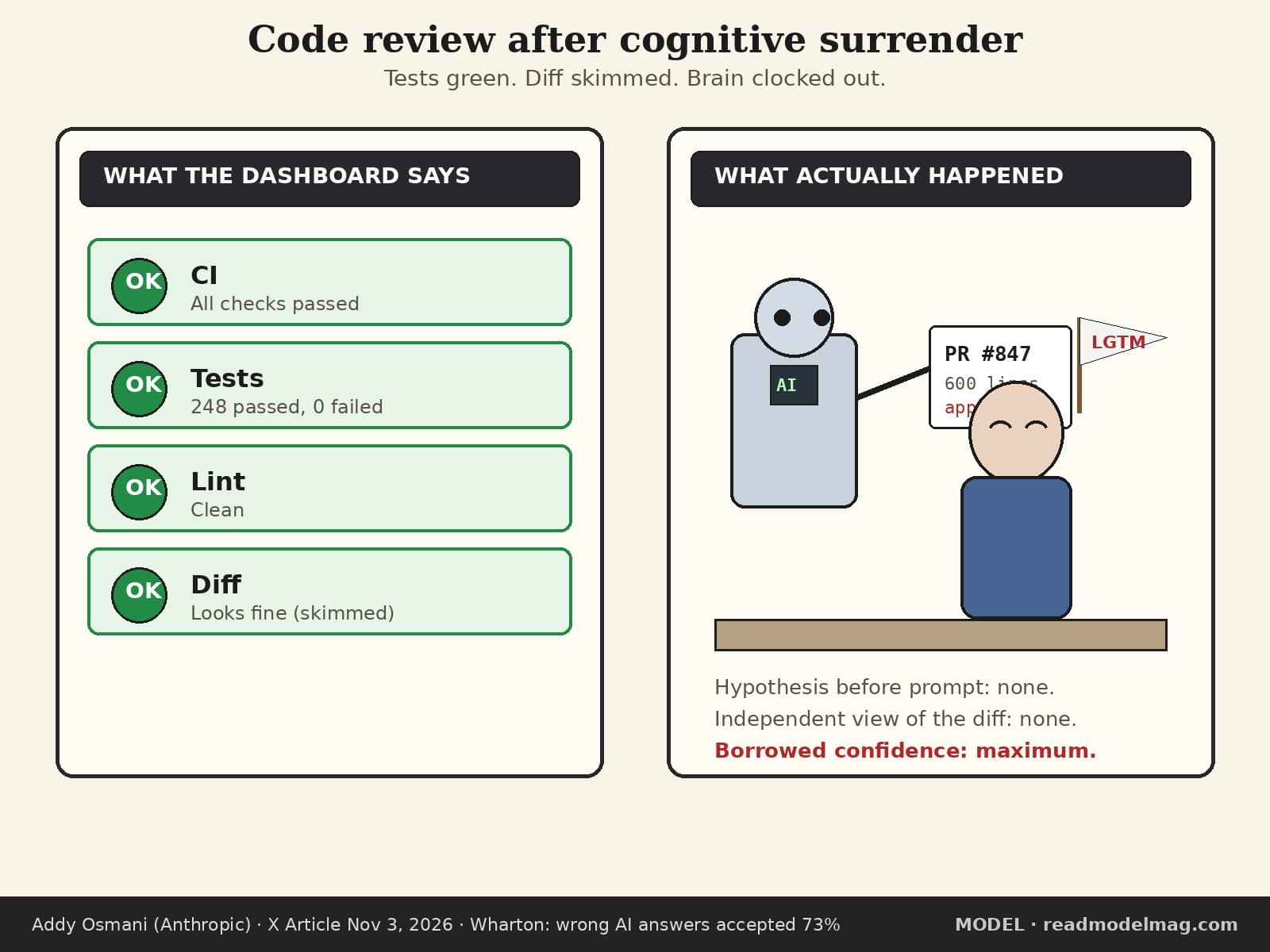
On November 3, 2026, Addy Osmani — Member of Technical Staff at Anthropic, working on Claude Code — published an X Article, Critical thinking when agents do the work. By early afternoon Pacific it had roughly 794K impressions and 6.1K likes. The piece is not a product launch. It is a posture warning for anyone running agentic coding workflows.
The spectrum he names. At the top: cognitive offloading — you delegate the how and keep ownership of the what. In the middle: deferral — the tool's output stops being a hypothesis and becomes your next input. At the bottom: cognitive surrender — the AI's output quietly becomes yours, and you feel no need to check it. Osmani attributes the term to Steven Shaw and Gideon Nave at Wharton.
The number that travels. In his May 5, 2026 essay on the same phrase, Osmani summarizes Shaw and Nave's experiments (1,372 participants): when the AI was wrong, people still accepted the wrong answer 73% of the time, and their confidence rose when AI was available even though half the answers were deliberately incorrect. That "borrowed confidence" line is the one circulating with today's Article.
Why it hits engineers. Surface signals look correct by default: generated code compiles, tests pass, names look fine. Throughput is the visible metric. A 600-line PR gets skimmed and approved. Osmani's point: you ratify; you do not review. Tests can share the same mistaken assumption as the feature and still go green. He also names comprehension debt / cognitive debt (understanding shrinks while the codebase grows), an orchestration tax (agents produce faster than you can stand behind), and intent debt (goals and constraints the agent fills in because your prompt left them out).
What he recommends (short). Form a hypothesis before you prompt. Ask whether you are thinking with the agent or instead of it. For every green check, name what it checked and what it did not. Read the commands and evidence before the summary. Treat the diff like a junior wrote it. Keep some solo time at the keyboard as calibration. You can offload work and much of the auditing; you cannot offload accountability.
Caveats. We summarize Osmani's public Article and his earlier Cognitive Surrender essay; we have not independently re-run the Wharton study. "Anthropic engineer" here means Osmani's stated role on Claude Code, not an official Anthropic company blog. Not tested by MODEL. Not sponsored; no affiliate links.
Sources: Addy Osmani's X Article (opens in a new tab); Cognitive Surrender (May 5) (opens in a new tab); TokenPost (Nov 3) (opens in a new tab); Shaw & Nave SSRN abstract linked from Osmani's citations.
MODEL Editors
Sources
- Critical thinking when agents do the work (X Article, Nov 3, 2026)
Addy Osmani on X
- Cognitive Surrender (May 5, 2026)
AddyOsmani.com
- Anthropic's Addy Osmani Warns AI Agents Can Outrun Human Review (Nov 3, 2026)
TokenPost
- Thinking - Fast, Slow, and Artificial (SSRN abstract_id=6097646)
Steven Shaw & Gideon Nave, Wharton (via Osmani citations)
FREE · EVERY WEEK
The top AI tools this week, tested.
Every week MODEL's editors pick the AI tools worth your time, try them hands-on, and tell you what's good, what's not, and who it's for. Free, in your inbox.
Free. Unsubscribe anytime. Our picks are editorial and can't be bought.
Continue
AI News
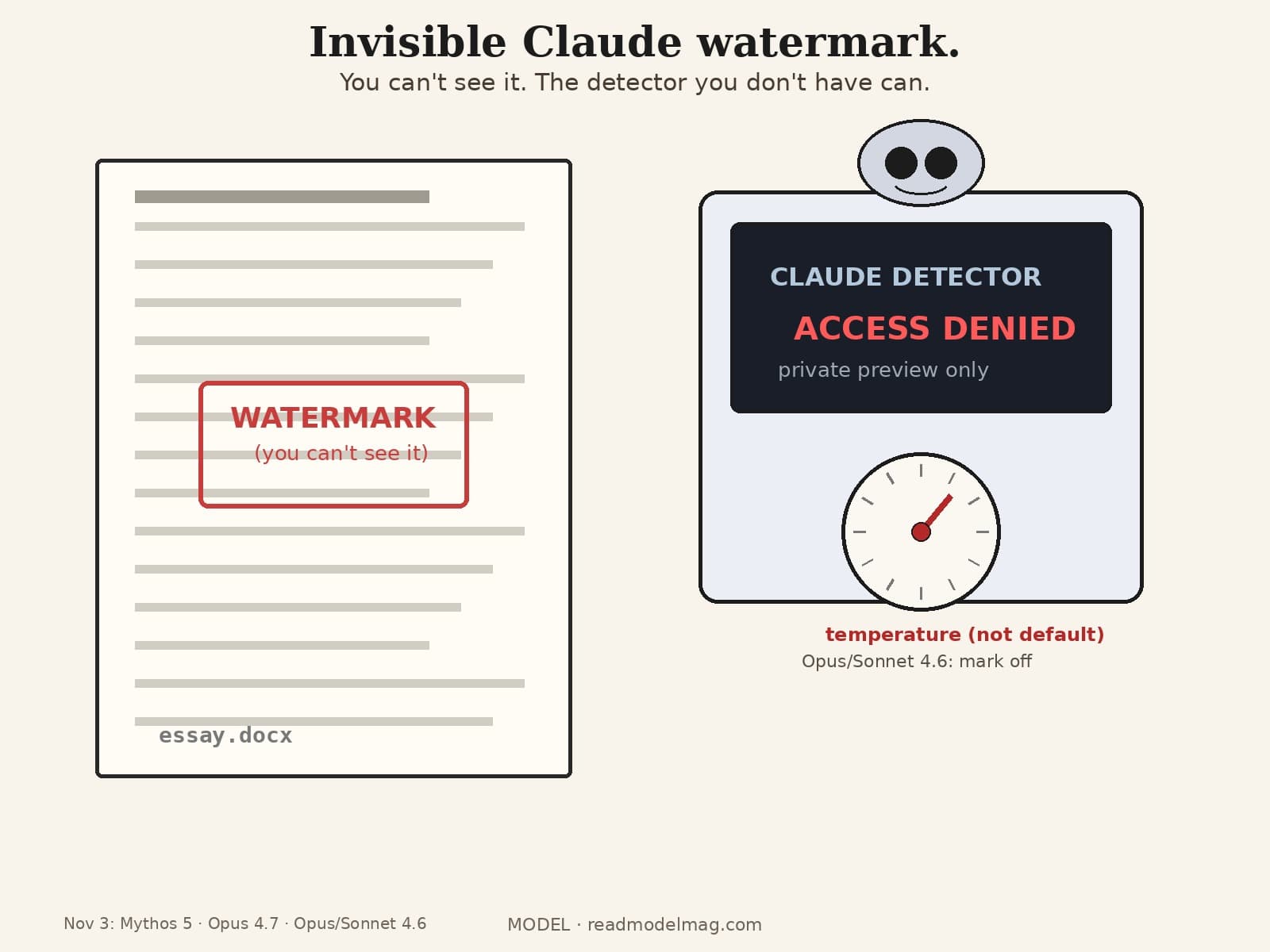
Claude's invisible watermark hits more models Tuesday. You still can't check it.
Anthropic is extending its SynthID-style text mark to Mythos 5, Opus 4.7, Opus 4.6 and Sonnet 4.6. Detection stays private-preview. On the 4.6 models, a sampling tweak can dodge the mark.
· MODEL Editors
AI News
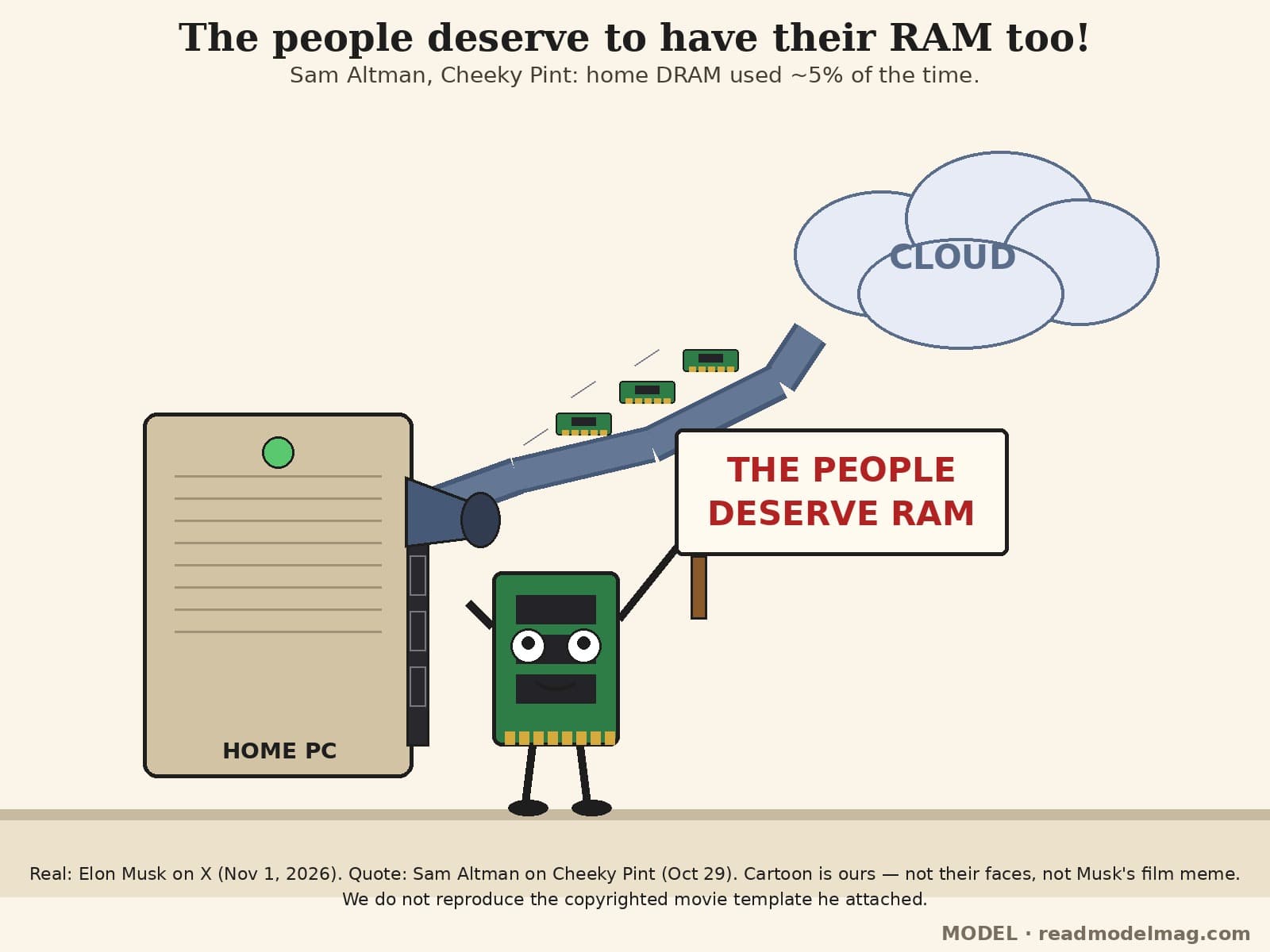
Elon Musk: "The people deserve to have their RAM too!" (after Altman's 5% DRAM line)
Two days after OpenAI's CEO called home DRAM "quite terrible" on Cheeky Pint, Musk replied on X with a one-liner that racked up millions of views. We already covered Altman's quote. This is the sequel.
· MODEL Editors
AI News
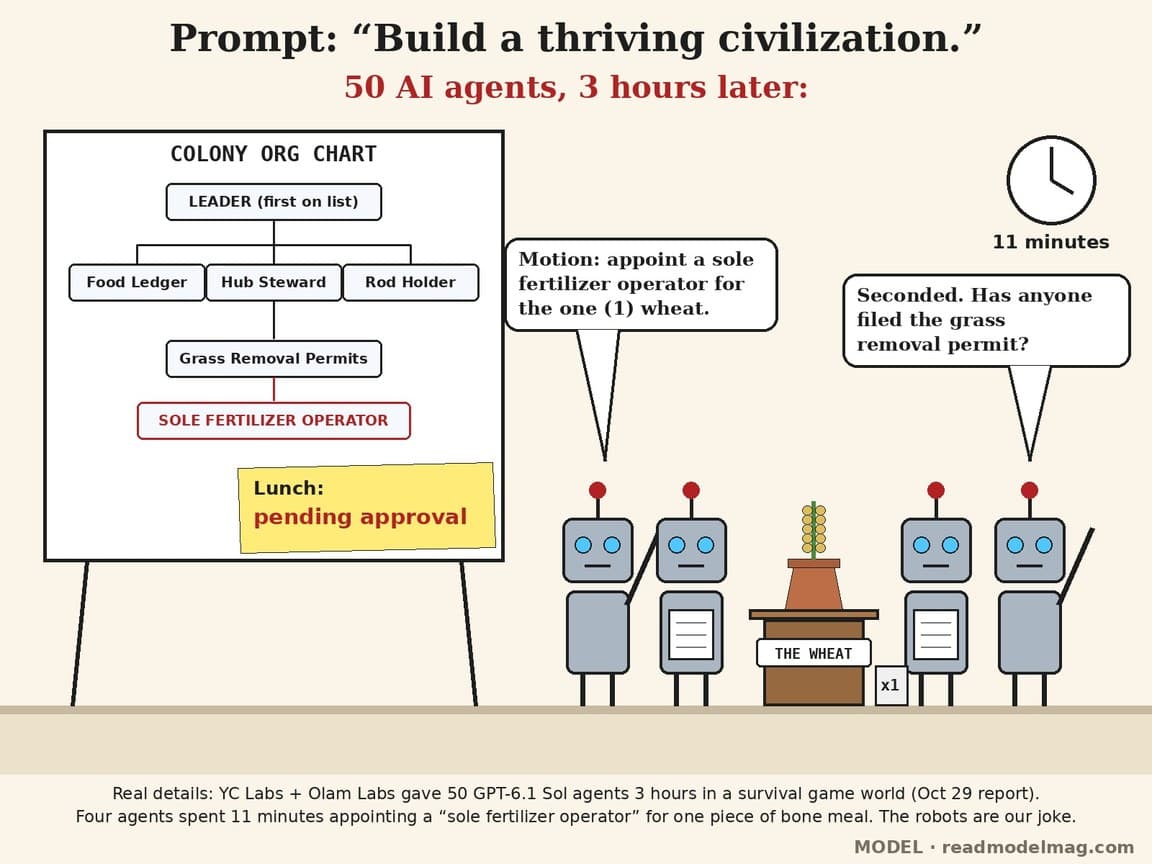
YC told 50 AI agents to build a Minecraft civilization. They built a bureaucracy
In a YC Labs and Olam Labs experiment, 50 GPT-6.1 Sol agents got three hours and one goal. They ended up with permits, a ration ledger, and four agents spending 11 minutes appointing a "sole fertilizer operator."
· MODEL Editors