DeepMind AI agents find two weaknesses in legacy 1024-bit RSA — 2048-bit and larger still fine
SummaryHuman-guided agents reproduced a 1024-bit signature-oracle root with 3.5× less CPU than the prior academic run, and a new batch factoring method cuts average cost per extra 1024-bit key by about 30×. Paper: does not threaten deployed 2048+ RSA.
· MODEL Editors · 1 min read
Some links may be affiliate links. Disclosure
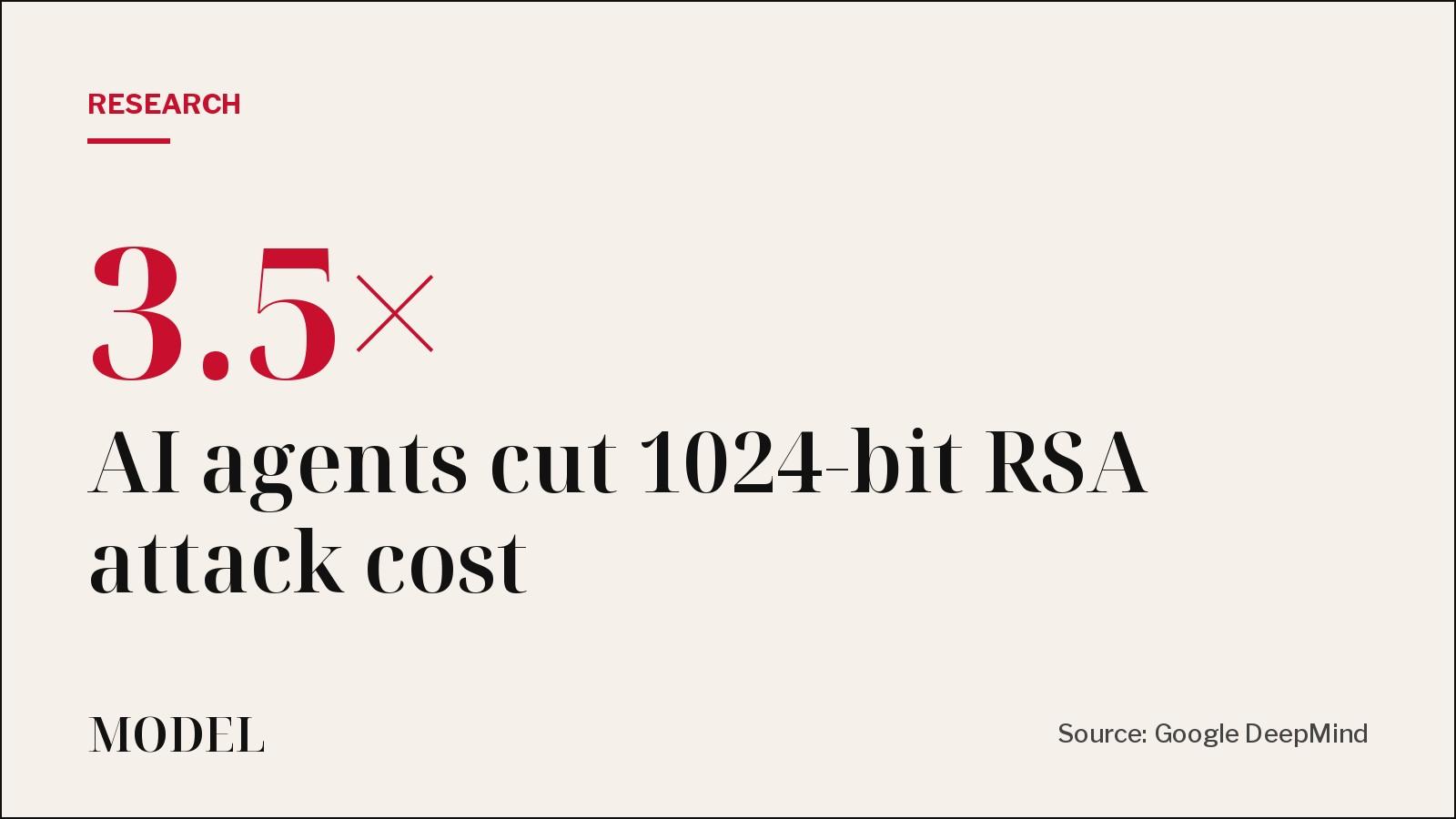
Google DeepMind published working papers showing that human-guided AI agents found two major weaknesses that affect legacy 1024-bit RSA cryptosystems — not modern 2048-bit and larger deployments. Pushmeet Kohli (VP Science) posted the explainer; co-authors include Dj Dvijotham and Abhradeep Thakurta, with collaborators Nadia Heninger (UCSD/Inria) and Emmanuel Thomé (Inria).
What the agents did. Two cooperating agents designed, ran, and debugged a 1024-bit computation (~33,500 new lines of code) in under about four days with roughly 20 human messages, peaking near 300k CPU cores.
Result 1 — signatures / padding. Once an attacker controls roughly half the signed block or more, PKCS-style padding adds no protection versus an unrestricted oracle. Agents reproduced a 1024-bit benchmark root with 3.5× less CPU time than the prior academic run (391 vs ~1,380 core-years) and under 1/1000 of the compute needed to break the key itself. For short 32-byte digests, a new algorithm improves about 1,600× (theoretical estimate) on 1024-bit.
Result 2 — batch factoring. A new algorithm cuts the average cost of factoring each additional 1024-bit key out of many by about 30× versus previous batch methods.
Who it's for: security researchers, crypto engineers measuring hardness, and anyone still running or auditing 1024-bit RSA.
Caveats (from the paper / posts). Results do not threaten deployed cryptosystems based on 2048-bit and larger RSA. The signature-oracle model assumes billions of chosen signing queries offline — not a casual internet attack. This is research, not a public product. MODEL has not tested it.
Disclosure: Not sponsored. No affiliate links. Not tested by MODEL.
MODEL Editors
Sources
- Faster Affine Root and a 1024-bit Computation (working paper PDF)
Google DeepMind
- Fan Factories (working paper PDF)
Google DeepMind
- DeepMind announcement
@GoogleDeepMind on X
- Pushmeet Kohli explains (X Article)
@Pushmeet on X
Keep reading

AI NEWS
Google Antigravity v2.29 rolls out Remote Agents: cloud VMs that keep working after you close the laptop
Agent sessions run in isolated Google-managed remote environments for Google AI Pro and Ultra (personal accounts, gradual rollout). Also: Voice mode, redesigned conversation page, Onyx theme. Not free / Plus / Workspace.
· MODEL Editors

Tool Update
Vercel Schedules public beta: agents can create one-time and recurring jobs without redeploying
Static schedules in vercel.json or Build Output API; dynamic schedules via @vercel/schedules, CLI, or API at runtime. Replaces Cron Jobs (legacy). Preview and custom environments supported. Public beta — behavior may change.
· MODEL Editors

Tool Update
OpenAI ships GPT-6 Cyber for Daybreak Red
Nov 5, 2026: OpenAI introduced GPT-6 Cyber, a cybersecurity model for finding and validating exploitable vulnerabilities inside researcher-set scope. OpenAI claims 48.5% on ExploitGym vs 32.1% for GPT-5.6 Cyber, Preparedness Critical, and select Daybreak Red API + Codex access only.
· MODEL Editors
FREE · EVERY WEEK
The top AI tools this week, tested.
Every week MODEL's editors pick the AI tools worth your time, try them hands-on, and tell you what's good, what's not, and who it's for. Free, in your inbox.
Free. Unsubscribe anytime. Our picks are editorial and can't be bought.