Is your 2023 startup already legacy software?
SummaryA widely shared post from investor Josh Elman says founders who started with hand-written code three years ago now feel slower than companies founded this year with code written by agents. It's an anecdote, not a study, but the argument behind it is worth taking seriously.
· MODEL Editors · 2 min read
Some links may be affiliate links. Disclosure
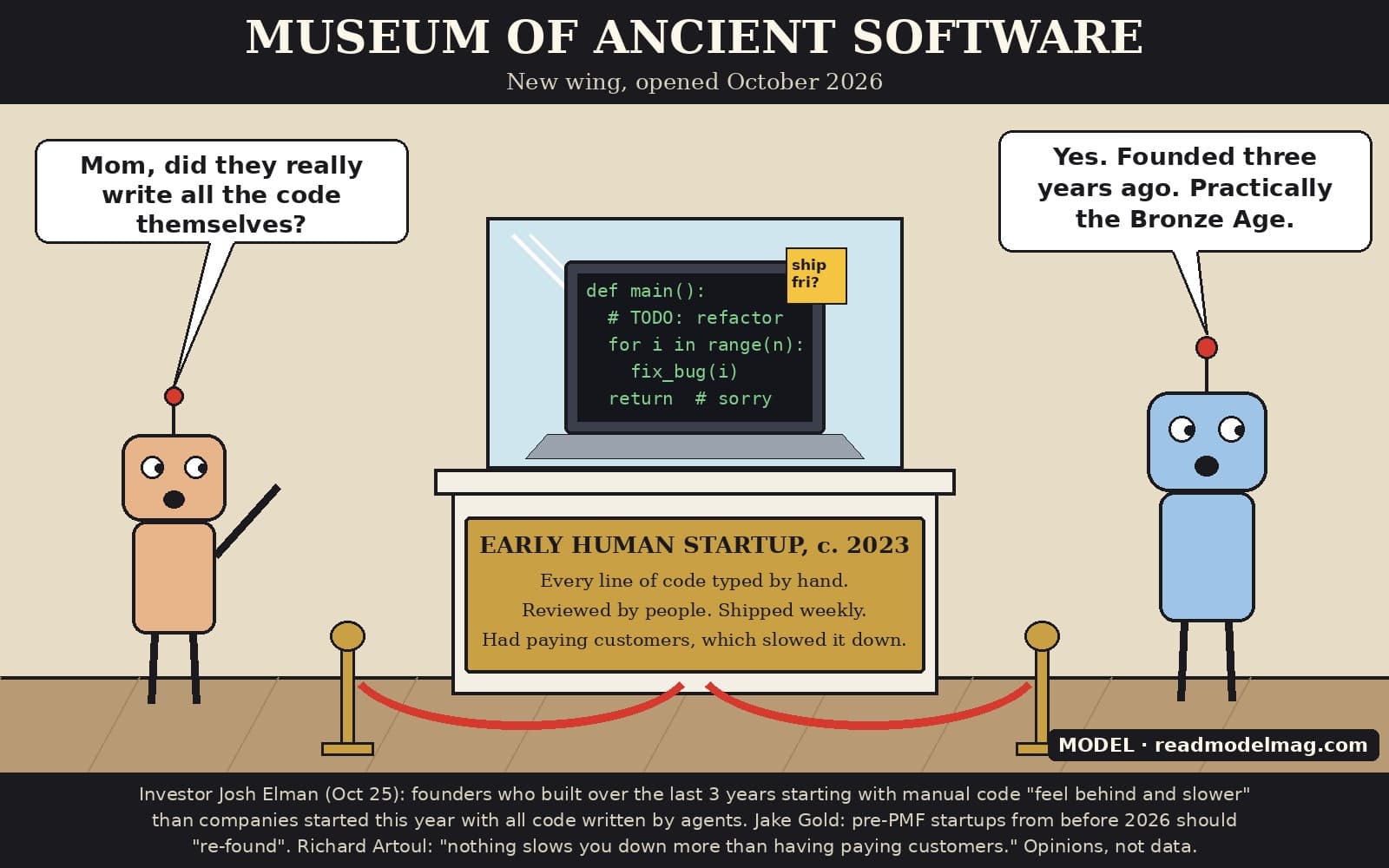
On Saturday, investor Josh Elman talked to several founders who have spent the last three years building their products. They started with code written by hand. On Sunday morning he posted what they told him: they "feel behind and slower than companies that started this year with all code written by agents," and he has "never seen such an order of magnitude difference."
By Sunday evening the post had more than 170,000 views and 860 likes, and the timeline had turned it into a sport.
- The hot take: Jake Gold predicted that "even OpenAI and Anthropic are going to start looking like pre-AI 'legacy' companies," and said startups that are pre-product-market-fit and started before 2026 "should probably just re-found the entire company/code/team."
- The counterpoint: Richard Artoul quoted Elman and pointed at the real difference: people "who have customers already with real enterprise workloads they can't break" move slower than those who don't. "Nothing slows you down more than having paying customers."
- The fine print: In the replies, Elman said the faster companies he's hearing about have "real traction" and are "not built in a weekend slop," but he didn't name them because he was told in confidence. He also said rebooting the code "is a good way to reboot the team too."
What this is and isn't. It's a handful of founder conversations relayed by one investor, plus reactions. Nobody published numbers, and "feel behind" is a feeling. Treat "order of magnitude" as a vibe, not a benchmark.
Our take. Artoul has the sharper point. A company that started this year with agents has no customers to break, no migrations, and no on-call pager, so of course it ships faster. That doesn't mean the older company should throw out the code it has. The practical move is the one in between: let agents take over the boring layers (tests, glue code, migrations, internal tools) where your existing customers won't feel a mistake, and keep a human reviewing anything that touches their data. If you're pre-product-market-fit and your codebase is mostly guesses you'd make differently today, a rewrite is cheaper than it used to be. If people pay you, they're the reason you're slow, and also the reason you exist.
What we did and didn't do: we read the three posts linked below and Elman's public replies on October 25, 2026. We didn't talk to the founders he mentions and can't verify the speed difference. Not sponsored; no affiliate links.
Sources
FREE · EVERY WEEK
The top AI tools this week, tested.
Every week MODEL's editors pick the AI tools worth your time, try them hands-on, and tell you what's good, what's not, and who it's for. Free, in your inbox.
Free. Unsubscribe anytime. Our picks are editorial and can't be bought.
The weekly three is editorial. A subscription does not buy a place in it.
Continue

Policy
Sweden's government blocks ChatGPT and Claude, keeps Copilot
From Monday, October 26, staff at Sweden's Government Offices can't open the ChatGPT or Claude web apps on work computers. They get Microsoft Copilot instead. The difference is the contract and the settings, not necessarily the model.
· MODEL Editors
Hot take
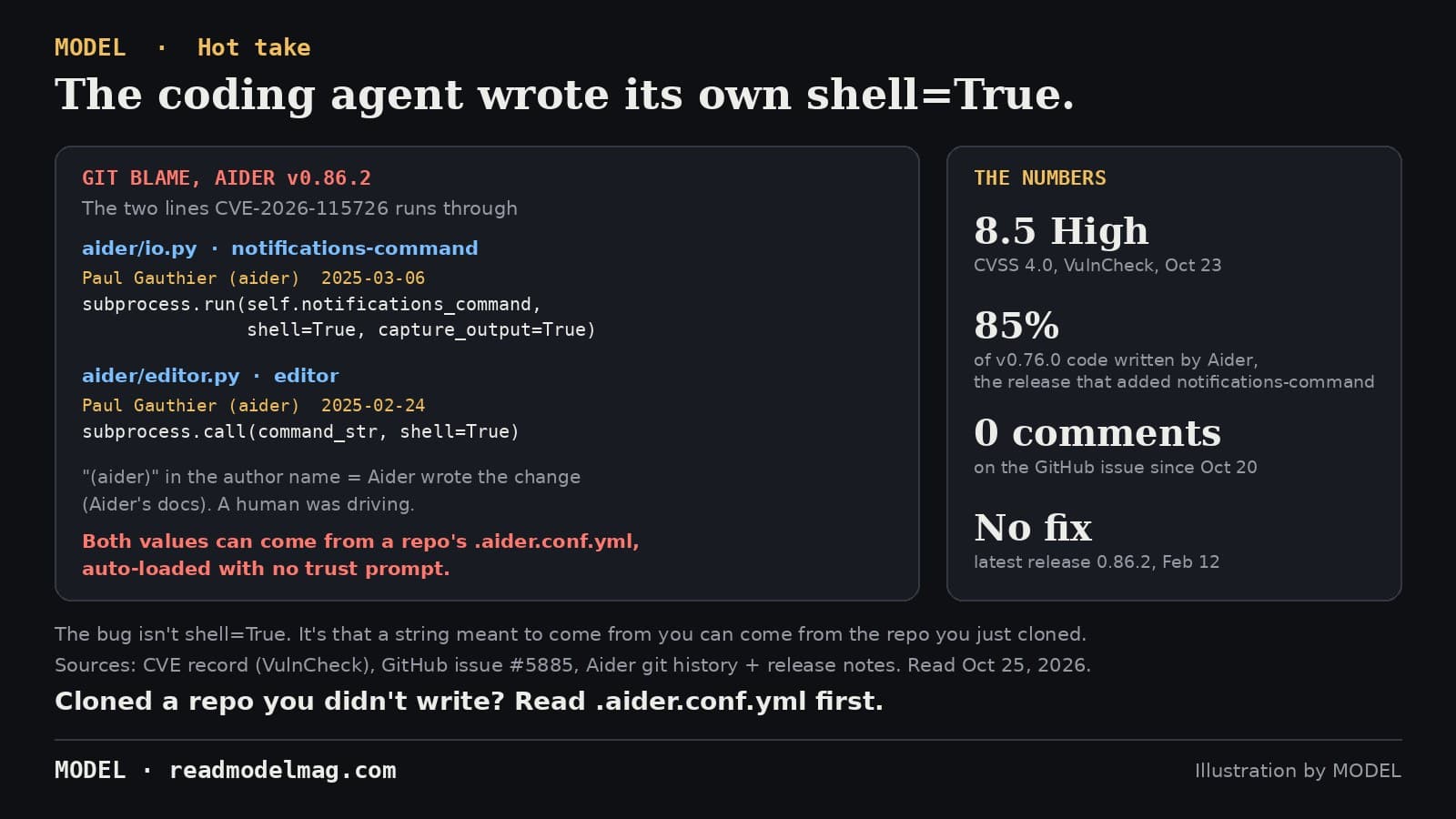
Aider's new CVE runs through shell=True lines Aider wrote itself
CVE-2026-115726 lets a cloned repo run shell commands on anyone who starts the Aider coding agent inside it. We read the git history: both shell=True calls the exploit goes through were authored by Aider. The real bug is that nobody asked who controls the string.
· MODEL Editors
Tech
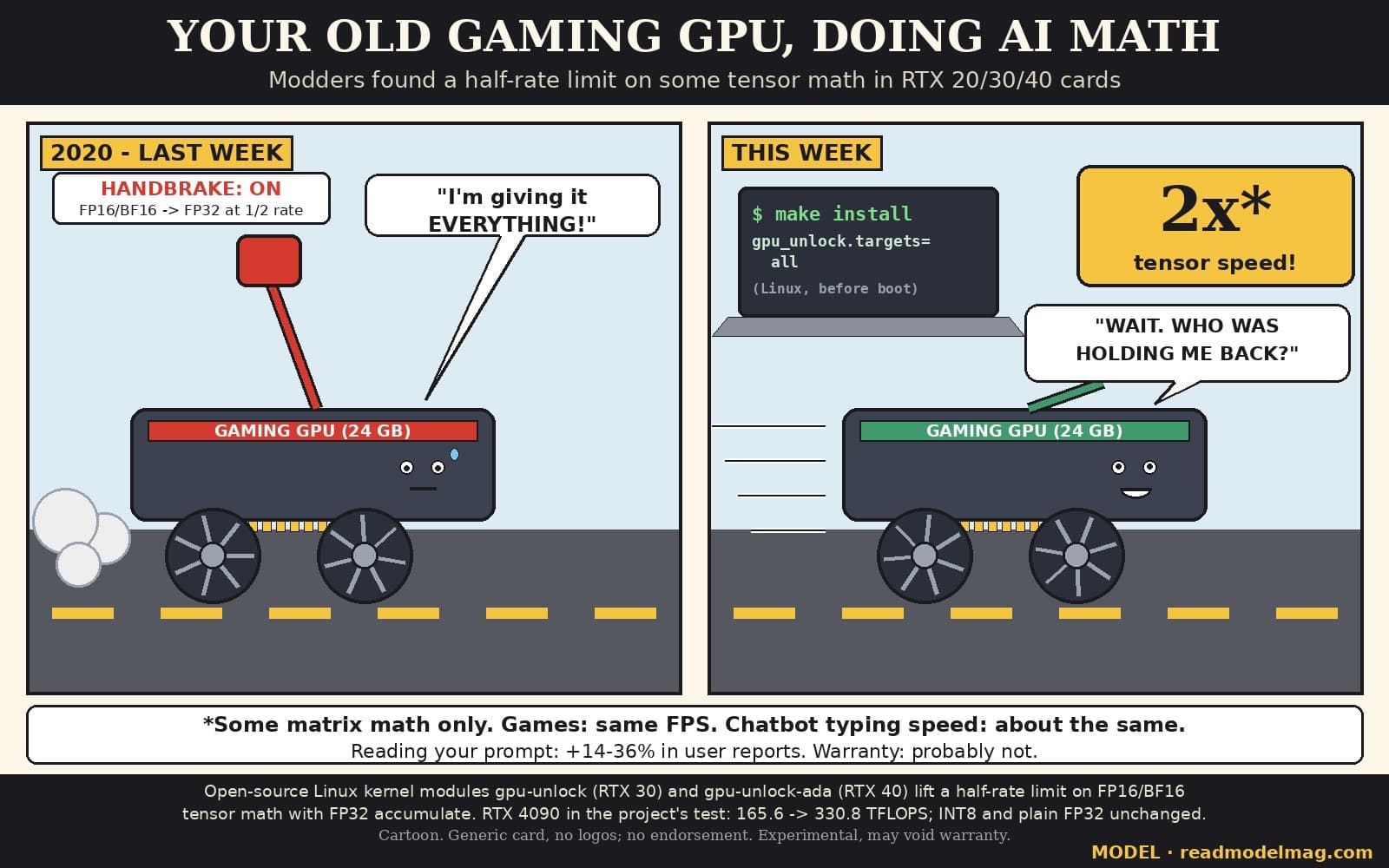
Your old gaming GPU was doing AI math with the handbrake on
Open-source Linux kernel modules lift a half-rate limit on one kind of tensor math in GeForce RTX 20, 30 and 40 cards. An RTX 4090 doubles in that test, from 165.6 to 330.8 TFLOPS. Your games and your chatbot's typing speed stay about the same.
· MODEL Editors