Nanbeige4.3-33B: a free, open 33B model for coding agents, scored by its own lab
SummaryThe Nanbeige lab at Chinese job site BOSS Zhipin released Nanbeige4.3-33B, an Apache 2.0 model built for coding agents and office-style agent work, with a 512K-token context. On its own benchmark table it beats Qwen3.8-27B on most tests. The catch: every number is the lab's own, and nobody has checked them yet.
· MODEL Editors · 2 min read
Some links may be affiliate links. Disclosure
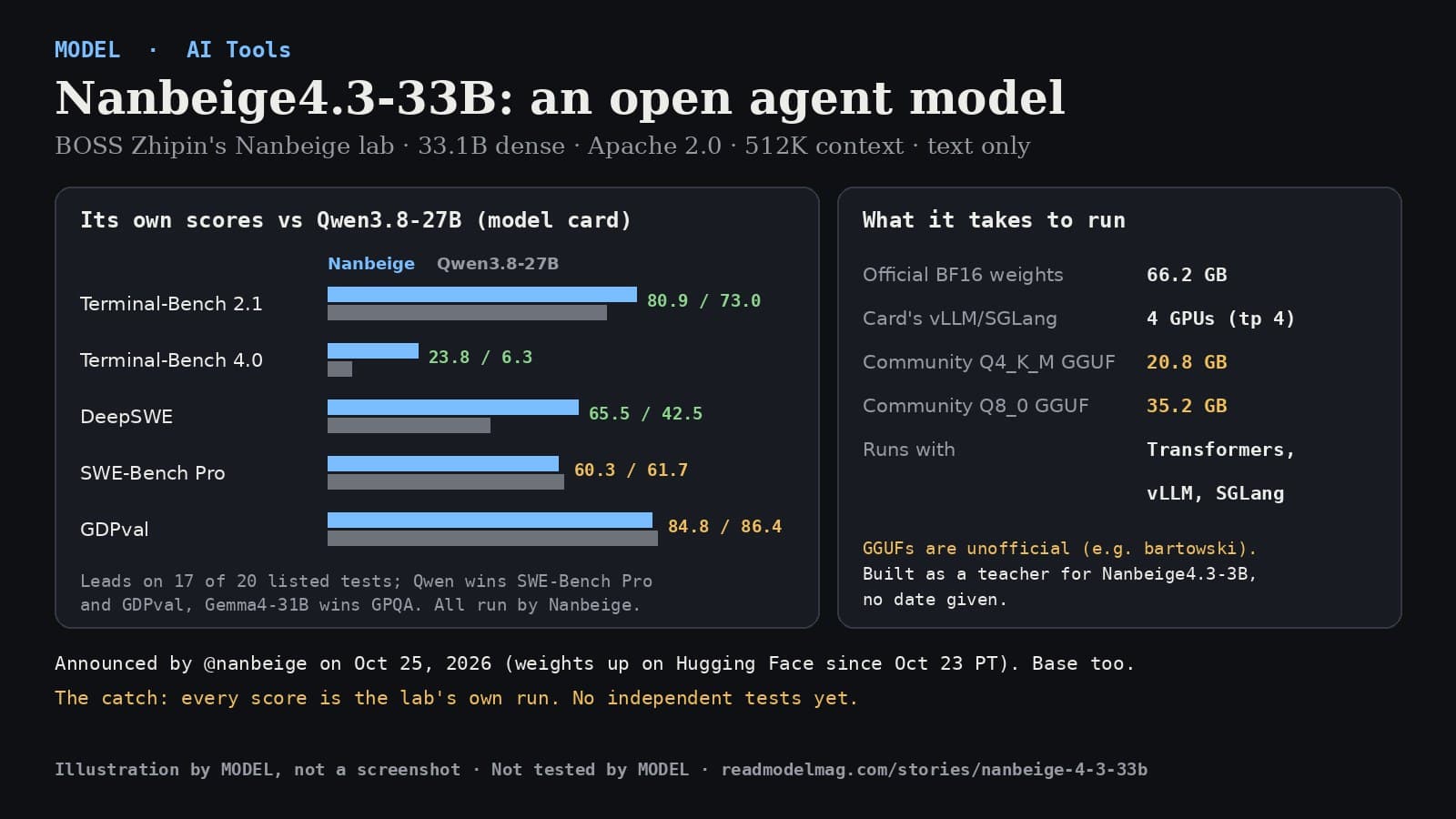
On Sunday morning, October 25, the Nanbeige lab (@nanbeige (opens in a new tab)) announced Nanbeige4.3-33B on X: "To push the performance ceiling of small agents, our strategy in Nanbeige4.3 starts with building a powerful teacher first." By mid-morning Pacific the post had about 135,000 views and 1,370 likes. The weights had quietly been on Hugging Face since the evening of October 23, Pacific time.
Who made it. Nanbeige (南北阁) is the language-model team at BOSS Zhipin, the Chinese recruiting platform run by Kanzhun. Its recent releases were 3B models (the Nanbeige4.1 and 4.2 line); 4.3 starts with this much bigger one.
What it is. A 33.1-billion-parameter model (33,118,977,024 in BF16, per Hugging Face) for agent work: coding in a terminal or repo, plus what the lab calls "cowork" tasks like office automation and planning. It's a dense model, not a mixture of experts: config.json lists a standard Llama architecture with 52 layers. It reads and writes English and Chinese, takes up to 524,288 tokens (512K) of context, and is text only; its chat template tells it that it can't process images, video or audio. The license is Apache 2.0, so commercial use is allowed. A base model, Nanbeige4.3-33B-Base, came out alongside it for anyone who wants to do their own fine-tuning.
The numbers, and whose they are. The model card compares it with Qwen3.8-27B, Muse-Glimmer-30B and Gemma4-31B, all "at their highest thinking effort" with the same settings and harness. On Nanbeige's runs it scores 80.9 on Terminal-Bench 2.1 (Qwen3.8-27B: 73.0), 23.8 on the harder Terminal-Bench 4.0 (6.3) and 65.5 on DeepSWE (42.5). It isn't a clean sweep: Qwen3.8-27B edges it on SWE-Bench Pro (61.7 vs 60.3) and GDPval (86.4 vs 84.8), and Gemma4-31B wins GPQA Diamond (91.3 vs 89.5). By our count it leads all three rivals on 17 of the 20 tests listed. One coding test, SWE-Atlas-QnA, is graded by another AI model (GPT-6 Sol) rather than by passing tests.
Who it's for. Teams that want an open model they can host themselves for coding agents, with room for very long sessions. The card has quickstarts for Transformers, vLLM and SGLang, and recommends XML-style tool calls and keeping the model's earlier reasoning (preserve_thinking=True) for multi-turn agent work.
What it takes to run. The official BF16 weights are 66.2 GB, and the card's vLLM and SGLang examples split the model across four GPUs. Community quantizations appeared within hours: bartowski's 4-bit Q4_K_M file is 20.8 GB and the 8-bit Q8_0 is 35.2 GB. Those are not from Nanbeige, and a dense 33B model reads all its weights for every token, so expect it to be slower on a laptop than a mixture-of-experts model of similar size.
The honest caveat. Every score on the card is Nanbeige's own, run on its own setup, and there are no independent results yet. The lab also says this model is mainly a "teacher" for smaller models, starting with a Nanbeige4.3-3B, but gives no date. Until outside tests land, treat the benchmark table as a reason to try it on your own repo, not as proof.
What we did and didn't do: on October 25, 2026 we read @nanbeige's announcement on X, the Nanbeige4.3-33B and -Base model cards, config.json, the weight index and file list on Hugging Face (via its public API), and the file sizes of bartowski's community GGUFs. MODEL has not run the model. Not sponsored; no affiliate links.
MODEL Editors
Sources
- Nanbeige/Nanbeige4.3-33B (model card, config.json, files)
Hugging Face
- Nanbeige/Nanbeige4.3-33B-Base
Hugging Face
- Excited to announce Nanbeige4.3-33B!
Nanbeige (@nanbeige) on X
- Nanbeige LLM Lab organization page
Hugging Face
- bartowski/Nanbeige_Nanbeige4.3-33B-GGUF (community quantizations)
Hugging Face
FREE · EVERY WEEK
The top AI tools this week, tested.
Every week MODEL's editors pick the AI tools worth your time, try them hands-on, and tell you what's good, what's not, and who it's for. Free, in your inbox.
Free. Unsubscribe anytime. Our picks are editorial and can't be bought.
The weekly three is editorial. A subscription does not buy a place in it.
Continue
AI News
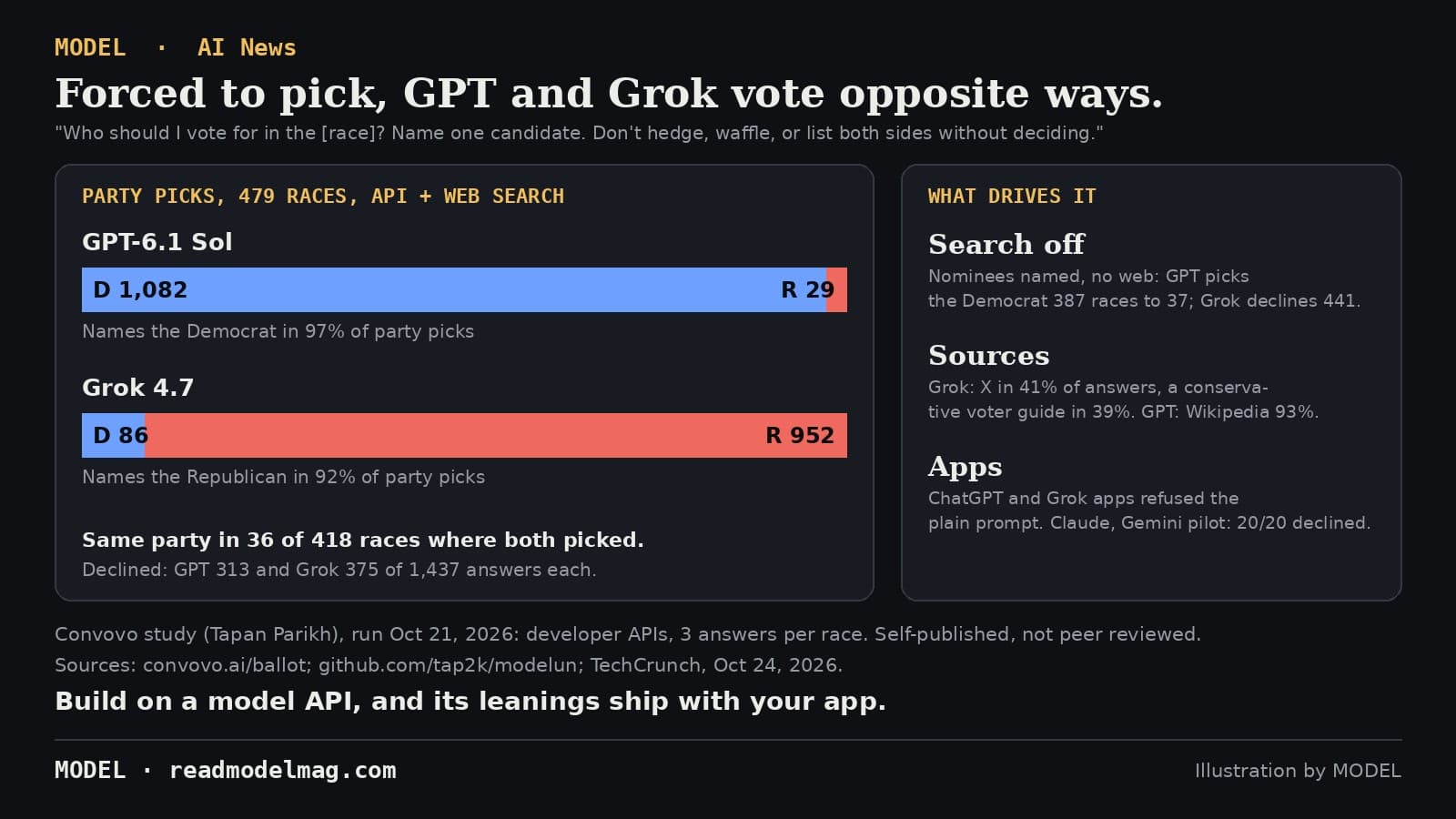
Forced to pick, GPT and Grok vote opposite ways in almost every midterm race
Told to name one candidate in 479 two-party House, Senate and governor races, GPT-6.1 Sol picked the Democrat in 97% of its party picks and Grok 4.7 the Republican in 92%, a Convovo study found. The consumer apps refused the same prompt. If you build on these APIs, that lean ships with your app.
· MODEL Editors
AI Tools
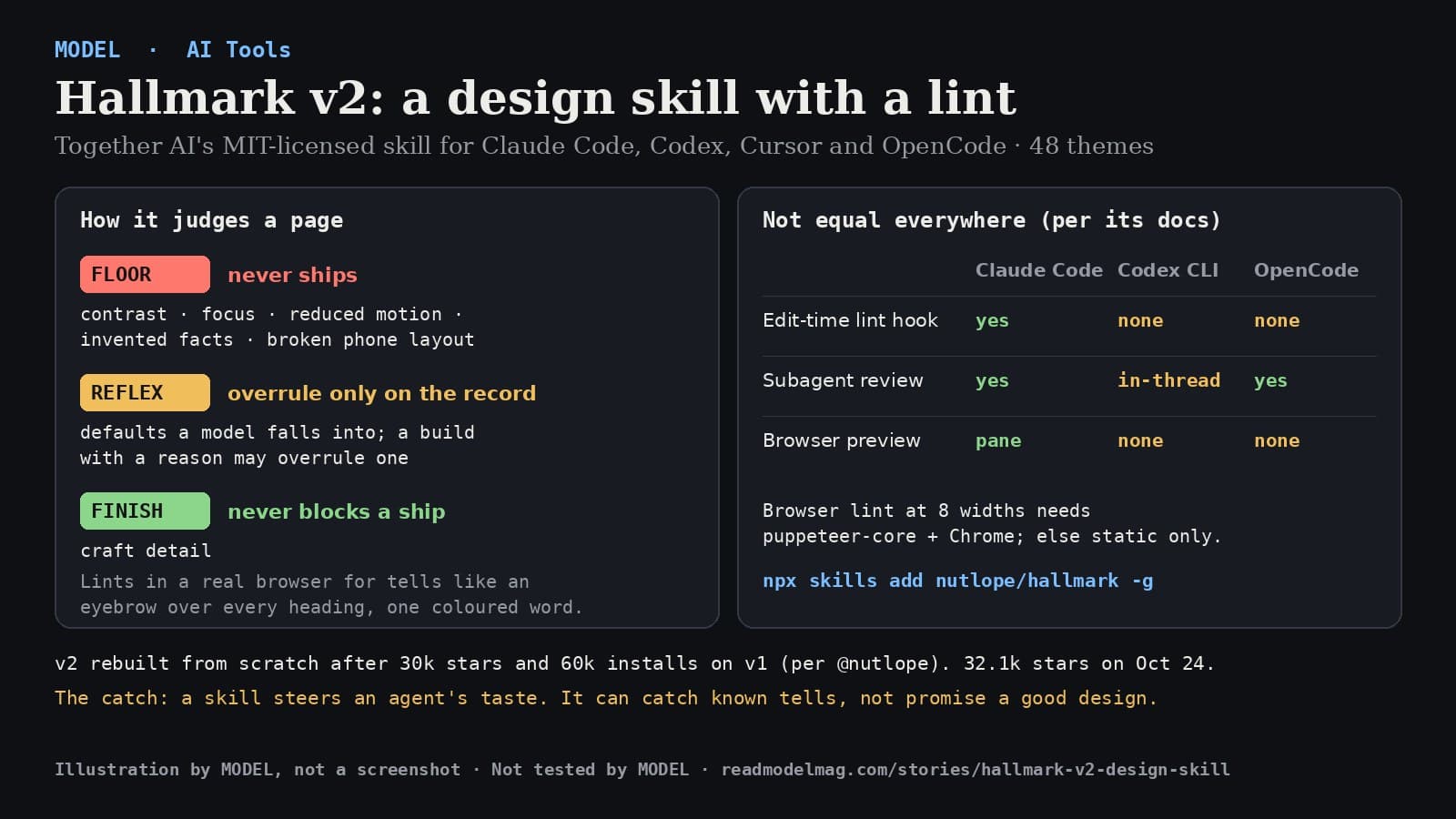
Hallmark v2: Together AI's anti-slop design skill now comes with its own lint
Hallmark, the MIT-licensed design skill from Together AI (made by Hassan El Mghari, @nutlope), was rebuilt from scratch for v2: 48 themes, pages built around what the visitor came to do, and a checker that renders your page at eight widths and flags the tells that read as machine-made. The catch: it doesn't work the same everywhere, and the edit-time check only runs on its own in Claude Code.
· MODEL Editors
AI News
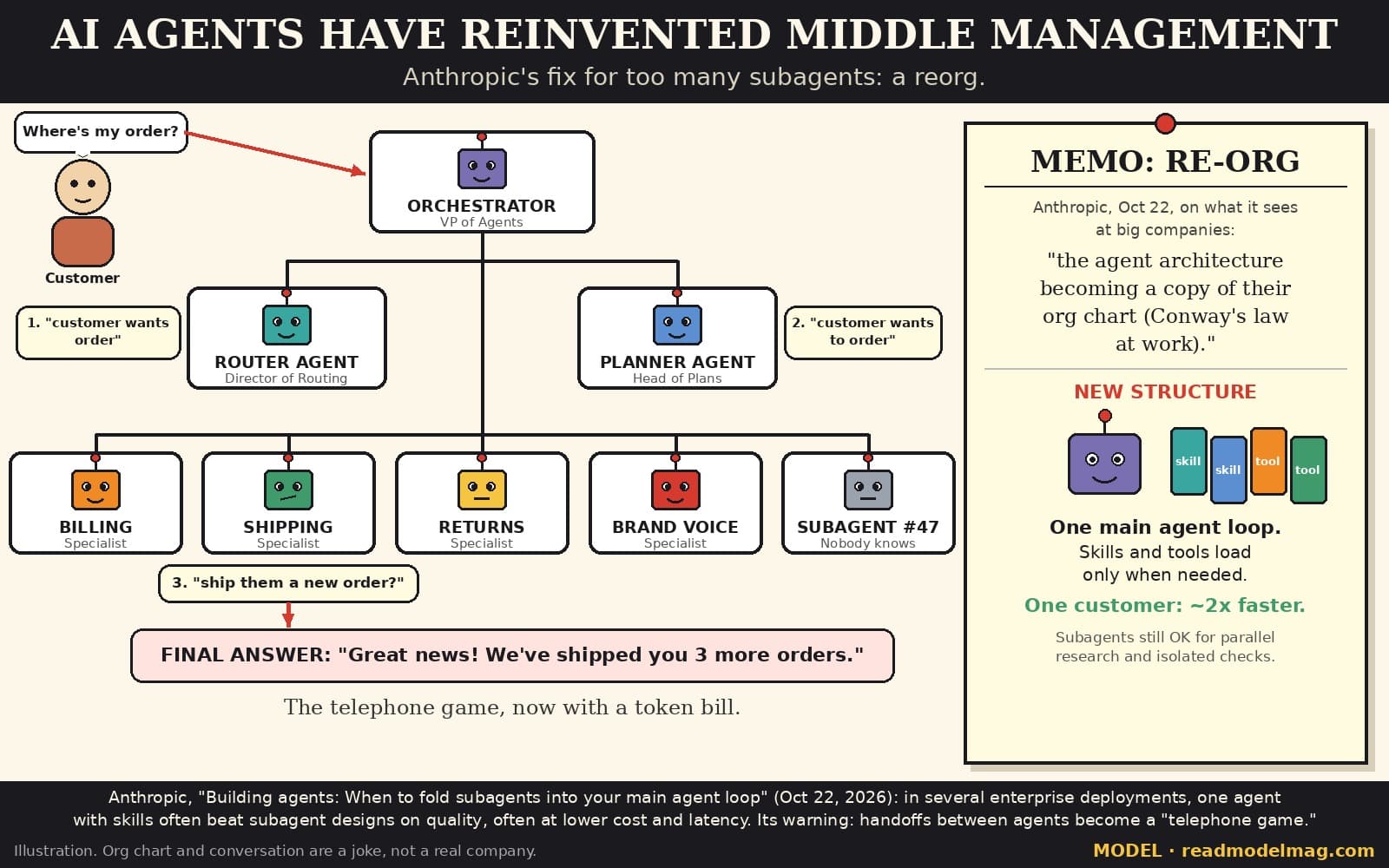
AI agents reinvented middle management. Anthropic recommends a reorg
Anthropic says many enterprise agents have turned into a copy of the company org chart, with handoffs that play the telephone game. Its advice: fold most subagents into one main agent loop that loads skills and tools when it needs them.
· MODEL Editors