OpenAI Private Intelligence: what it actually gives businesses
SummaryOpenAI bundled its business privacy protections under one name on October 30: Zero Data Retention with Private Safety Processing, a preview of Private Inference, and admin controls over what agents can touch. Much of it is limited to eligible workflows or still in preview, and OpenAI lists no prices.
· MODEL Editors · 2 min read
Some links may be affiliate links. Disclosure
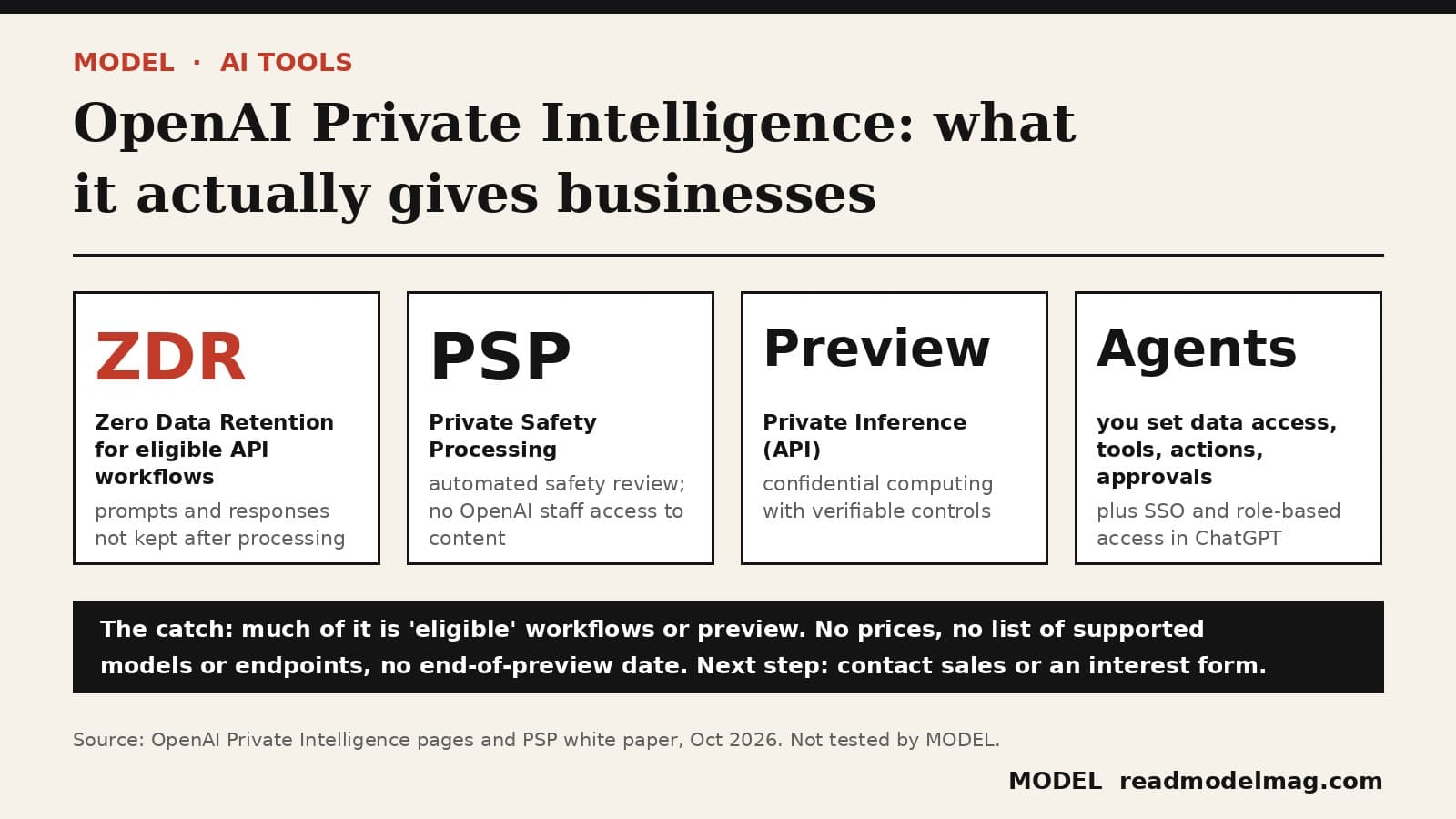
On Friday morning, October 30, OpenAI announced OpenAI Private Intelligence on X: "Privacy should advance as fast as intelligence." The new product page gathers OpenAI's business privacy protections under one name. It's less a single new product than a bundle, and one part of it, Private Inference, is new and still in preview.
What's in it. OpenAI's page lists four promises and three mechanisms:
- Access restrictions. OpenAI says it sets "strict limits" on its own access to business content, and offers Zero Data Retention (ZDR) and Private Inference "for eligible workflows."
- Data ownership. You own your business data, including inputs and outputs.
- Agent actions. Admins decide what agents can access, which tools and actions they can use, and when they need approval.
- Data security. Encryption, access controls and threat detection.
- Zero Data Retention. For eligible API customers, OpenAI doesn't keep prompts or model responses after a request is processed. Since September 22 it pairs this with Private Safety Processing (PSP): flagged content is stored encrypted in storage the customer controls, reviewed only by an automated system inside OpenAI, and OpenAI employees can't get the decryption keys. OpenAI says the retained content is used only for safety and never for training.
- Private Inference (preview). An API option that combines confidential computing with "strict, verifiable controls" to protect prompts and responses while the model processes them.
- Compliance. SOC 2 Type 2, ISO certifications, HIPAA support through a Business Associate Agreement for eligible services, and FedRAMP support for designated government offerings.
Who it's for. Businesses handling sensitive data: OpenAI's earlier post names financial records, health data, confidential plans and proprietary research. A second page covers controls across ChatGPT, Codex and the API, including SSO and role-based access in ChatGPT for enterprises. The ZDR and Private Inference parts are API features. OpenAI says it built the protections with "some of our largest customers," but doesn't name them.
Price and availability. Not stated. The pages offer "Contact sales" and an interest form. OpenAI doesn't say which models or endpoints qualify, what Private Inference costs, or when the preview ends.
The caveats. "Eligible" carries a lot of weight here, and OpenAI doesn't define it publicly. Its own white paper says Private Inference "does not automatically cover the initial API request" or "every OpenAI system," and that it covers first-party OpenAI traffic only, not Amazon Bedrock or other third-party resellers. Even under ZDR, OpenAI says images flagged as potential child sexual abuse material are still kept for manual review and reporting, as the law requires.
Our take. For a small team calling the API, nothing here changes your bill or setup today. ZDR is only for eligible API customers, and Private Inference is a preview you'd ask sales about. For companies whose lawyers have kept them off frontier models, this gives them a specific checklist to take to OpenAI. MODEL has not tested Private Intelligence. This summary is based only on OpenAI's published pages and white paper, read October 30, 2026.
Sources
FREE · EVERY WEEK
The top AI tools this week, tested.
Every week MODEL's editors pick the AI tools worth your time, try them hands-on, and tell you what's good, what's not, and who it's for. Free, in your inbox.
Free. Unsubscribe anytime. Our picks are editorial and can't be bought.
Continue
Hot Take
Hot take: sloppy AI code is a checking problem, not a model problem
Anthropic says Claude wrote the Rust port of its Messages API, starting with no Rust developers on the team, and that the safety net was shadow traffic, not line-by-line review. The same week, Veracode found about 4 in 10 AI coding tasks still produce code with a known vulnerability. Here is what was actually said, what the viral version gets wrong, and our take.
· MODEL Editors
Tool Update
Notion's week: its agent now makes Excel, Word, PowerPoint and PDF files, and edits say which agent did them
Notion's Halloween recap bundles four updates from Oct 27 to 30: an agent that builds real office files, speaker labels for Google Meet notes, bigger automatic offline downloads, and a 'Last edited by' label that names the agent or MCP client behind a change. Here is what each one does, and what Notion hasn't said.
· MODEL Editors
We tested it
One robots.txt line now asks four AI companies not to train on your site. We tested it, and the order of your lines matters
OpenAI, Google, Microsoft and Anthropic backed a shared __usage_ai-training token on Oct 30. None of them reads it yet. We ran the draft's own example through a standard robots.txt parser and found two traps for anyone checking their file with existing tools.
· MODEL Editors