Vork: a headless 3D/VFX engine built for AI agents
SummaryNov 6, 2026: Ravi Parikh / Voyager ships Vork research preview — agents write scenes as code (Rust + Slang; Vulkan/Metal). Getting-started help ~2,500 tokens. Vendor demo: 1M self-steering birds simulated+rendered in 97s on one NVIDIA L4 (after setup/warmup).
· MODEL Editors · 2 min read
Some links may be affiliate links. Disclosure
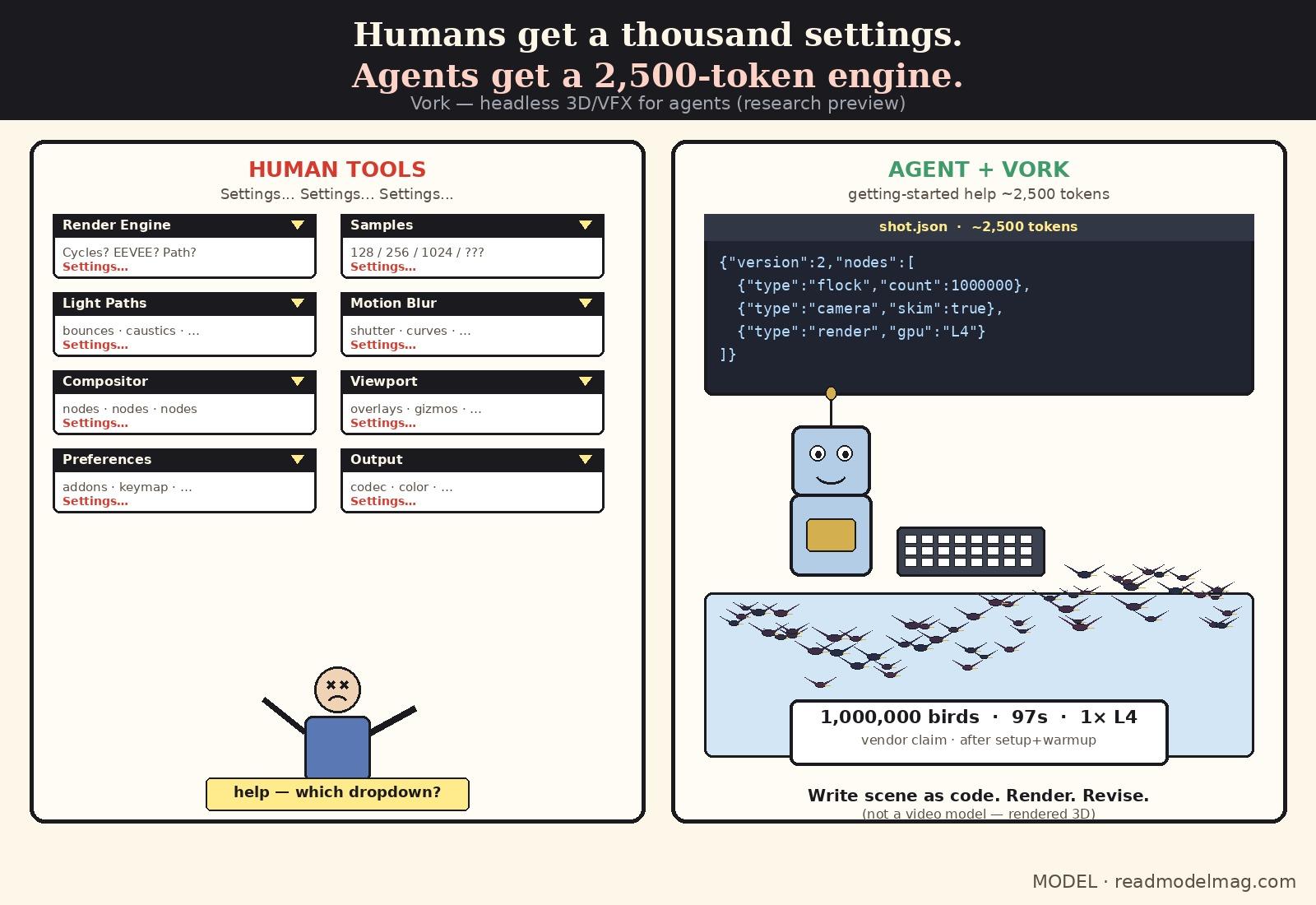
Vork is a headless 3D and VFX engine built for agents, announced Nov 6, 2026 by Ravi Parikh (@ravisparikh (opens in a new tab)) / Voyager. Per voyager.so/vork (opens in a new tab): an agent writes a scene as code, renders it, inspects the result, and revises. Stack: Rust + Slang, GPU via Vulkan / Metal. It is a research preview — source-available and free during the preview.
Small surface for agents. The site says getting-started help is about 2,500 tokens, including a complete first scene. Ordinary shots need scene data; programming hooks cover unusual cases. Blender / Houdini / Unreal / Nuke are framed as human tools with thousands of settings; Vork’s kernel holds what agents can’t write on the fly (geometry, ray queries), and the rest is code the agent writes as it goes.
Million-bird demo (vendor numbers). Site: a million birds, each steering itself, simulated and rendered in 97 seconds on one GPU. Timing nuance on the same page: the eight-second skim took 97s after 244s setup + 166s scene warmup on an NVIDIA L4 (asset prep separate). EEVEE is projected 13–18 minutes draw-only at the same samples (~8–11×), flock handed to Blender — quality/material/motion differ. Camera + nine foreground birds authored; the million simulated birds don’t flap. Astra wrote the shot; flocking sim by GPT-6.1 Sol earlier. Creator X also claimed 2× more token-efficient vs Blender/Unreal/Houdini and up to 24× faster rendering — those are creator claims, not MODEL measurements.
Not a video model. Moving parts are rendered 3D, or real footage + rendered 3D (tracking/cutouts via tools like OpenCV / SAM; one car-shot backdrop used an image-model painting on a 3D card).
Install (per site). Windows/Linux with a recent NVIDIA GPU; Apple Silicon with Metal (bundled Slang targets macOS 26; older macOS unqualified).
Research-preview limits (must-know). Fog/volumes not in yet; heavy interiors can abort on Mac; path tracer slower than Cycles in measured cases; Final approximates indirect lighting (more samples cannot restore omitted transport). Run vork help limits before committing to a shot.
Who it's for: founders building agent loops that need controllable 3D/VFX output, and teams tired of driving DCC UIs from an LLM.
Caveats. All performance and token figures above are vendor / creator-reported. MODEL has not installed or benchmarked Vork.
Disclosure: Not sponsored. No affiliate links. Not tested by MODEL.
MODEL Editors
Sources
- Vork by Voyager
Voyager / Ravi Parikh
- Ravi Parikh announces Vork
X / @ravisparikh
- voyager-so/vork
GitHub
Keep reading

Tool Update
Claude Code cloud environments: save deps, network, and API keys for the next session
On Pro, Max, Ultra (and Team / Enterprise premium or Chat+Code seats), Claude figures out dependencies, network access, and API keys for a cloud session, then saves the environment. Network secrets stay outside the VM — Anthropic's agent proxy attaches them after the request leaves. Paid tiers only; not tested by MODEL.
· MODEL Editors
RESEARCH
Claude agents dream offline — Anthropic on the components of agent memory
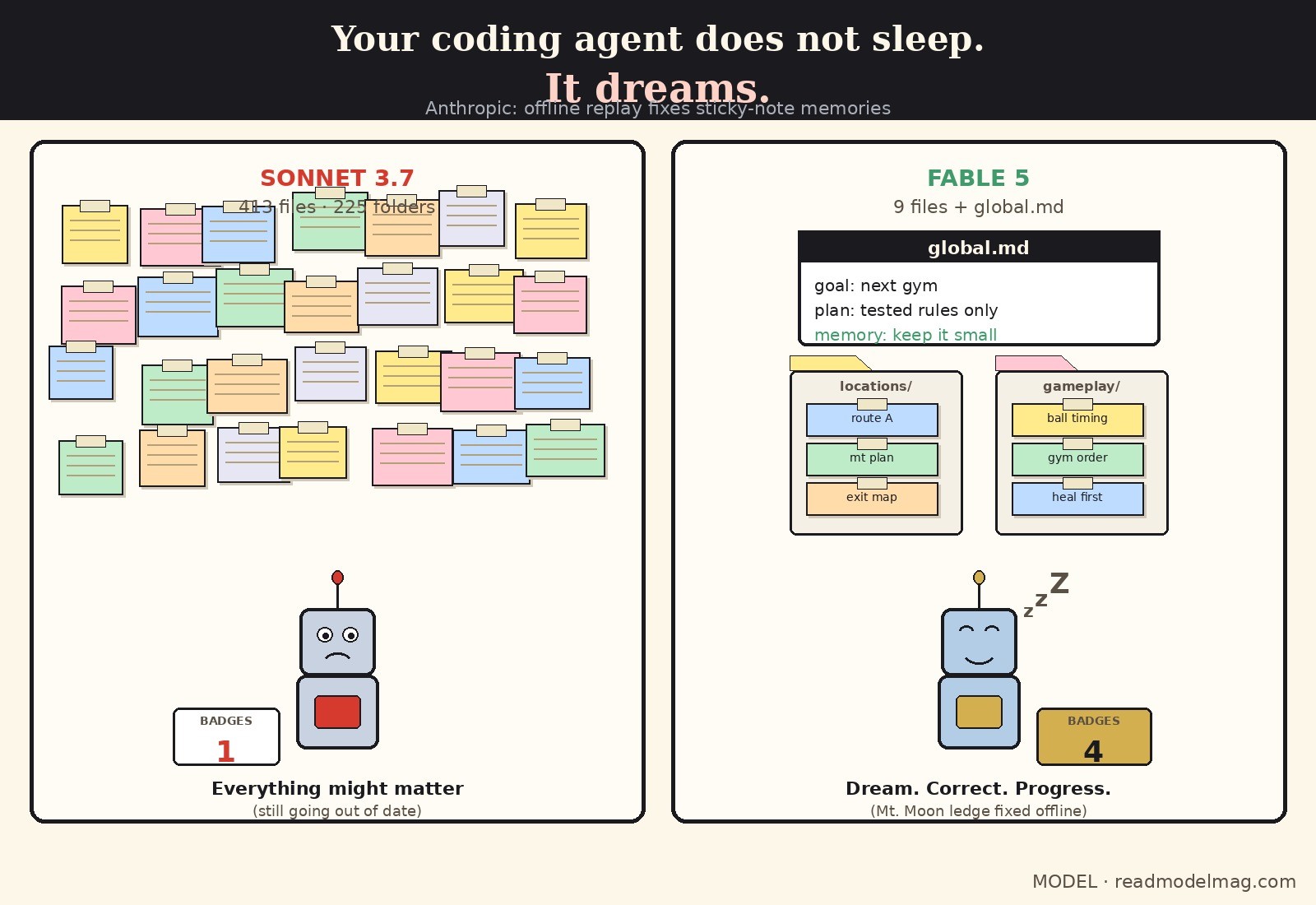
Nov 6, 2026 Anthropic Engineering (Lance Martin): agent memory as notes + offline dreaming. Pokémon Red: Sonnet 3.7 wrote 413 files across 225 folders (1 badge); Fable 5 wrote 9 files + global.md (4 badges). Dreaming corrected a wrong Mt. Moon PokéCenter note after Claude walked a ledge 3×.
· MODEL Editors

SECURITY
Claude Code leaked signed-in emails into User-Agent — Anthropic shipped a narrow privacy mod
Claude Code put the signed-in account email into model context; the model sometimes invented HTTP User-Agent headers with that address on outbound web/shell calls. Anthropic confirmed on HN and shipped built-in cc-plugin-privacy from 2.1.317+ (default on). Mod is a courtesy, not a boundary — WebFetch/WebSearch/MCP unchecked.
· MODEL Editors
FREE · EVERY WEEK
The top AI tools this week, tested.
Every week MODEL's editors pick the AI tools worth your time, try them hands-on, and tell you what's good, what's not, and who it's for. Free, in your inbox.
Free. Unsubscribe anytime. Our picks are editorial and can't be bought.