AlphaGenome 2: Google DeepMind's DNA model now predicts variant effects cell type by cell type
SummaryGoogle DeepMind's new DNA sequence model predicts how genetic variants act in specific human cell types and states. It is free via the AlphaGenome API for non-commercial research. Not tested by MODEL.
· MODEL Editors · 2 min read
Some links may be affiliate links. Disclosure
What launched. On Wednesday, Nov. 11, @GoogleDeepMind announced (opens in a new tab) AlphaGenome 2, a new version of its DNA sequence model. Per DeepMind's blog post (opens in a new tab), it predicts how DNA sequences and their variants affect specific human cell types and cell states, not just broad tissue averages like the first AlphaGenome.
What changed. The first model predicted many experiments in parallel from a million-letter DNA sequence. AlphaGenome 2 is a conditional model: you give it the DNA sequence plus one target condition (a tissue, cell type or cell state) and it predicts for that condition. DeepMind says it was trained on bulk and single-cell data from human and mouse samples, including over 107 million individual cell profiles across 68 tissues. Besides gene expression, histone modifications and chromatin accessibility, it now also predicts DNA methylation.
Your own cells, no retraining. Researchers can upload a single-cell RNA-seq snapshot from as few as a few dozen cells, and the model uses it to predict variant effects for that new cell state without retraining. If you give it one measurement, it can also predict unmeasured ones, such as chromatin accessibility.
DeepMind's numbers. On the TenK10K single-cell dataset (28 primary immune cell types), DeepMind reports AlphaGenome 2 identified 30% of causal variants vs. 16% for the original AlphaGenome fine-tuned on single-cell data and other specialized tools, and 43% vs. 23% of directional gene effects. It also says the model reproduced, computationally, a published finding that a distant variant drives inflammatory bowel disease by boosting the ETS2 gene in gut macrophages. These are DeepMind's own results; MODEL has not checked them.
Availability. Available now for non-commercial research via the AlphaGenome API, with interactive Colab tutorials, and in private preview for commercial research. The AlphaGenome docs (opens in a new tab) say the API is free of charge for non-commercial use and that query rates vary with demand. DeepMind says AlphaGenome 2 "Skills" for its Google Antigravity agent platform are coming "soon"; no date given.
Who it's for. Genetics and single-cell researchers who want to rank which DNA variants matter in which cells before running lab experiments. It is not a consumer tool.
The caveats.
- Research use only. DeepMind says AlphaGenome and AlphaGenome 2 have not been validated or approved for clinical or diagnostic purposes.
- Commercial use is a private preview, not open access.
- Benchmarks and the ETS2 example come from DeepMind's own announcement.
Disclosure: Not tested by MODEL. Not sponsored. No affiliate links.
MODEL Editors
Get three tested tools every Friday
Free, weekly. Unsubscribe anytime.
Sources
- AlphaGenome 2: Deciphering how cells read DNA to better understand disease
Google DeepMind (deepmind.google)
- AlphaGenome documentation
Google DeepMind (alphagenomedocs.com)
- Google DeepMind on X
X (@GoogleDeepMind)
Keep reading
Builder tip
Google's new Gemini Decision 1 answers yes/no without writing a word. The builder tip: stop paying a chat model for routing
Google launched the Gemini Decisions API on Nov. 11, powered by a new model, Gemini Decision 1. It scores closed-set questions (yes/no, multiple choice, rubric) in one pass and bills zero output tokens. Here is where that fits in an agent, and the catches.
· MODEL Editors

Builder tip
NVIDIA gave its AI agent sandbox, OpenShell, to the CNCF. The builder lesson: put your agent's rules outside the agent
OpenShell, NVIDIA's open source runtime for securing and governing autonomous AI agents, joined the CNCF as a Sandbox project at KubeCon on Nov. 10. The idea behind it is worth copying even if you never install it: enforce what an agent can touch in the infrastructure, not in its prompt.
· MODEL Editors

Tool Update
Cursor Projects is now multiplayer: your agents can coordinate with your teammates' agents
Cursor rebuilt Projects so a whole team and all of its agents share one workspace, with a shared task board and shared context. It is rolling out in beta to all users. Not tested by MODEL.
· MODEL Editors
AI Talk
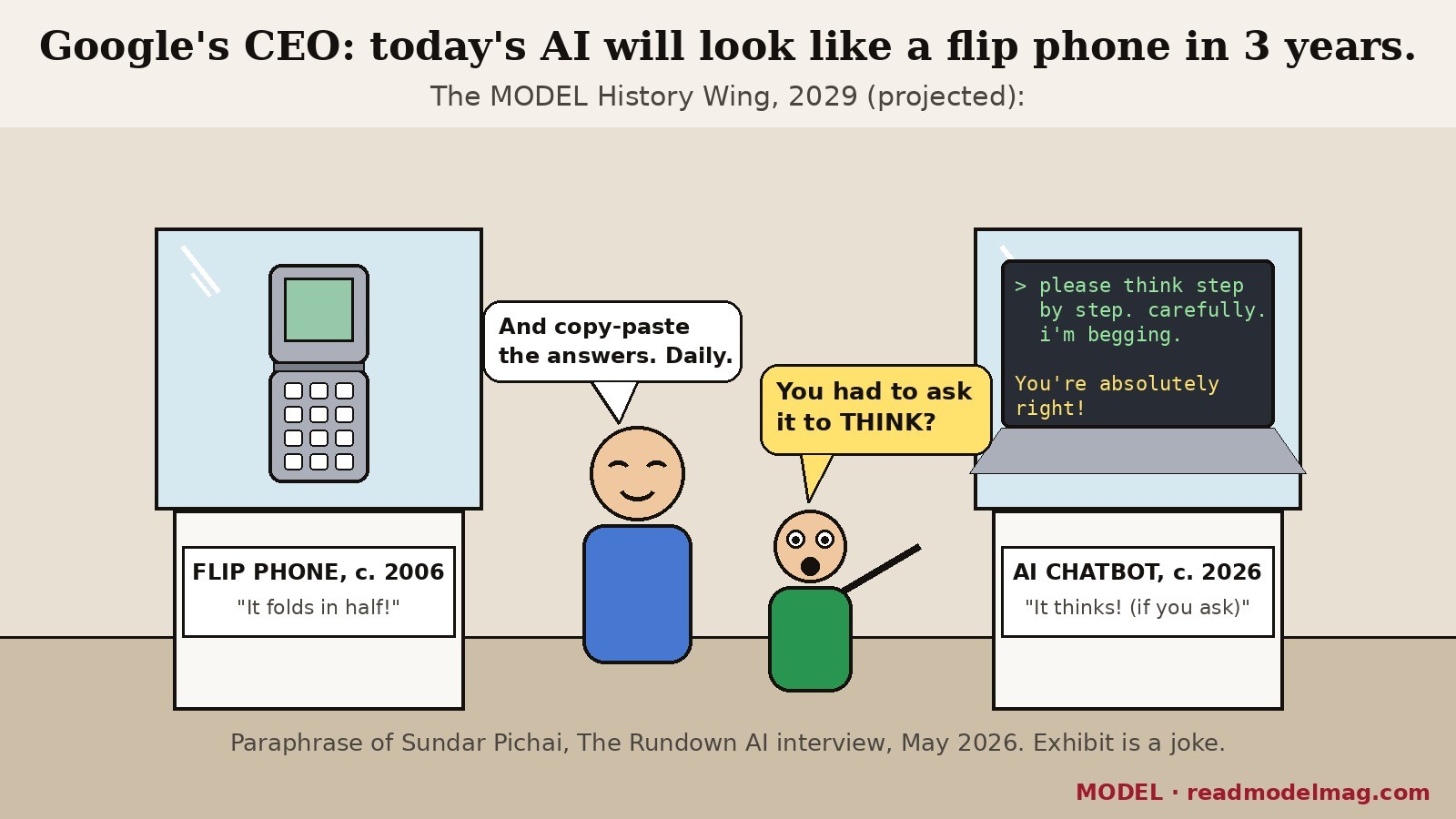
Google's CEO says today's AI will look like a flip phone in three years
Sundar Pichai made the call in a May 2026 interview with The Rundown AI. A clip of it went around X again today. Here's what he actually said, and what to make of it.
· MODEL Editors
FREE · EVERY WEEK
The top AI tools this week, tested.
Every week MODEL's editors pick the AI tools worth your time, try them hands-on, and tell you what's good, what's not, and who it's for. Free, in your inbox.
Free. Unsubscribe anytime. Our picks are editorial and can't be bought.