Google's new Gemini Decision 1 answers yes/no without writing a word. The builder tip: stop paying a chat model for routing
SummaryGoogle launched the Gemini Decisions API on Nov. 11, powered by a new model, Gemini Decision 1. It scores closed-set questions (yes/no, multiple choice, rubric) in one pass and bills zero output tokens. Here is where that fits in an agent, and the catches.
· MODEL Editors · 2 min read
Some links may be affiliate links. Disclosure
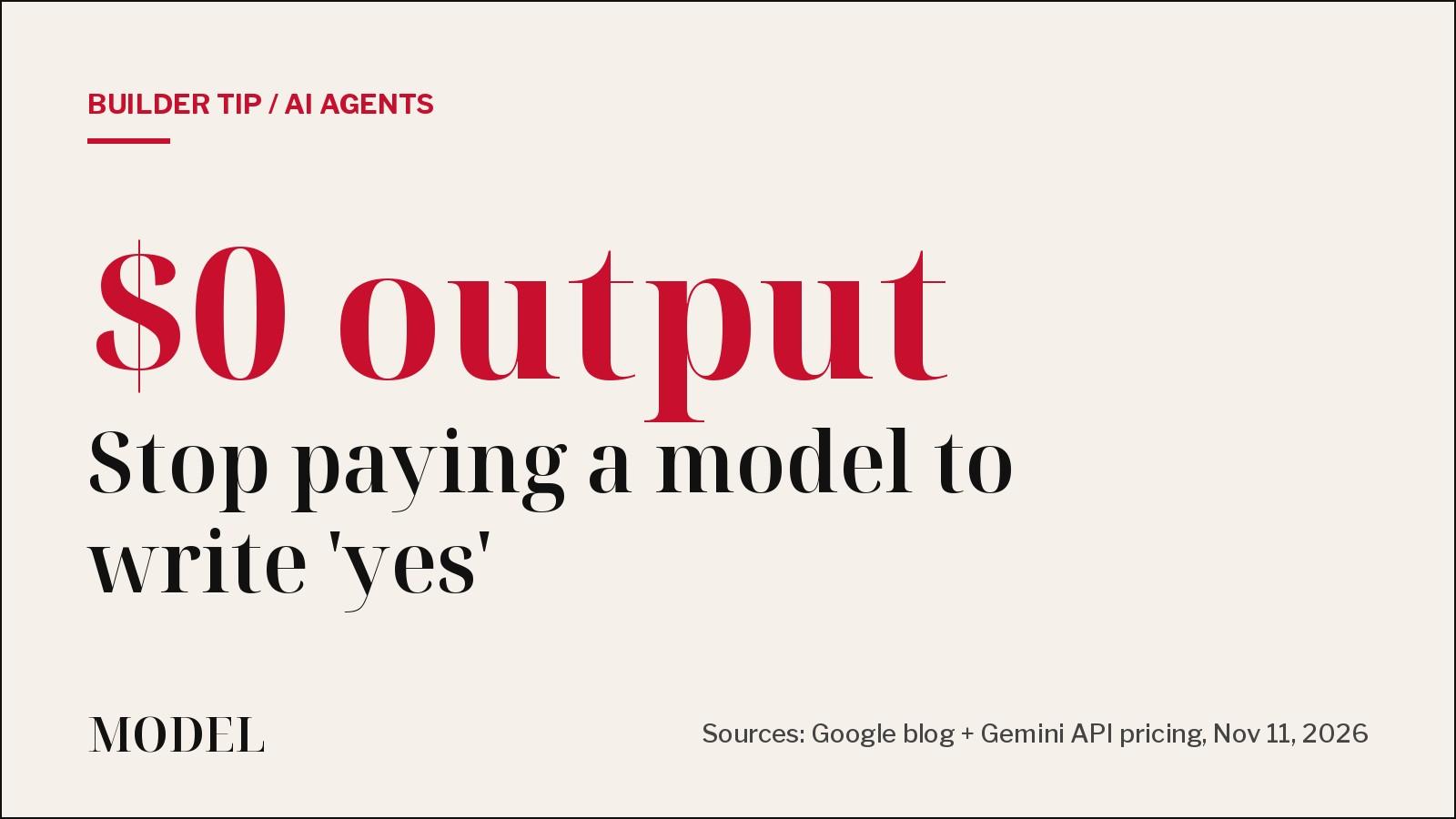
What happened. On Wednesday, Nov. 11, Google introduced the Gemini Decisions API (opens in a new tab), a new endpoint in the Gemini API (Google AI Studio) powered by a new model, Gemini Decision 1 (gemini-decision-1). It is built for closed-set choices: tool selection, policy checks, model routing and grading context.
What it does. You send one input (text, images, audio, video or PDFs, up to 256K tokens) and up to 1,000 independent questions. Instead of writing an answer token by token, the model scores the candidate options in a single forward pass. Three question types:
- Yes/no (Google calls it
noul): the probability that a condition holds. - Multiple choice: 2 to 255 options, with a winner and a probability for each.
- Rubric score: an ordered scale starting at 0, with a weighted score and per-level probabilities.
Every answer comes with a confidence score from 0 to 1.
Price. Per Google's pricing page (opens in a new tab): $0.10 per 1M input tokens on the paid tier, and no output tokens at all. The shared input is billed once per request, however many questions you ask; each question adds only its own instruction tokens. There is a free tier in AI Studio for prototyping.
Google's own claims (not checked by MODEL). 150-250 ms end to end; latency nearly flat from 1 to 100 questions per request; the lowest calibration error on Google's benchmark suite; and "nearly 5x cheaper" across that suite than Gemini 3.5 Flash-Lite through the Interactions API. Google says it already uses the API inside Gemini Notebook for model routing, in Stitch, and as a safety layer for MCP tools in Search.
Where else. Vercel AI Gateway (opens in a new tab) and OpenRouter (opens in a new tab) listed it the same day. Google says LangChain, LiteLLM, Pydantic AI and others are rolling out, with Gemini in Google Cloud "coming soon."
The builder tip
Look at your agent's logs and count the calls where a big chat model only had to pick: which tool, which model tier, is this allowed, is this a refund request. Each one pays for generated text you parse and throw away.
- Split the decision from the work. Send routing, policy checks and tool picks to a scoring endpoint. Keep the generative model for the actual answer.
- Batch the questions. Ask all your checks against the same input in one request. The input is billed once.
- Use the confidence score. Pick a threshold. Below it, fall back to a bigger model or a human. Don't let a 0.55 "yes" approve a payment.
- Test on your own data first. Run a few hundred of your past decisions through it and compare with what actually happened before you switch.
The catch. Google's examples call it through the v1beta API version, which Google's docs describe as early features that may change. On the free tier, Google's pricing page says your content is used to improve its products; on the paid tier it is not. The Batch API and context caching are not supported. And the speed, calibration and cost numbers are Google's own.
Disclosure: Not tested by MODEL. Not sponsored. No affiliate links. Facts from Google's Nov. 11, 2026 announcement and pricing page, plus Vercel and OpenRouter listings.
MODEL Editors
Get three tested tools every Friday
Free, weekly. Unsubscribe anytime.
Sources
- Gemini Decisions API: Fast, calibrated multimodal decisions
Google (The Keyword)
- Gemini Developer API pricing (Gemini Decision)
Google AI Studio
- Gemini Decision 1 now available on AI Gateway
Vercel
- Gemini Decision 1 - API Pricing & Providers
OpenRouter
Keep reading
Tool Update
AlphaGenome 2: Google DeepMind's DNA model now predicts variant effects cell type by cell type
Google DeepMind's new DNA sequence model predicts how genetic variants act in specific human cell types and states. It is free via the AlphaGenome API for non-commercial research. Not tested by MODEL.
· MODEL Editors
Builder tip
NVIDIA gave its AI agent sandbox, OpenShell, to the CNCF. The builder lesson: put your agent's rules outside the agent
OpenShell, NVIDIA's open source runtime for securing and governing autonomous AI agents, joined the CNCF as a Sandbox project at KubeCon on Nov. 10. The idea behind it is worth copying even if you never install it: enforce what an agent can touch in the infrastructure, not in its prompt.
· MODEL Editors
Tool Update
Cursor Projects is now multiplayer: your agents can coordinate with your teammates' agents
Cursor rebuilt Projects so a whole team and all of its agents share one workspace, with a shared task board and shared context. It is rolling out in beta to all users. Not tested by MODEL.
· MODEL Editors
AI Talk
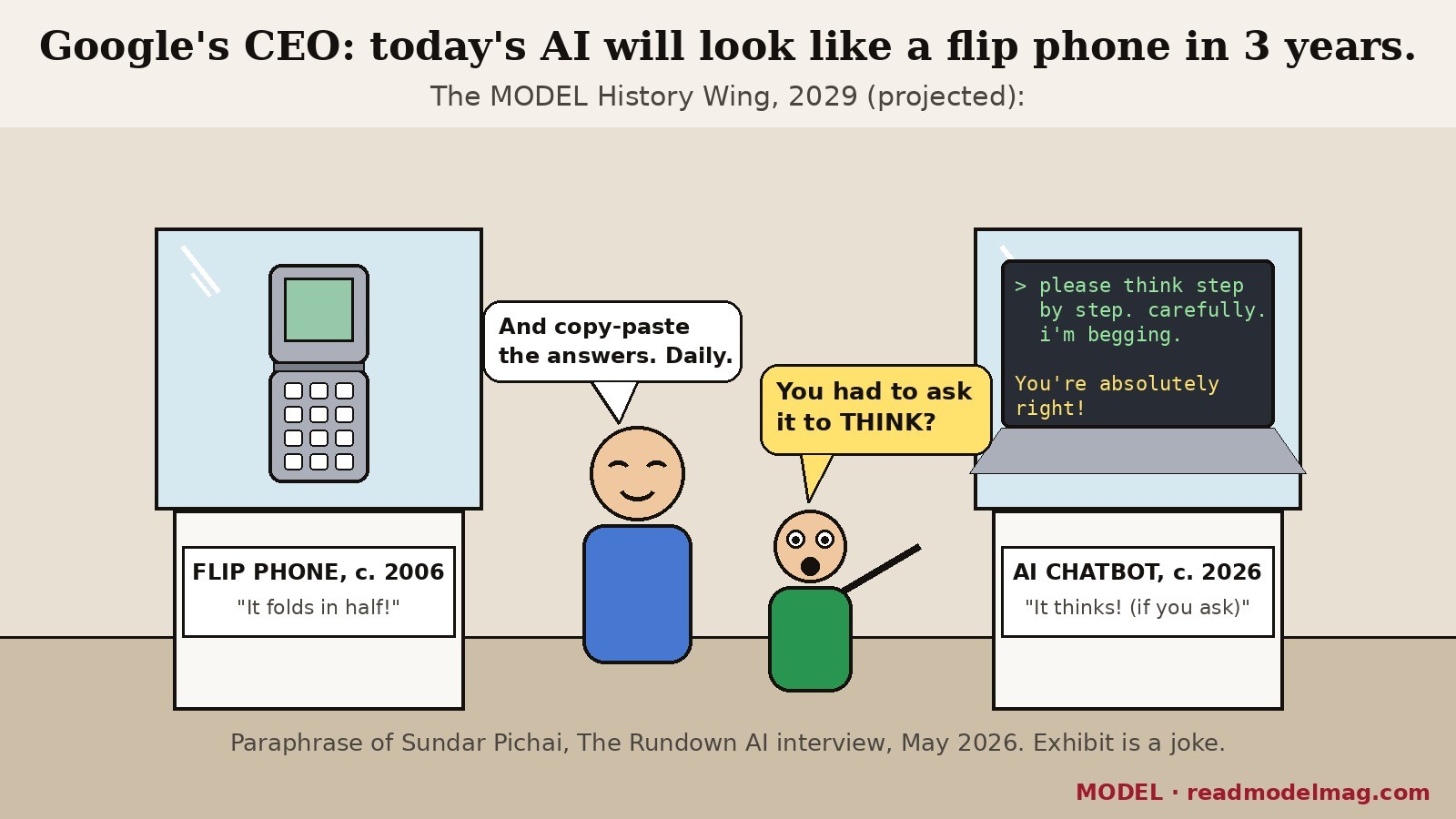
Google's CEO says today's AI will look like a flip phone in three years
Sundar Pichai made the call in a May 2026 interview with The Rundown AI. A clip of it went around X again today. Here's what he actually said, and what to make of it.
· MODEL Editors
FREE · EVERY WEEK
The top AI tools this week, tested.
Every week MODEL's editors pick the AI tools worth your time, try them hands-on, and tell you what's good, what's not, and who it's for. Free, in your inbox.
Free. Unsubscribe anytime. Our picks are editorial and can't be bought.