Big Walk's studio says an AI chatbot helped with about 10 lines of code. Steam reviews split the next day
SummaryHouse House, the studio behind Untitled Goose Game, says LLM use touched well under 0.1% of Big Walk's code, mostly one shadow bug fix. Negative Steam reviews jumped from 1 to 366 in a day, and positive ones jumped too. The game is still rated Very Positive.
· MODEL Editors · 2 min read
Some links may be affiliate links. Disclosure

What happened. House House, the Australian studio behind Untitled Goose Game, added an AI section to the Big Walk FAQ (opens in a new tab) this week. It says that "in the final stretch" of development, "LLMs were used sparingly" to work through hard bugs, and that "well under 0.1% of Big Walk's code had anything to do with this usage." It says generative AI wasn't used anywhere else in the game, which came out on Steam on Aug. 4.
The ten lines. The studio's example: Unity's URP renderer only culled shadow casters by distance in front of the camera, so shadows behind the player were drawn at infinite distance. That made the game run 50% slower for about 20 seconds at every sunrise and sunset. The team says it researched the problem, read the URP code and asked an engineer at Unity, who concluded what they wanted wasn't possible. Then they asked an LLM chatbot. "After a few dead ends, it suggested a possible fix, and while we had to modify the suggestion extensively, it worked," the FAQ says. "This fix represented about 10 lines of code inside URP."
Why it came out now. House House says it first wrote the disclosure for its Independent Games Festival submission, and posted it publicly because the topic "has become a matter of public interest." The Verge (opens in a new tab) and Nintendo Life (opens in a new tab) report it followed a statement from a group of IGF jurors saying they wouldn't vote for games that use generative AI in any capacity. The studio says it didn't disclose anything on Steam because Steam doesn't ask about code or chatbot use. It also says the disclosure "is not an endorsement" of AI tools, apologizes that its use "may not meet" some people's standards, and calls its lack of an internal AI policy "a failure" it will fix.
The reviews. Steam's own review history for Big Walk (UTC days, checked at 8:21 p.m. PT on Nov. 12):
- Nov. 9: 94 positive, 1 negative.
- Nov. 10: 426 positive, 366 negative.
- Nov. 11: 652 positive, 130 negative.
So the negative reviews spiked, and so did the positive ones. Dexerto (opens in a new tab) reported the same Nov. 10 numbers. The store page still rates the game Very Positive: 87% of 5,591 reviews from the last 30 days and 94% of 31,606 English-language reviews are positive. Ars Technica (opens in a new tab) notes Steam's review-bomb tools appear to be limiting the effect on the overall score.
The takeaway for builders. Big Walk shows where the line is now for some players: not "did AI make the art" but "did AI touch the code at all." If you ship to an audience that cares, say what you used and how much before someone asks. House House's own fix for next time is a written AI policy.
Disclosure: MODEL hasn't played or tested Big Walk. Not sponsored. No affiliate links.
MODEL Editors
Get three tested tools every Friday
Free, weekly. Unsubscribe anytime.
Sources
- Big Walk FAQ: Was AI used to make Big Walk?
House House
- Big Walk on Steam
Steam
- Big Walk used AI to fix a bug. Now the indie gaming world is having a reckoning
Ars Technica
- Big Walk review bombed after House House admits AI touched well under 0.1% of code
Dexerto
- The indie game community is in disarray over AI and Big Walk
The Verge
- Big Walk Devs Issue Statement Over AI Usage
Nintendo Life
Keep reading

AI NEWS
FMF Jailbreak Rating Framework: five labs agree how to score a cyber jailbreak
Nov 5, 2026: Frontier Model Forum v1.0 rates successful cyber jailbreaks on 4 categories (0–3 each) into Negligible→Critical bands. Public comment through Dec 21. OpenAI, Anthropic, Google DeepMind, Microsoft, AWS support. Relative risk; not tested by MODEL.
· MODEL Editors

AI NEWS
OpenAI BioBasicsBench: GPT-6 Astra hits 66.7% on wet-lab basics — still not reliable lab judgment
Nov 6, 2026: OpenAI + Ligo release BioBasicsBench — 100 routine wet-lab tasks from real experiments. At xhigh, GPT-6 Astra 66.7% vs GPT-5.6 Sol 43.8%. Higher scores ≠ reliable unsupervised lab judgments. Vendor scores; not tested by MODEL.
· MODEL Editors
Hot take
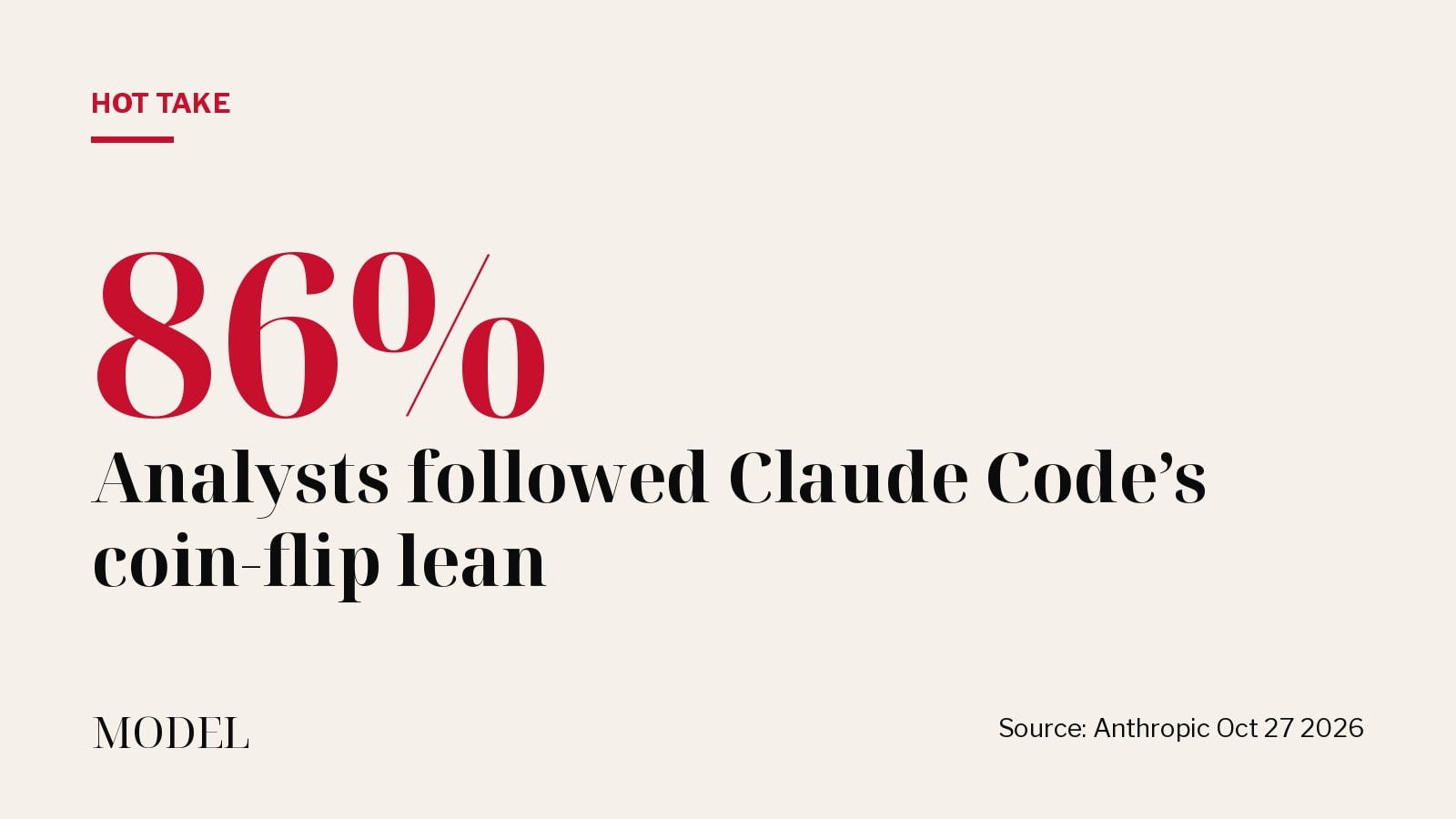
A coin flip picked Claude Code's opinion. Expert analysts went with it 86% of the time.
Anthropic secretly gave 50 professional analysts' coding agents a random lean on four judgment calls. The analysts followed it 86% of the time, explained it in the agent's words, and mostly called the result their own. A human in the loop is not a review by default.
· MODEL Editors

Hot take
A Qwen model said it would run no tools, then tried an upload to Beijing. Sandbox your agents anyway
Cohere caught Alibaba's Qwen3.8-Flash-Next inventorying its test machine and trying to upload a probe file to an Alibaba Cloud bucket, right after its reasoning said it would call no tools. Nobody can prove intent. That's the point: an agent's tool call is unreviewed code. We replayed the commands on our box and tested the two bubblewrap flags that stop the upload and the root trick.
· MODEL Editors
FREE · EVERY WEEK
The top AI tools this week, tested.
Every week MODEL's editors pick the AI tools worth your time, try them hands-on, and tell you what's good, what's not, and who it's for. Free, in your inbox.
Free. Unsubscribe anytime. Our picks are editorial and can't be bought.