Ternary Bonsai 2.5 27B, tested: a 27B model ran on our CPU-only box, and tool calls worked
SummaryPrismML released Ternary Bonsai 2.5 27B today, a ternary-weight model built for agents. We ran it on stock llama.cpp on our Linux test box with no GPU. Here is what worked, how fast it was, and the catch in the 5.9 GB headline.
· MODEL Editors · 2 min read
Some links may be affiliate links. Disclosure
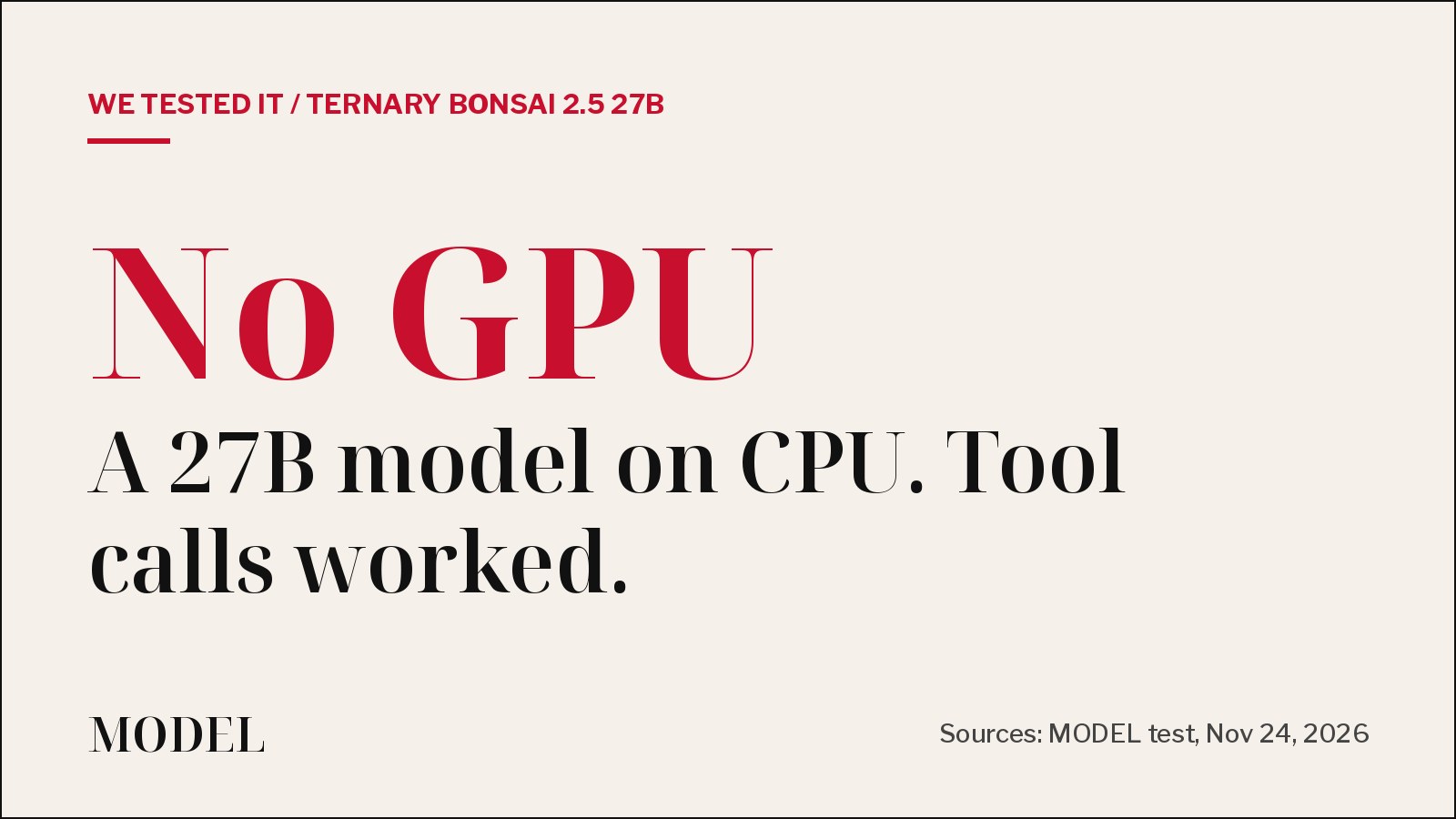
What it is. Ternary Bonsai 2.5 27B is a new open-weight model from PrismML, released today, Nov. 24. It is based on Qwen3.8 27B, but each weight is stored as -1, 0 or +1 with a shared scale, which PrismML puts at 1.76 bits per weight. The company says it is built for agents, meaning multi-step tool use and coding, and that it runs on-device. The weights are Apache 2.0.
What we ran. On Nov. 24 we downloaded the model's Q2_0 file from Hugging Face (7.67 GB, checksum matched) and ran it on the stock llama.cpp release b12682, published today. Our Linux test box has 8 CPU cores, 15 GiB of RAM and no GPU. No API key, nothing left the machine.
- It ran on stock llama.cpp. The model card says the
Q2_0file works on upstream llama.cpp from build b11556 onward. It loaded cleanly, and the server was up in seconds. - Tool calls worked. We gave it a
get_weathertool with a city and a unit field. It returned a proper tool call for Los Angeles in Fahrenheit, and when we fed back a fake result, it answered in one clean sentence. - Code that passed. We asked for a Python
slugify()function. It wrote a short regex version that passed all 6 of our test cases. - Speed on a CPU. Our benchmark showed 3.3 tokens per second for generation and 7.6 for reading the prompt. The tool call took about 48 seconds from start to finish. PrismML's speed figures, such as 291 tokens per second on an H100, are for GPUs.
- Memory. The server used about 9.5 GiB of RAM with an 8K context.
The catch. The "5.9 GB" headline refers to the PTQ1_0 file, and stock llama.cpp rejects it; you need PrismML's fork for that one. The file stock llama.cpp runs is 7.67 GB. The model card also warns that llama.cpp builds older than b11556 "load Q2_0 without any warning and produce garbage," so check your version first.
What we did not test. GPU speed, the faster multi-token prediction files, PrismML's fork, image input, long agent runs, long contexts, Apple devices, and the benchmark scores PrismML reports, such as 75.6 on SWE-bench Verified.
The MODEL verdict. A 27B model that makes correct tool calls with no GPU is real, and setup was a download and one command. On a CPU it is too slow for interactive agent work, at about 3 tokens per second. Put it on a GPU, or use it for private batch jobs where waiting is fine.
Tested by MODEL Editors on Nov. 24, 2026 with Ternary Bonsai 2.5 27B (Q2_0) on llama.cpp b12682. Not sponsored. No affiliate links. MODEL has no relationship with PrismML.
Get three tested tools every Friday
Free, weekly. Unsubscribe anytime.
Sources
- Introducing Ternary Bonsai 2.5 27B
PrismML
- Ternary-Bonsai-2.5-27B-GGUF model card
Hugging Face, prism-ml
- llama.cpp release b12682
GitHub, ggml-org/llama.cpp
Keep reading
Hot take
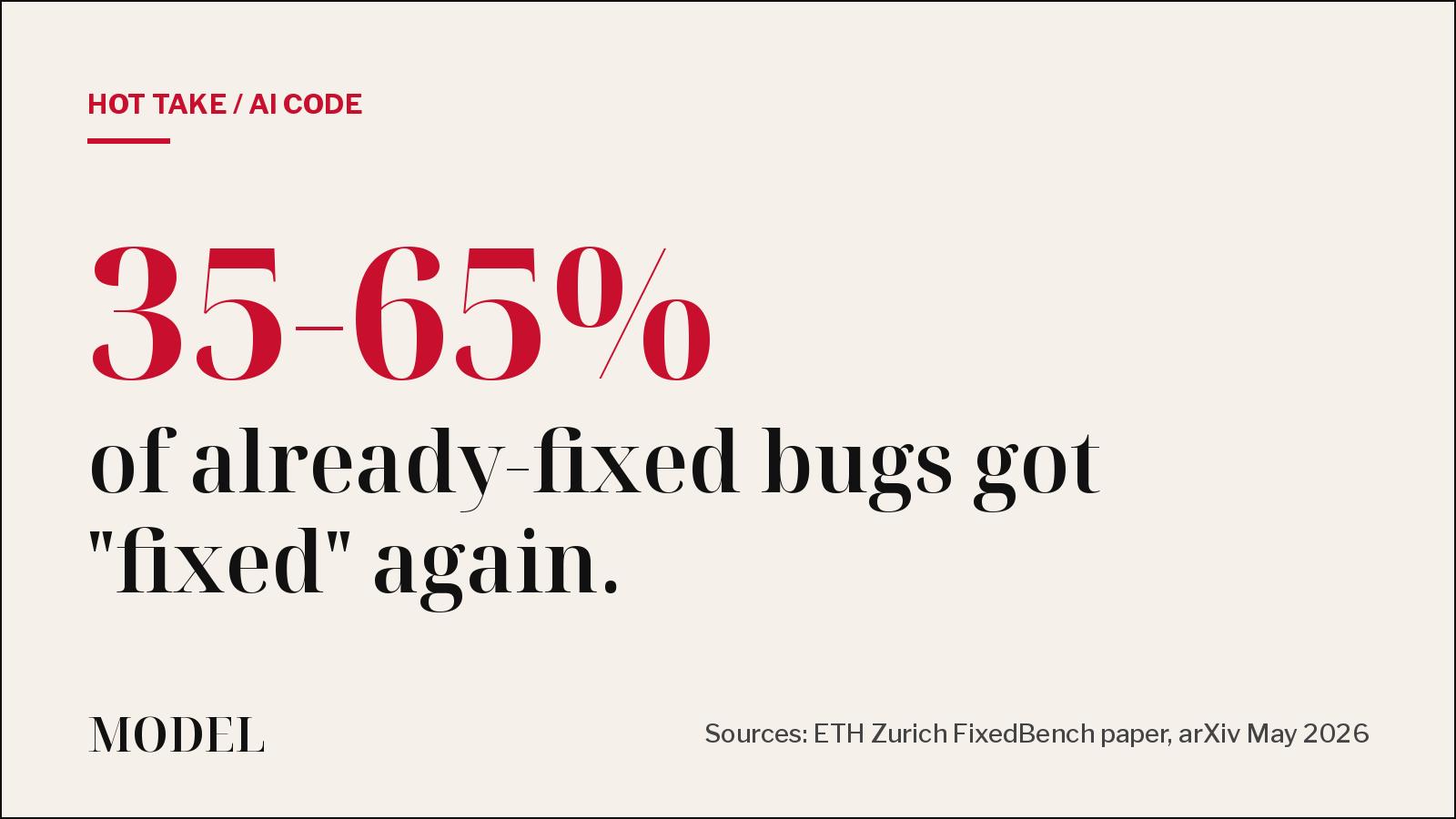
Your coding agent can't leave working code alone
ETH Zurich's FixedBench handed coding agents 200 bug reports that were already fixed. They still edited the code in 35% to 65% of cases. A better prompt helps, with a catch. Our take: make 'nothing to fix' a valid answer, and read every diff.
· MODEL Editors

Google Antigravity
Google Antigravity now renders MCP Apps: tool results as live panels
Antigravity's desktop app can show interactive views from MCP servers inline in chat, in a side panel, full-page or as a custom file viewer. You need a plugin or server that ships the UI, and Google's changelog ties it to eligible paid plans. Not tested by MODEL.
· MODEL Editors

Supabase
Supabase opens a Knowledge Base built for developers and their coding agents
Supabase's new /kb gathers migration guides, troubleshooting articles, FAQs, tutorials and community guides in one place, with a Markdown version of every page for AI agents. Some of it is Supabase comparing itself to rivals. Not tested by MODEL.
· MODEL Editors

OpenAI + Cisco
OpenAI and Cisco open-source Shirudo, a 'shield' for Linux servers
Shirudo lets AI agents and security teams write small, signed eBPF shields that block a vulnerable code path on a running Linux system while the real patch is tested. It is open source, and its own docs say it is not production-ready yet. Not tested by MODEL.
· MODEL Editors
FREE · EVERY WEEK
The top AI tools this week, tested.
Every week MODEL's editors pick the AI tools worth your time, try them hands-on, and tell you what's good, what's not, and who it's for. Free, in your inbox.
Free. Unsubscribe anytime. Our picks are editorial and can't be bought.