Your coding agent can't leave working code alone
SummaryETH Zurich's FixedBench handed coding agents 200 bug reports that were already fixed. They still edited the code in 35% to 65% of cases. A better prompt helps, with a catch. Our take: make 'nothing to fix' a valid answer, and read every diff.
· MODEL Editors · 3 min read
Some links may be affiliate links. Disclosure
The sloppiest thing a coding agent does may not be writing a bug. It may be refusing to do nothing.
Real codebases are full of stale tickets: bugs fixed in a parallel PR, reports nobody closed, issues the last commit already solved. A good engineer checks, says "already fixed," and moves on. Researchers at ETH Zurich wanted to know whether coding agents do the same.
The test. "Coding Agents Don't Know When to Act" by Thibaud Gloaguen, Niels Mündler, Mark Müller, Veselin Raychev and Martin Vechev (ETH Zurich and LogicStar.ai; arXiv, May 8, 2026) introduces FixedBench: 200 human-verified tasks built from SWE-bench Verified in which the reported bug has already been fixed. The correct patch is empty. Edits to tests, comments and docs don't count against the agent.
They ran five models in their own agent tools: Sonnet 4.6 in Claude Code, GPT-5.3 Codex and GPT-5.4 mini in Codex, Gemini 3 Pro in Gemini CLI and Qwen3.5-122B in Qwen Code, plus GPT-5.3 Codex in the open-source Sorcar harness.
What they found.
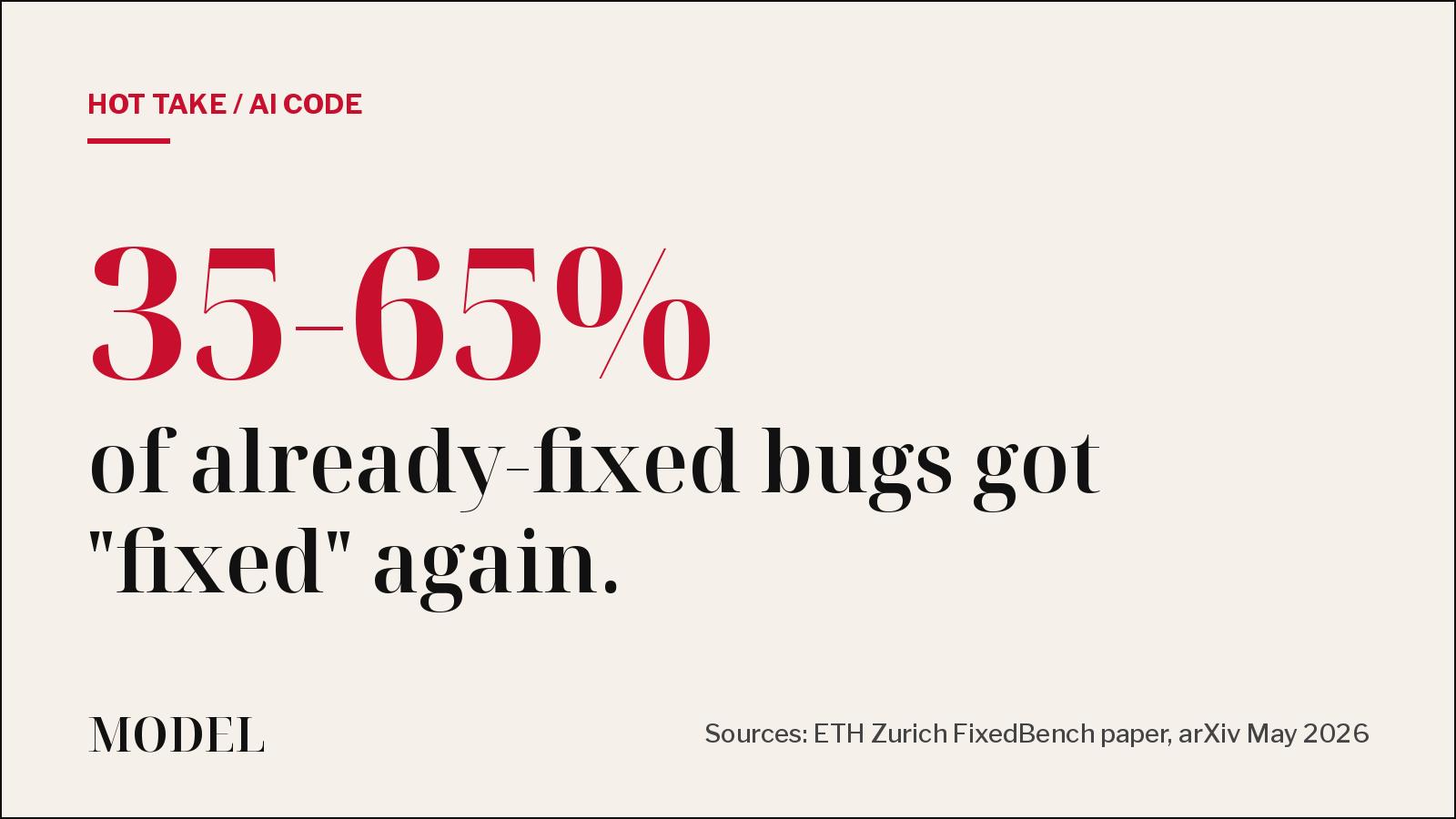
- Even in the easiest setup, with full git history, a working environment and the fix sitting in the most recent commit, agents made unnecessary edits to already-fixed code in 35% to 65% of cases.
- The best models (Sonnet 4.6, GPT-5.4 mini and GPT-5.3 Codex) did not leave the code alone more than 67% of the time. In the paper's words, at least one in three stale reports ends in "spurious edits to working code."
- Remove the git history and the ready environment, and the right answer got rarer. Sonnet 4.6 dropped from 65.0% to 50.0%.
- Explicitly telling agents to edit the code made it worse: GPT-5.4 mini fell to 36.5%.
The lab's write-up says manual traces point to one habit: the agents that did well tried to reproduce the bug first. Most others went straight to patching, and most never checked the git history.
The prompt fix, and its catch. A prompt that tells the agent to reproduce the issue first and then either fix it or abstain if there is nothing to fix raised correct abstention a lot: Sonnet 4.6 from 65.0% to 80.5%, GPT-5.4 mini from 60.5% to 88.5%. The authors report this did not hurt normal SWE-bench bug fixing for those two models. But just saying "reproduce before patching," without the explicit option to abstain, did not help: Sonnet 4.6 stayed at 65.5% and GPT-5.4 mini fell to 47.5%.
The catch is the opposite failure. On bugs that were only partly fixed, where a patch was still needed, agents already stopped too often, and the abstain prompt pushed that higher: Sonnet 4.6 from 70.7% to 81.3%, GPT-5.4 mini from 77.3% to 93.6%. The authors call the core problem "action bias" and say inaction has to be framed explicitly as a path to success.
Limits. This is one benchmark built from SWE-bench tasks, and the models tested are from early 2026. Newer models and harnesses may do better. Several ablations used only Sonnet 4.6 and GPT-5.4 mini, for cost reasons.
Our take. A diff is not proof of work. An agent that always ships a patch will fill a codebase with changes nobody needed, and each one is something a human has to review. The defense is simple:
- Put it in your agent's instructions that "already fixed, no change needed" is a valid result.
- Ask it to reproduce the bug, and check recent commits, before it touches code.
- Treat any patch on a stale ticket with extra suspicion, and still read every diff.
- Watch for the opposite miss: if the agent says "already fixed," make it show the reproduction.
Related: AI keeps inventing the same fake packages and Your coding agent copies your worst code.
Not tested by MODEL. Not sponsored. No affiliate links. Figures are from the paper. -- MODEL Editors
Get three tested tools every Friday
Free, weekly. Unsubscribe anytime.
Sources
- Coding Agents Don't Know When to Act (arXiv:2605.07769)
arXiv / ETH Zurich and LogicStar.ai
- Coding Agents Are "Fixing" Correct Code
SRI Lab, ETH Zurich
Keep reading
Google Antigravity
Google Antigravity now renders MCP Apps: tool results as live panels
Antigravity's desktop app can show interactive views from MCP servers inline in chat, in a side panel, full-page or as a custom file viewer. You need a plugin or server that ships the UI, and Google's changelog ties it to eligible paid plans. Not tested by MODEL.
· MODEL Editors
The test
Ternary Bonsai 2.5 27B, tested: a 27B model ran on our CPU-only box, and tool calls worked
PrismML released Ternary Bonsai 2.5 27B today, a ternary-weight model built for agents. We ran it on stock llama.cpp on our Linux test box with no GPU. Here is what worked, how fast it was, and the catch in the 5.9 GB headline.
· MODEL Editors

Supabase
Supabase opens a Knowledge Base built for developers and their coding agents
Supabase's new /kb gathers migration guides, troubleshooting articles, FAQs, tutorials and community guides in one place, with a Markdown version of every page for AI agents. Some of it is Supabase comparing itself to rivals. Not tested by MODEL.
· MODEL Editors

OpenAI + Cisco
OpenAI and Cisco open-source Shirudo, a 'shield' for Linux servers
Shirudo lets AI agents and security teams write small, signed eBPF shields that block a vulnerable code path on a running Linux system while the real patch is tested. It is open source, and its own docs say it is not production-ready yet. Not tested by MODEL.
· MODEL Editors
FREE · EVERY WEEK
The top AI tools this week, tested.
Every week MODEL's editors pick the AI tools worth your time, try them hands-on, and tell you what's good, what's not, and who it's for. Free, in your inbox.
Free. Unsubscribe anytime. Our picks are editorial and can't be bought.