Claude helped map the first prokaryotic vault particle
SummaryAnthropic's biology lab used Claude to find, isolate, and solve the first 3D structure of a vault particle from a bacteriophage protein (L05) made in E. coli — 96 copies, ~9.5 megadaltons, first model in ~34 hours. Function still unknown. Preprint submitted to bioRxiv.
· MODEL Editors · 2 min read
Some links may be affiliate links. Disclosure
On November 4, 2026, Anthropic's biology research lab published another finding: the first 3D structure of a vault particle found in prokaryotic cells — a bacteriophage-derived shell made in E. coli. Vaults are large hollow protein barrels; their function has been unknown since Leonard Rome and Nancy Kedersha discovered them in 1986. Anthropic says a preprint has been submitted to bioRxiv (link not live on the page yet).
The particle. The phage protein they call L05 builds a vault from 96 copies (48 per half), about 9.5 megadaltons. Mammalian vaults use 78 major vault protein copies (39 per half). The L05 vault is roughly 54 nm long by 45 wide versus mammalian ~67 × 40; it encloses about 25% more volume because it is more spherical. Its wall has 7 repeating segments (mammals: 9), flatter caps, and a tiered-dome cap that closes in three steps.
What Claude did. Under human direction, Claude searched about 15 billion predicted proteins, designed DNA constructs, helped optimize isolation, and ran cryo-EM processing (RELION in a multi-agent harness). MVP homologs showed up in 29 bacterial and 4 archaeal phyla, but in less than 1% of sequenced species. They chose 44 candidates; 15 of 24 made soluble protein in E. coli; 7 of 15 looked vault-like under EM; cryo-EM confirmed 4. Conventional purification takes about 3 days; their size-exclusion route cut that to about 90 minutes (Claude first argued against chromatography, then helped make it work). A first structural model was ready in about 34 hours (they estimate weeks normally); final maps about a week after processing began. Engineering two extra wall repeats (7→9) made larger vaults with about +20% enclosed volume.
Catch. Function is still unknown. Particles have only been made in E. coli so far — not yet shown in native bacteria or phages. Claude made real mistakes: a bad growth-medium additive cost about two weeks, and an early cryo-EM skip produced a mirror-blended map. An unidentified pocket molecule looks a bit like coenzyme A (unconfirmed). Not peer-reviewed yet — preprint submitted. Not tested by MODEL. Not sponsored.
Sources: Anthropic research post (opens in a new tab); PDF (opens in a new tab); Anthropic X (opens in a new tab).
MODEL Editors
Sources
- Investigating vault particles with Claude (Nov 4, 2026)
Anthropic (Science)
- Investigating vault particles with Claude (PDF)
Anthropic CDN
- Anthropic X post on vault particles
Anthropic on X
FREE · EVERY WEEK
The top AI tools this week, tested.
Every week MODEL's editors pick the AI tools worth your time, try them hands-on, and tell you what's good, what's not, and who it's for. Free, in your inbox.
Free. Unsubscribe anytime. Our picks are editorial and can't be bought.
Continue
AI News
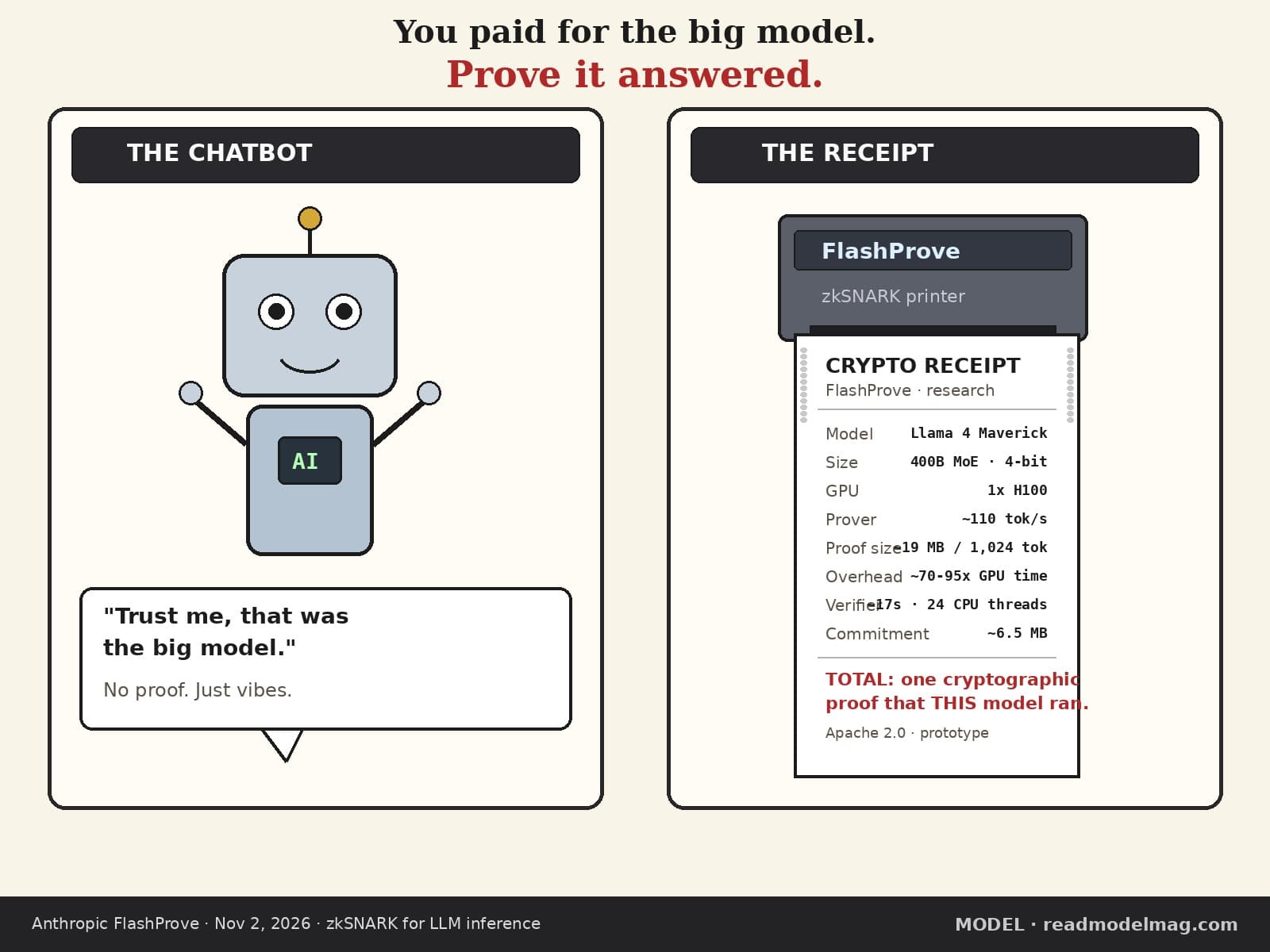
You paid for the big model. Prove it answered.
Anthropic's Nov 2 FlashProve research prototype attaches a zkSNARK receipt to LLM replies. Demo: Llama 4 Maverick 400B MoE on one H100 at ~110 tok/s proving, ~19 MB proofs, ~70-95x the GPU time of the answer. Not Claude production yet.
· MODEL Editors
AI News
OpenAI is buying Pierre, the Git tools already inside Codex
OpenAI will acquire Pierre Computer Company, Inc. Codex already uses Pierre's Trees and Diffs for file browsing and change review. After close, Code Storage features are meant to move into Codex. No price disclosed; deal not closed yet.
· MODEL Editors
AI News
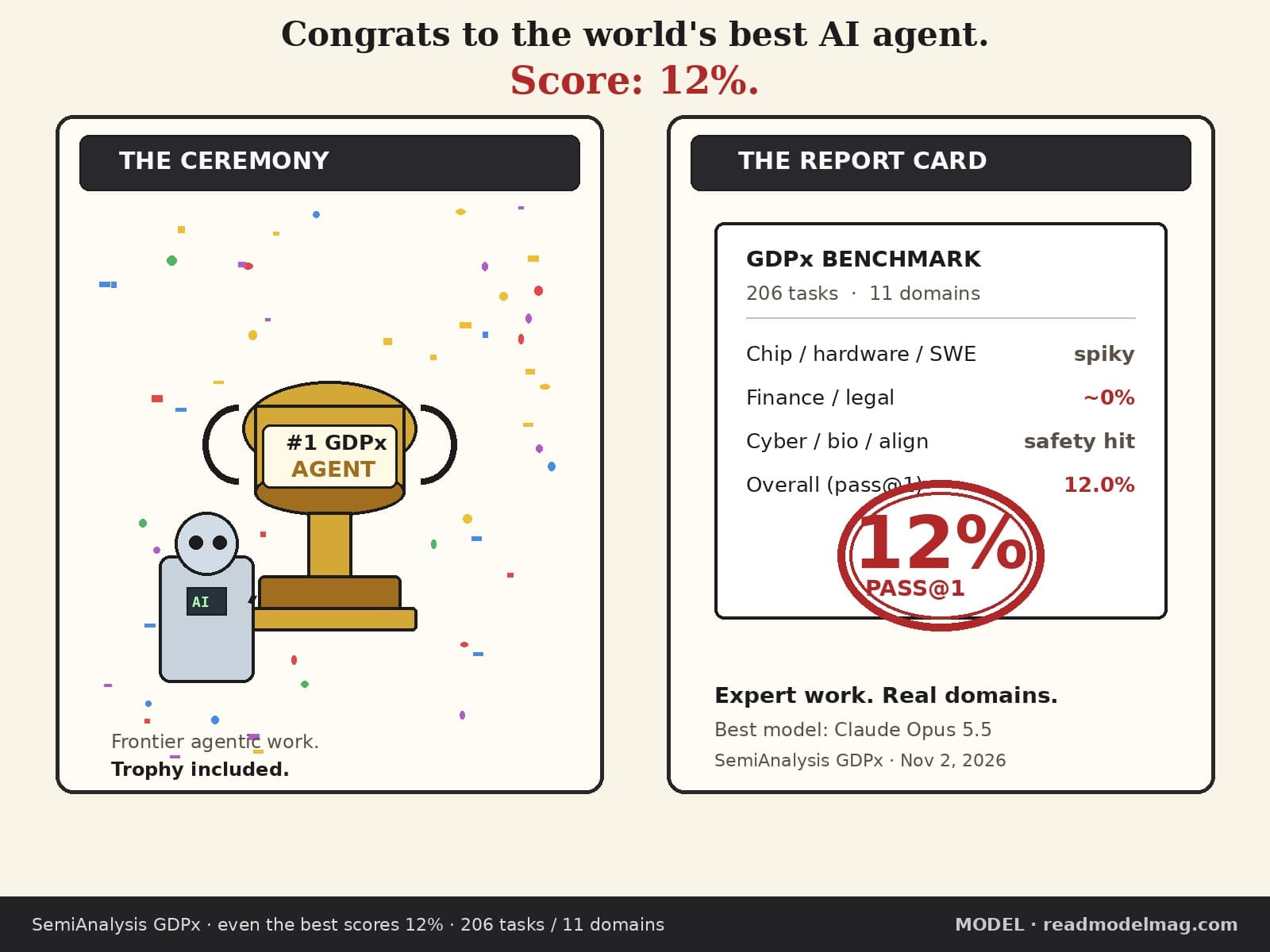
GDPx: even the best AI agent scores 12%
SemiAnalysis's Nov 2 GDPx benchmark puts frontier agents on 206 expert tasks across 11 high-value domains. Claude Opus 5.5 leads at 12.0%; Gemini 4 Carbon 10.9%; GPT-6 Astra 9.6%. Finance and legal are nearly zero for everyone.
· MODEL Editors