You paid for the big model. Prove it answered.
SummaryAnthropic's Nov 2 FlashProve research prototype attaches a zkSNARK receipt to LLM replies. Demo: Llama 4 Maverick 400B MoE on one H100 at ~110 tok/s proving, ~19 MB proofs, ~70-95x the GPU time of the answer. Not Claude production yet.
· MODEL Editors · 1 min read
Some links may be affiliate links. Disclosure
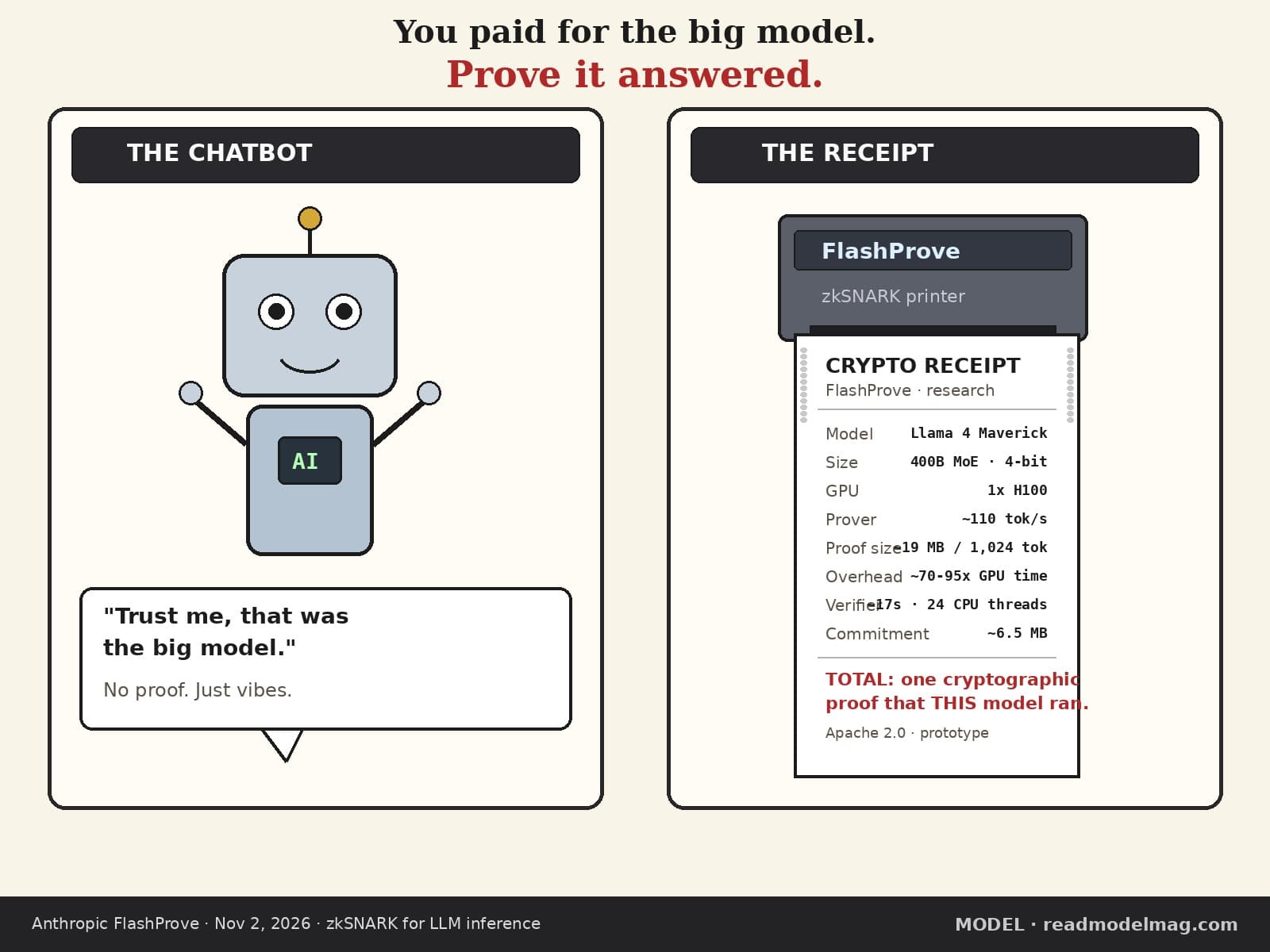
On November 2, 2026, Anthropic's Frontier Red Team published FlashProve: an open-source research prototype for provable inference — a cryptographic receipt that a reply came from a specific committed model, not a cheaper substitute or a tampered token stream.
The joke that is also the product pitch. You paid for the big model. Judging the reply by vibes does not prove which weights ran. FlashProve's answer is a zkSNARK: the provider commits to weights, then proves each checked response was produced by that commitment. The proof hides the weights; it does not hide the architecture.
The measured demo (Anthropic's numbers). They ran Llama 4 Maverick, a 400B-parameter mixture-of-experts model in 4-bit weights, on a single H100. The prover hits about 110 tokens/second. Each proof is about 19 MB per 1,024-token request (they measure 18.78 MB). Proving takes roughly 70–95× the GPU time of running the same work on vLLM. The verifier is CPU-only: about 17 seconds on 24 threads, with a model commitment of about 6.5 MB. Code, Lean proofs, and docs ship under Apache 2.0.
What it is not. This is a research prototype, not Anthropic production Claude. Limitations they list include: greedy/integer model semantics (floating-point or sampled decoding can diverge), contexts up to 1,024 tokens, architecture not hidden, and no formal guarantee that the fast C++ verifier matches the Lean statement line-for-line. Anthropic's related RSP "inference verification" goal was met by a separate signing/recompute prototype; FlashProve is the cryptographic track.
Caveats. Numbers and claims are from Anthropic's research post and release artifacts. Not tested by MODEL. Not every API call will ship a 19 MB receipt tomorrow. Not sponsored.
Sources: Anthropic research post (opens in a new tab); github.com/anthropics/FlashProve (opens in a new tab); Anthropic X (opens in a new tab).
MODEL Editors
Sources
- Progress on provable inference for large language models (Nov 2, 2026)
Anthropic (Frontier Red Team)
- FlashProve open-source repository
GitHub (anthropics/FlashProve)
- Anthropic X post on FlashProve
Anthropic on X
FREE · EVERY WEEK
The top AI tools this week, tested.
Every week MODEL's editors pick the AI tools worth your time, try them hands-on, and tell you what's good, what's not, and who it's for. Free, in your inbox.
Free. Unsubscribe anytime. Our picks are editorial and can't be bought.
Continue
SCIENCE
Claude helped map the first prokaryotic vault particle
Anthropic's biology lab used Claude to find, isolate, and solve the first 3D structure of a vault particle from a bacteriophage protein (L05) made in E. coli — 96 copies, ~9.5 megadaltons, first model in ~34 hours. Function still unknown. Preprint submitted to bioRxiv.
· MODEL Editors

AI News
OpenAI is buying Pierre, the Git tools already inside Codex
OpenAI will acquire Pierre Computer Company, Inc. Codex already uses Pierre's Trees and Diffs for file browsing and change review. After close, Code Storage features are meant to move into Codex. No price disclosed; deal not closed yet.
· MODEL Editors

AI News
GDPx: even the best AI agent scores 12%
SemiAnalysis's Nov 2 GDPx benchmark puts frontier agents on 206 expert tasks across 11 high-value domains. Claude Opus 5.5 leads at 12.0%; Gemini 4 Carbon 10.9%; GPT-6 Astra 9.6%. Finance and legal are nearly zero for everyone.
· MODEL Editors